Bull Put Spread: Definitions, How It Works & Examples
A bull put spread is a strategic options trade designed to profit from a moderate rise in an underlying asset's price while limiting risk. This strategy involves selling put options with a higher strike price, and buying put options with a lower strike price, both with the same expiration date. It allows traders to capitalize on stability or mild upward trends while defining both potential profits and losses. Below, we will explore its mechanics, applications, and key considerations.
● A bull put spread may profit from a modest rise or neutral market, using a short and long put to define risk and reward.
● Maximum gain is the net premium received, while max loss is capped at the strike difference minus that premium.
● Potentially suitable for low-to-moderate volatility environments, this strategy benefits from time decay and clear breakeven levels.
What Is Bull Put Spread Strategy
The bull put spread is a bullish, limited-risk options strategy used in markets expected to rise or stay neutral. It involves two simultaneous put option trades:
1. Sell a put option with a higher strike price (short put), generating premium income.
2. Buy a put option with a lower strike price (long put), limiting downside risk.
This vertical spread "bears" the name "bull" due to its bullish intent, while "put" refers to the use of put options. The strategy profits if the underlying asset's price is above the short put's strike price at expiration, allowing both options to expire worthless and the trader to keep the net premium received. If the price drops below the long put's strike price, losses are capped.
How Bull Put Spread Works
Position Opening
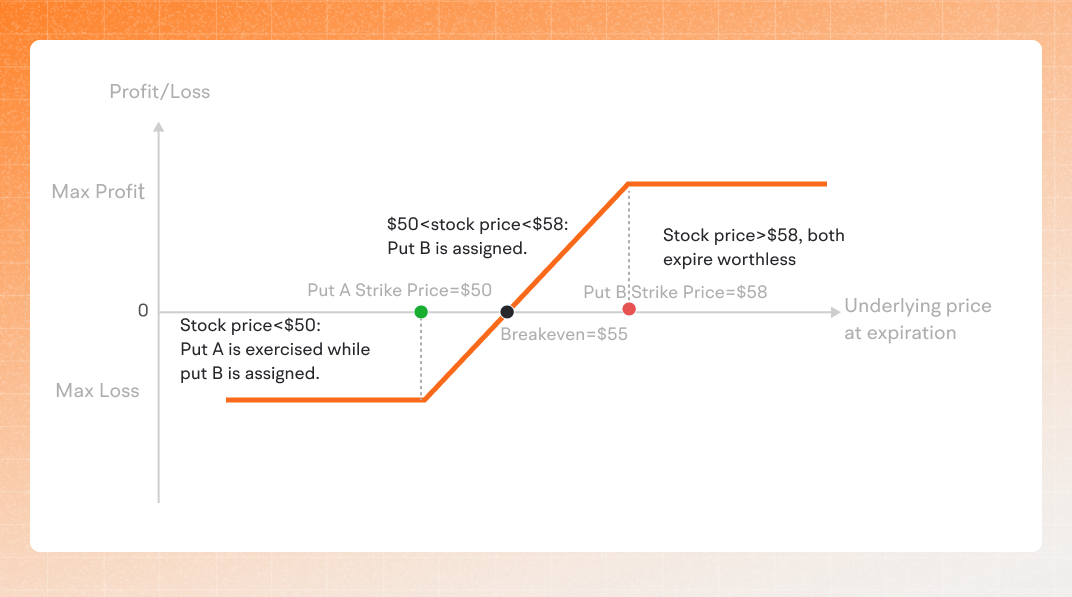
Sell one higher-strike put ($50 strike) → Receive $400 premium
Buy one lower-strike put ($45 strike) → Pay $100 premium
Net credit: $300 (initial cash inflow)
Expiration Outcomes
Scenario 1: Stock ≥ $50 (e.g., $52)
Both puts expire worthless
Profit = $300 (retain full net credit)
Scenario 2: Stock between strikes (e.g., $48)
Assignment phase
Put buyer exercises right → Trader must buy 100 shares at $50 ($5,000 obligation)
Trader's decision
Option A: Hold shares → $2/share unrealized loss
Option B: Sell immediately at $48 → $200 realized loss
Long put status
Expires worthless (no action)
Net result
$300 credit - $200 realized loss = $100 profit
Scenario 3: Stock ≤ $45 (e.g., $42)
The short put would be auto-exercised assigning the trader a long position of 100 shares effectively offsetting the 100-share short position created by the auto-exercise of the ITM long put closing out the strategy.
Net result: $500 loss - $300 credit = $200 net loss
The strategy's structure limits theoretical maximum profit to the net premium and theoretical maximum loss to the strike price difference minus the net premium.
Moomoo will automatically liquidate the options upon expiration only in cases where the account meets margin requirements, and it is important to verify that this applies to your account. Liquidation is not guaranteed, and investors should monitor their positions closely.
When and How Bull Put Spread Strategy is Used
Consider using a bull put spread when:
When moderately bullish: Expect the stock to stay above the short put strike, with the long put acting as protection against unexpected declines.
Volatility is low to moderate, as high volatility increases put premiums (benefiting sellers but risking larger losses).
Risk management is prioritized, as the strategy caps both gains and losses.
Steps to implement:
Identify an underlying asset (e.g., stock, ETF) with a bullish trend.
Select two put options with the same expiration but different strike prices (\( K1> K2 \)).
Ensure the net credit (premium received) aligns with risk tolerance.
Monitor the asset's price and evaluate exiting before expiration if the trend reverses.
Example of Bull Put Spread
Scenario: A trader is bullish on XYZ stock, currently at $100. They execute a bull put spread with:
- Short put: Strike price $95, premium $3.
- Long put: Strike price $90, premium $1.
- Net credit: $3 - $1 = $2 per contract (max profit).
- Max loss: (\$95 - \$90) - \$2 = \$3 per contract.
- Breakeven: $95 - $2 = $93.
Outcomes:
If XYZ ≥ $95 at expiration: Profit = $2.
If XYZ = $92: Loss = $95 - $92 - $2 = $1.
If XYZ ≤ $90: Loss = $3 (max).
Maximum Profit
The maximum profit in a bull put spread is fixed and equals the net credit received from selling the higher-strike put and buying the lower-strike put. This is achieved when the underlying asset's price is at or above the short put's strike price at expiration, causing both puts to expire worthless. The trader keeps the entire net premium, which represents the strategy's full profit potential.
Maximum Risk
The maximum risk is calculated as the difference between the strike prices minus the net credit received. This occurs if the underlying asset's price falls below the long put's strike price at expiration. For example, if strike prices are $95 and $90 with a net credit of $2, max risk = ($95 - $90) - $2 = $3. This finite risk makes the strategy appealing for risk-averse traders.
Maximum potential loss and profit for options are calculated based on the single leg or an entire multi-leg trade remaining intact until expiration with no option contracts being exercised or assigned. These figures do not account for a portion of a multi-leg strategy being changed or removed or the trader assuming a short or long position in the underlying stock at or before expiration. Therefore, it is possible to lose more than the theoretical max loss of a strategy.
Breakeven Stock Price
The breakeven price is the short put's strike price minus the net credit received. Using the earlier example:
Breakeven = $95 - $2 = $93.
At breakeven, the loss on the ITM short put equals the net credit received. For example at $93: $95 short put has $2 intrinsic loss, offset by $2 net credit.
Factors Affecting Bull Put Spread
Key factors include underlying price trends (bullish moves potentially profit, bearish risk losses), volatility (higher IV boosts premiums but raises costs), time decay (benefits as expiration nears), dividends (possibly cause price drops), and liquidity (affects trade execution).
Underlying Price Change
The underlying asset's price trajectory is central to the strategy's success. Maximum profit occurs when the stock closes at or above the short put strike at expiration, regardless of interim price movements. Conversely, a sharp decline below the long put's strike price triggers maximum loss. Partial profits or losses materialize when the price hovers between strikes, with gains or losses tied to how close the price stays to the short put's strike. Traders must monitor trends to adjust or exit before adverse moves.
Volatility
Implied volatility (IV) directly impacts put premiums. Higher IV increases the premium received from selling the short put but also raises the cost of the long put, potentially narrowing net credit. Conversely, low IV reduces both premiums, but time decay (theta) accelerates as expiration nears, benefiting the strategy. Sudden volatility spikes—such as earnings reports or market shocks—can inflate put values, increasing risks for short puts.
Time
Time decay (theta) works in favor of bull put spreads, as both puts lose value as expiration approaches. This is particularly beneficial if the underlying price remains above the short put's strike, allowing premiums to erode. However, time also increases uncertainty: longer expirations carry higher volatility risks, while shorter expirations may not provide enough time for the price to move favorably. Early assignment (typically before dividends) may require purchasing shares at the strike price, requiring immediate capital and altering risk exposure.
Other Factors
Dividends: Ex-dividend dates may trigger early assignment if dividend exceeds put's time value, potentially forcing stock acquisition below market price.
Liquidity: Illiquid options have wider bid-ask spreads, reducing net credit and complicating exits.
Interest Rates: Minimal impact, as options' short-term nature diminishes rate influence.
Regulatory/Market Events: Policy changes (e.g., margin rule adjustments) or systemic shocks can disrupt pricing and execution.
Underlying Asset Type: Stocks, ETFs, or indices have different volatility profiles, affecting strategy viability.
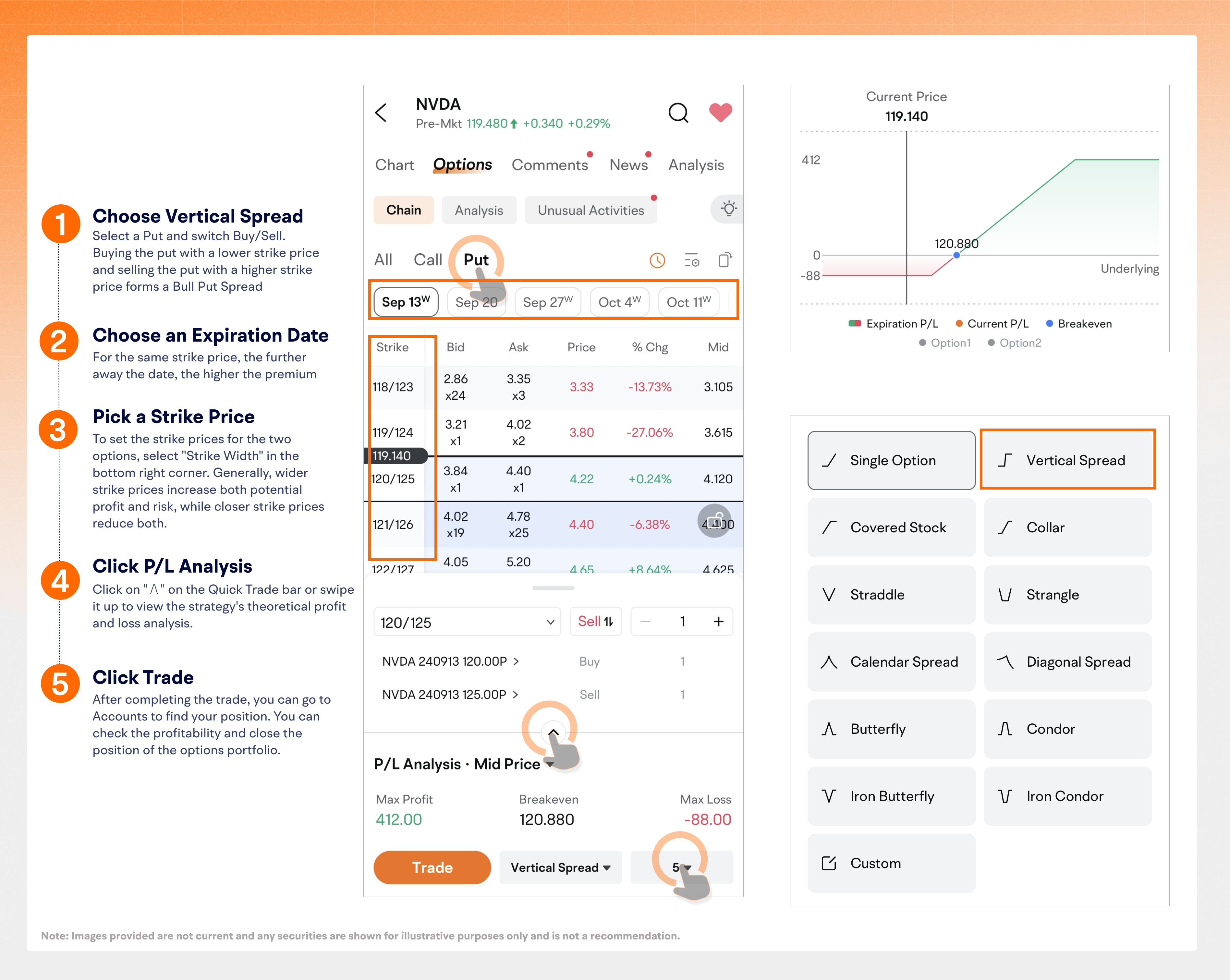
How to Manage a Bull Put Spread on moomoo
Pros and Cons of Bull Put Spread
Pros
- Limited risk: Losses are capped at the strike price difference minus the net credit.
- Income generation: Collects premium upfront, enhancing potential returns in neutral markets.
- Flexibility: Adjustable by choosing different strike prices or expiration dates.
Cons
- Limited profit: Gains are capped at the net credit, even if the asset surges.
- Margin requirements: Requires margin for the short put, tying up capital.
- Market timing: Sensitive to price direction; losses occur if the market drops sharply.
Bull Put Spread vs Bull Call Spread
Factor | Bull Put Spread | |
Mechanism | Sells puts, buys lower-strike puts. | Buys calls, sells higher-strike calls. |
Cost/Net Flow | Receives credit (net premium). | Pays debit (net cost). |
Profit Profile | Generally, profits from time decay and mild prices rise. | Generally, profits from strong prices rise. |
Risk Profile | Limited risk (strike difference – credit). | Limited risk (debit paid). |
Best For | Neutral to slightly bullish markets. | Strongly bullish markets with low volatility. |
Conclusion
The bull put spread is a versatile strategy for options traders seeking to profit from mild bullish or neutral markets while managing risk. By defining both profit and loss parameters, it offers a balanced approach to options trading. However, success requires careful analysis of market trends, volatility, and timing. Always align the strategy with your risk tolerance and broader investment goals.
FAQ About Bull Put Spread Options Strategy
What is the difference between a bull put and a bear put spread?
- Bull put spread: Slightly bullish strategy using put options, profits from price stability, or mild gains. It involves selling a higher-strike put and buying a lower-strike put.
- Bear put spread: Bearish strategy, profits from price declines. Involves buying a higher-strike put and selling a lower-strike put (reverse of bull put).
What are the risks of a bull put spread?
- Downside risk: Losses if the price drops below the long put's strike price, capped at the strike difference minus the net credit.
- Margin calls: Possible if the short put becomes ITM, requiring additional capital.
- Volatility spikes: Unexpected market declines can increase put values, potentially amplifying losses.
How do you calculate the maximum profit of a bull put spread?
Maximum profit = Net credit received = Premium received from short put – Premium paid for long put.
Example: Short put premium ($3) – Long put premium ($1) = $2 max profit.
What is the margin requirement for a bull put spread?
Margin requirements vary by broker but typically involve the potential loss on the short put, offset by the long put's value. Brokers may require a margin equal to the strike price difference minus the net credit (e.g., $5 strike difference – $2 credit = $3 margin per contract).
This presentation is for informational and educational use only and is not a recommendation or endorsement of any particular investment or investment strategy. Investment information provided in this content is general in nature, strictly for illustrative purposes, and may not be appropriate for all investors. Read more