Chinese Assets Are Soaring: How to Choose Investment Targets

In the globalised investment landscape, the Chinese stock market is attracting global investors with its unique charm and potential. Recently, with the interest rate cut by the Federal Reserve and a series of favourable policy measures launched by the People's Bank of China since 24 September, the Hang Seng Index has risen by more than 14% and the Shanghai Composite Index by more than 13% in a week. China's stock market has become more and more prominent in the global capital market and has become the focus of attention of many investors.

This article will delve into the background of China's asset surge, analysing the economic and policy factors behind it and providing a professional perspective on the potential of China's stock market. It also provides insights on selecting specific investment vehicles such as US-listed Chinese companies, ETFs, A-shares and Hong Kong stocks. The reasons for choosing to invest using the moomoo platform will also be presented. The purpose of this article is to provide a comprehensive guide on how to target the right investments in Chinese assets and help investors find the most promising investment opportunities in the complex Chinese stock market.
Background of the Surge in Chinese Assets
The surge in Chinese assets has become a phenomenon that cannot be ignored on the global investment stage. Behind this trend is the strong growth of the Chinese economy and the deepening of market reforms. Here are a few key factors driving Chinese asset growth:
Policy Support and Market Reforms
The Chinese government has recently introduced a series of key measures and documents that will help ease market liquidity, thereby boosting investor confidence and paving the way for a remarkable recovery in China's stock market. For example, the favourable policy measures announced by the People's Bank of China since 24 September have been followed by impressive gains in both the Hang Seng Index and the Shanghai Composite Index.
Impact of the Fed's Interest Rate Cut
The Fed's interest rate cuts, in tandem with China's domestic policies, have also played a key role in boosting liquidity in China's capital markets. Interest rate cuts usually lead to capital flows to markets with higher yields, and also lower borrowing costs, stimulating economic growth and business investment, which tends to have a positive impact on China's stock market.
Economic Growth and Consumer Demand
China's economic fundamentals continue to improve and its structure continues to be optimised, and the economy is expected to grow steadily. The fixed asset investment grew by 3.4 per cent year-on-year from January to September 2024, exceeding market expectations, and this growth demonstrates the dynamism of China's economic growth. In addition, a modest pick-up in consumer demand is also expected to boost corporate earnings.
Global Supply Chain Restructuring and the Energy Revolution
China is a key player in the restructuring of global supply chains and the electrification and energy revolution. Chinese companies are expected to benefit significantly by expanding their supply chains and global footprints to capture a larger share of the global customer base. Chinese companies currently enjoy cost advantages arising from their large domestic market and economies of scale.
Views on Chinese assets
Against the complex backdrop of the global economy, the performance of Chinese assets has attracted widespread attention from international financial institutions and analysts. Here are the predictions and views of some top financial institutions on the future performance of Chinese assets:
Goldman Sachs View
Analysts at Goldman Sachs predicted that the Chinese market could show signs of an economic recovery, fuelled by easing and a modest pick-up in consumer demand, boosting the stock market. Goldman Sachs strategists remain cautiously optimistic about China's stock market, believing that improved economic conditions are expected to drive a rebound in corporate earnings and that Chinese equities could be considered for allocation to portfolios.
Morgan Stanley View
Analysts at Morgan Stanley are also optimistic about the China stock market, highlighting its valuation advantages. Analysts noted that the role of government policies in supporting China's asset growth may boost investor confidence in China's stocks.
Overseas Analyst Consensus
Overseas analysts generally agree that the strong performance of Chinese assets, including Chinese concept stocks, ETFs, FTSE China A50 Index futures, Hang Seng Index futures and the appreciation of the RMB, is the result of continued policy catalysts from the Chinese government. These policy supports are expected to continue to boost the performance of the China stock market.
Choosing Chinese Assets for Investment
Investing in Chinese assets offers unique opportunities and challenges. With the market showing strong growth and increasing global recognition, there are multiple avenues for investors to explore.
1. US-listed Chinese Companies
Chinese companies listed in the US are popular with international investors for their accessibility and transparency. These companies are listed on major U.S. stock exchanges such as the New York Stock Exchange (NYSE) and NASDAQ, making trading easier for investors outside of China.
Key Considerations
Market position: Investors should consider the company's position in the Chinese and global markets and whether they have a competitive advantage in their respective industries.
Growth potential: A company's growth potential is an important factor in investment decisions, especially for investors who are looking for long-term appreciation.
Financial health: Review the company's financial statements, looking at its profitability, debt levels and cash flow position, all of which are key indicators for assessing the company's financial health.
Policy Implications: Changes in Chinese government policy can have a significant impact on listed companies, and investors need to pay close attention to policy developments, especially those that may affect specific industries.
Compliance risk: Compliance risk is also a factor to consider when investing, given the special disclosure requirements of the US Securities and Exchange Commission (SEC) for Chinese companies.
Here are top US-listed Chinese companies:
Alibaba Group Holding Ltd.
Alibaba is one of the largest e-commerce platforms in the world, known for its flagship sites such as Taobao and Tmall. The company has expanded into a variety of sectors, including cloud computing, entertainment and financial services.
PDD Holdings Inc.
PDD is a social commerce platform(e.g. Temu) that provides users with cost-effective goods through group buying.
JD.com Inc.
JD is one of the major online retailers in China, with self-owned e-commerce and efficient logistics as its core business, providing solutions including online retailing, digital technology, and logistics services.
2. ETFs
Exchange Traded Funds (ETFs) provide a convenient and diversified way to invest in Chinese assets. ETFs can track major China indices such as the CSI 300, FTSE China A50 or MSCI China Index, or they can focus on specific sectors such as technology, consumer goods or healthcare.
Key Considerations
Market coverage and diversity: When selecting an ETF, consider whether it provides broad coverage of the China stock market and includes stocks with different market capitalisations and different price ratios for portfolio diversification.
Expense ratio: The expense ratio of an ETF is an important factor in long-term investment returns. Higher expense ratios may erode returns.
Liquidity: ETFs with high liquidity are easier to buy and sell and are priced closer to their net asset value (NAV), which is especially important for large investors.
Performance: Historical performance is not a guarantee of future performance but can be used as a reference. Investors should look at the ETF's one-, three- and five-year total returns.
Policy impact: Changes in Chinese government policy can significantly affect the market. Investors should consider the impact of policy changes on ETF positions, especially in terms of market liberalisation and macroeconomic policies.
3. Top China ETFs
Here are some top China ETFs:
ETF Name | Code | Management fee % | Dividend Yield (by 15 November 2024) |
Direxion Daily FTSE China Bull 3X Shares ETF | 0.75% | 2.17% | |
Direxion Daily FTSE China Bear 3X Shares ETF | 0.75% | 10.58% | |
KraneShares CSI China Internet ETF | 0.68% | 1.54% | |
iShares MSCI China ETF | 0.59% | 2.50% |
Direxion Daily FTSE China Bull 3X Shares ETF
YINN is a US-listed leveraged ETF designed to provide investors with a triple positive investment return in relation to the daily return of the FTSE China 50 Index.
Direxion Daily FTSE China Bear 3X Shares ETF
YANG is an inverse leveraged ETF that enables investors to hedge their exposure to the Chinese equity market or benefit from market declines through single-day leverage. The management fee of Direxion Daily FTSE China Bear 3X Shares ETF is 0.75%.
KraneShares CSI China Internet ETF
KWEB is an ETF that tracks the CSI Overseas China Internet Index, providing direct access to internet companies in the Chinese market. The management fee of KraneShares CSI China Internet ETF is 0.68%.
iShares MSCI China ETF
MCHI is an exchange-traded fund that tracks the MSCI China Index and is designed to provide investors with broad exposure to large- and mid-cap stocks in China. The management fee of KraneShares CSI China Internet ETF is 0.59%.
4. A-shares and Hong Kong stocks
The HK market and the mainland A-share market offer another important channel for investing in Chinese assets. Through stock connectivity programs like the Shanghai-Hong Kong Stock Connect and the Shenzhen-Hong Kong Stock Connect, investors can directly trade stocks listed on both the mainland China exchange and the HK Stock Exchange.
Key Considerations
Market access: For international investors, investing in A-shares may require going through specific channels, such as the Shanghai-Hong Kong Stock Connect and the Shenzhen-Hong Kong Stock Connect, whereas investing in Hong Kong stocks is relatively easy as the HK market is more open to international investors.
Currency risk: When investing in A-shares, investors need to consider the risk of exchange rate fluctuations of RMB, whereas investing in HK stocks is denominated in HKD, which is comparatively less of a currency risk.
Sectoral distribution: The sectoral distribution of the A-share and HK stock markets are different and investors should choose their investment targets based on their investment preferences and market research.
Valuation difference: There is a valuation difference between A-shares and H-shares, i.e. the A-H premium, which may provide arbitrage opportunities for investors but also requires in-depth understanding and analysis of the market.
Policy and regulatory changes: China's policy and regulatory environment may have an impact on the A-share and HK markets, and investors need to monitor these changes closely.
Here are some top a-stock and Hong Kong stocks:
Company Name | Listing Code | Total Market Cap (by 14 November 2024) | YTD % change (until 14 November 2024) |
Tencent Holdings Ltd. | HK$ 3.74 trillion | 39.01% | |
Xiaomi Corporation | HK$ 695.21 billion | 78.53% | |
Industrial and Commercial Bank of China Ltd. (ICBC) | HKEX: SSE: | HK$ 1.65 trillion | 32.31% |
BYD Co. Ltd. | HKEX: SZSE: | HK$ 773.28 billion | 25.98% |
Tencent Holdings Ltd.
Tencent an Internet technology company that focuses on social media, online games, digital payments and cloud computing.
Xiaomi Corporation
Xiaomi is a consumer electronics and smart manufacturing company centred on smartphones, smart hardware and IoT platforms.
Industrial and Commercial Bank of China Ltd. (ICBC)
ICBC is one of the largest commercial banks in China, offering a wide range of financial services including corporate banking, personal banking and asset management.
BYD Co. Ltd.
BYD is one of the leading companies in China's new energy automotive industry, with core businesses covering new energy vehicles, batteries, electronics and rail transport.
Investing in China Assets through moomoo

The moomoo Singapore platform is a one-stop digital financial services platform that integrates trading, quotes, information, social networking and other functions, and it provides an effective channel for global investors to explore and invest in Chinese assets. Here are a few key reasons to choose the moomoo platform to invest in Chinese assets:
One-stop Global Investment Platform
Using moomoo, investors can invest in the US, HK, Singapore and China markets, covering a wide range of investment products such as stocks, options, ETFs, REITs, etc., enjoying low commissions and efficient capital flows. This means investors can diversify their portfolios with exposure to Chinese assets through one platform.
Comprehensive Research Tools
Moomoo supports comprehensive research tools to help investors conduct in-depth research and make informed decisions. In addition to real-time stock quotes, news and financial data that keep you up to date with market trends and company performance, the screening tool, fundamental and technical analysis, and sector segmentation are also provided.
Competitive Fees
Moomoo offers competitive commission rates and a transparent fee structure so that investors can reduce the cost of trading Chinese stocks and have a higher return on their investment.
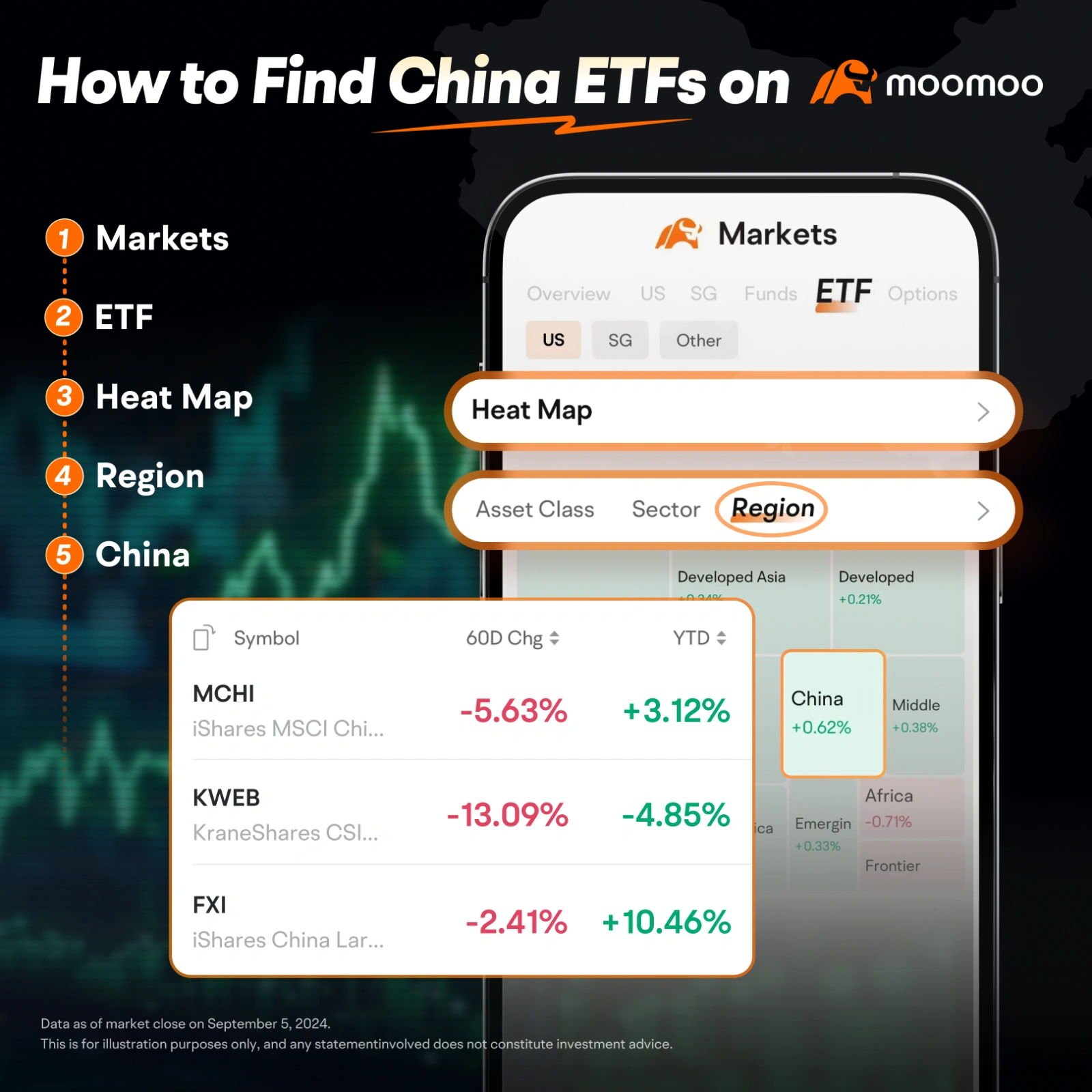
The following steps can be followed to invest in China ETFs on moomoo:
Conclusion
Investing in Chinese assets is not just about pursuing short-term market dynamics, it is a reflection of confidence in China's long-term economic growth and market potential. With China's growing role in the global economy, the China stock market has become an important part of the global investor community that cannot be ignored. Whether through direct investment in US-listed Chinese companies or through ETFs and participation in the A-share and HK stock markets, investors can share the dividends of China's economic growth.The moomoo platform serves as a tool that provides diversified investment options and efficient trading services to help investors easily access the China stock market.
When choosing to invest in Chinese assets, it is vital to consider key factors such as market position, growth potential, financial health, policy implications and compliance risk. Investors need to choose the most appropriate investment route based on their investment objectives, risk tolerance and market understanding. By carefully evaluating these factors and being aware of the associated risks, investors can make informed decisions and better manage their investments in the China market.
This presentation is for informational and educational use only and is not a recommendation or endorsement of any particular investment or investment strategy. Investment information provided in this content is general in nature, strictly for illustrative purposes, and may not be appropriate for all investors. Read more