How to Choose Chinese Assets Investment Targets
With China's rapidly growing economy and expanding global influence, investing in Chinese assets has become a lucrative option for global investors. However, the Chinese market's complexity, coupled with regulatory and economic fluctuations, can make choosing the right investment targets a challenging task. This comprehensive guide aims to demystify the process, offering strategic insights in accessing Chinese assets for your investment portfolio.

Understanding the Chinese Market Landscape
Before diving into specific investment opportunities, it's crucial to grasp the broader economic and regulatory environment in China. The country has undergone significant economic reforms that have opened up numerous sectors to foreign investments. From technology and consumer goods to real estate and green energy, the opportunities are vast but come with unique challenges such as regulatory changes, market volatility, and cultural differences in business practices.
Evaluate Economic Sectors with Growth Potential
Technology and Innovation: China's tech industry, particularly in areas like e-commerce, fintech, and artificial intelligence, continues to grow at an impressive rate. Companies like Alibaba, Tencent, and Baidu are at the forefront of this surge. Investing in these companies or in tech-focused funds can be a smart move, given the sector's potential for sustained growth.
Consumer Market: As the middle class expands in China, so does the demand for higher-quality consumer goods and services. This shift presents opportunities in retail, luxury goods, automotive, and travel sectors. Companies that cater to these consumer needs or ETFs that track consumer goods are worth considering.
Green Energy: China is a global leader in renewable energy, particularly in solar and wind power production. The government's commitment to reducing carbon emissions by boosting green energy consumption creates opportunities in this sector. Look for companies involved in the production of renewable energy technologies or related services.
Consider Geopolitical and Regulatory Impacts
Investing in China requires an understanding of the geopolitical landscape and how it affects markets. U.S.-China trade relations, for example, can significantly impact various sectors. Additionally, China's internal policies on foreign investments and business operations can change rapidly, influencing the profitability and operational capabilities of companies.
Stay updated on Chinese government policies and international relations that could affect your investments. Consider consulting with experts who specialize in Chinese market regulations to navigate this complex environment effectively.
Analyze Market Trends and Consumer Behavior
To successfully invest in Chinese assets, one must understand local market trends and consumer behavior. This involves not just looking at economic data but also understanding cultural factors that influence purchasing decisions and lifestyle choices.
For instance, an increasing concern for health among Chinese consumers has spurred growth in the healthcare and organic food sectors. An investment in these sectors might be timely. Utilizing market research reports and consumer surveys can provide valuable insights into these trends.
Diversify Your Investments
Given the volatility and regulatory risks associated with the Chinese market, diversification is crucial. Don't put all your eggs in one basket. Spread your investments across different sectors and asset classes such as equities, bonds, and real estate to mitigate risks.
Consider mixing large-cap stocks with potential high-growth small to mid-cap stocks. Including some stable government and corporate bonds or real estate investments can also balance the risk-reward ratio in your portfolio.
Monitor Investments and Adjust Strategically
Investing in Chinese assets requires active monitoring and a readiness to adapt your strategies as market conditions change. Set up a system to track the performance of your investments and stay informed about significant economic, political, and corporate developments that could impact your assets.
Regularly review and adjust your investment portfolio to align with new data and changing market dynamics. This proactive approach can help you capitalize on opportunities quickly and mitigate losses effectively.
Chinese Assets Are Soaring
Starting from September 24th, with the People's Bank of China releasing favorable policies, Chinese assets have seen a significant increase. The Hang Seng Index $Hang Seng Index (800000.HK)$has risen by more than 14% within a week, and the Shanghai Composite $SSE Composite Index (000001.SH)$ Index has increased by over 13%. How should we view the frenzied trend of Chinese assets? How can we keep up with such opportunities?
With the Federal Reserve rate cut and favorable policies improving China's capital market liquidity, many international investors and analysts have also noticed the opportunities here:
Goldman Sachs' strategy expert Scott Rubner stated that the recent strong performance of Chinese stocks, especially the significant increase in the NASDAQ Golden Dragon China Index, indicates the possibility of a recovery in the Chinese stock market. He believes that once the U.S. election is over, Chinese stocks should be an important part of investors' investment plans.
Morgan Stanley's strategists are also optimistic, believing that China's CSI 300 Index may have about 10% more room to rise in the short term. This forecast is based on an analysis of the borrowing cost of China's re-lending program and the current dividend rate of the CSI 300 Index.
Overseas analysts generally believe that the overall strength of Chinese assets, including Chinese concept stocks, Chinese asset ETFs, FTSE China A50 index futures, Hang Seng index futures, and the appreciation of the Chinese yuan, is the result of continuous policy catalysts from the Chinese government.
So, what Chinese assets can we choose? We can start with Chinese companies listed on the US stock market, where many Chinese companies are also listed, such as $Alibaba (BABA.US)$ $PDD Holdings (PDD.US)$ $JD.com (JD.US)$ , and other internet-related companies. With the recovery of Chinese consumption, economic recovery, and policy stimulus, their performance is expected to be directly promoted. Of course, we can also consider related ETFs, such as the $KraneShares CSI China Internet ETF (KWEB.US)$,$KraneShares CSI China Internet ETF (KWEB.US)$ to buy a basket of internet-related company stocks, or leveraged ETFs such as the $Direxion Daily FTSE China Bull 3X Shares ETF (YINN.US)$ to amplify the gains of the rise. Meanwhile, if you think the rise is unsustainable and will be accompanied by a sharp decline, you can consider using inverse ETFs, such as the $Direxion Daily FTSE China Bear 3X Shares ETF (YANG.US)$ to hedge potential market decline risks.

At the same time, moomoo MY now supports the trading of Hong Kong stocks and A-shares, and you can enjoy commission-free trading for a limited time.
We can directly participate in the investment and purchase of Chinese assets in the Hong Kong and A-share markets, such as $TENCENT (00700.HK)$, or Chinese bank stocks such as Bank of China $BANK OF CHINA (03988.HK)$ , Industrial and Commercial Bank of China $ICBC (01398.HK)$. For a complete guide to Hong Kong stock investment.
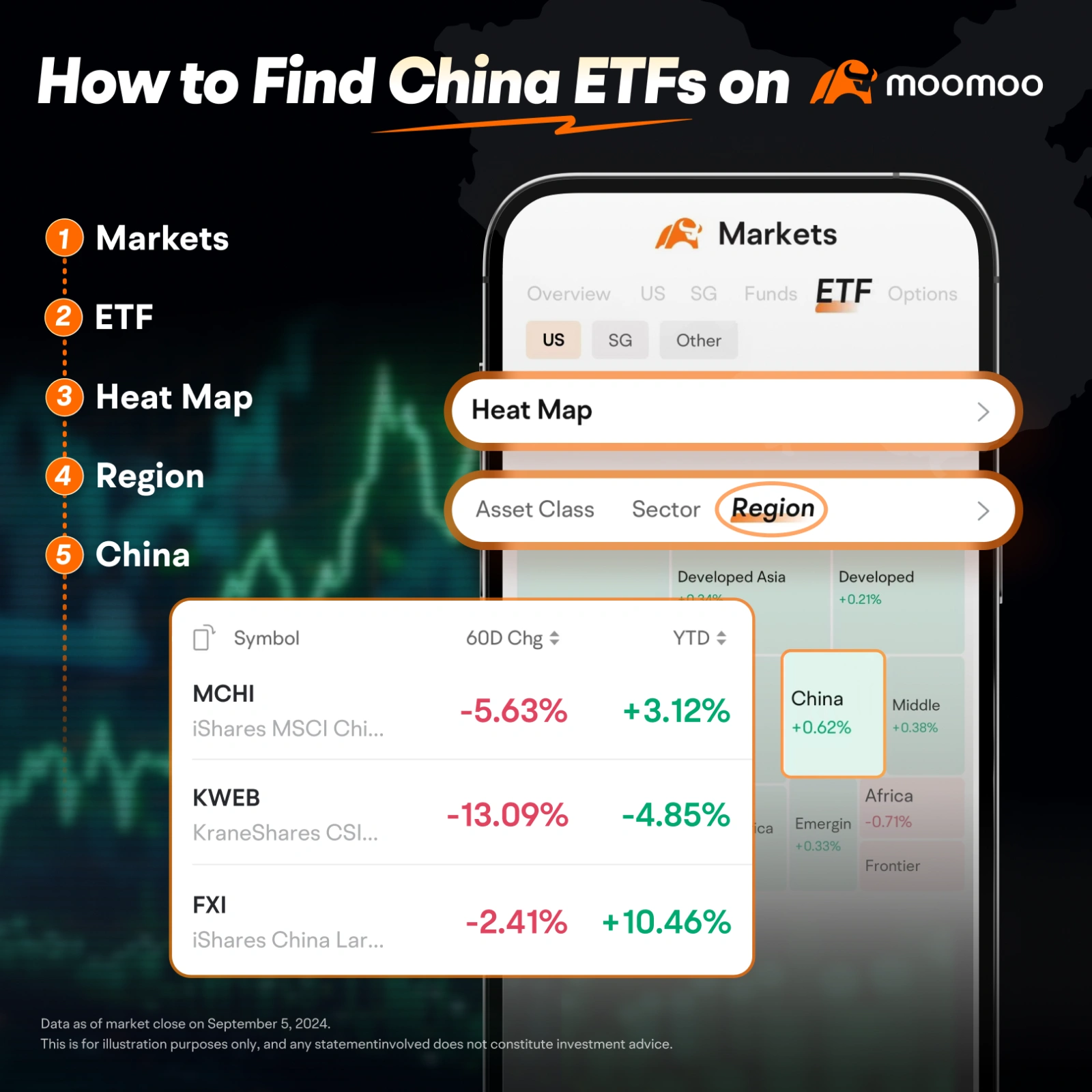
To explore and invest in China ETFs, you can follow these steps on moomoo:
In the current market environment, investors should maintain a cautious and optimistic attitude, closely monitor market dynamics and policy changes, reasonably allocate assets, and achieve a balance between risk and return. At the same time, it is also important not to be disturbed by the short-term fluctuations of the market and to maintain a long-term investment perspective.

Conclusion
Choosing the right Chinese assets for investment requires a well-rounded approach that includes a deep understanding of the market, strategic diversification, and continual adjustment and monitoring. By following these guidelines, investors can navigate the complexities of the Chinese market and potentially reap significant rewards from their investments. Remember, while the opportunities are plentiful, the risks are also significant, making thorough research and strategic planning essential components of successful investment in China.
This presentation is for informational and educational use only and is not a recommendation or endorsement of any particular investment or investment strategy. Investment information provided in this content is general in nature, strictly for illustrative purposes, and may not be appropriate for all investors. Read more