

Moomoo Insights
Jul 16 15:38
TSMC Earnings: AI Demand Is Stronger Than the Chip Selloff Suggests
Moomoo Insights
Sep 30 05:04
Live Take | Anthropic’s $518B Compute Bet: Who Wins From the AI Buildout?
The prices of options with different strike prices and different maturities vary greatly and can not be compared directly.
So, is there a good analysis method to determine whether the option price at a certain point in time may be a better value or not?
The answer is YES. Option Implied Volatility Analysis, a practical tool on moomoo, can help you estimate an option's potential value more accurately.
① What is implied volatility
Implied volatility reflects the market's expectations of the underlying stock's future price movements.
The unknown variable implied volatility can be inferred from some known variables, including the underlying price, the option price, interest rates, and time to expiration, based on a pricing model.
It can thus generally be considered a more accurate indicator of options’ value than option prices.
Expect the stock will have significant fluctuations in the future
Investors tend to offer higher bids for its options, pulling up options' prices, and options' implied volatility will rise correspondingly, assuming all other things remain constant.
Expect the stock to remain relatively stable
Investors are more likely to offer lower bids for its options, pushing down options' prices, and options' implied volatility will thus fall, assuming all other things remain constant.
Implied volatility can help make more informed trading decisions, including:
For trading a single option, implied volatility can help us determine a potentially profitable trading direction and measure market sentiment.
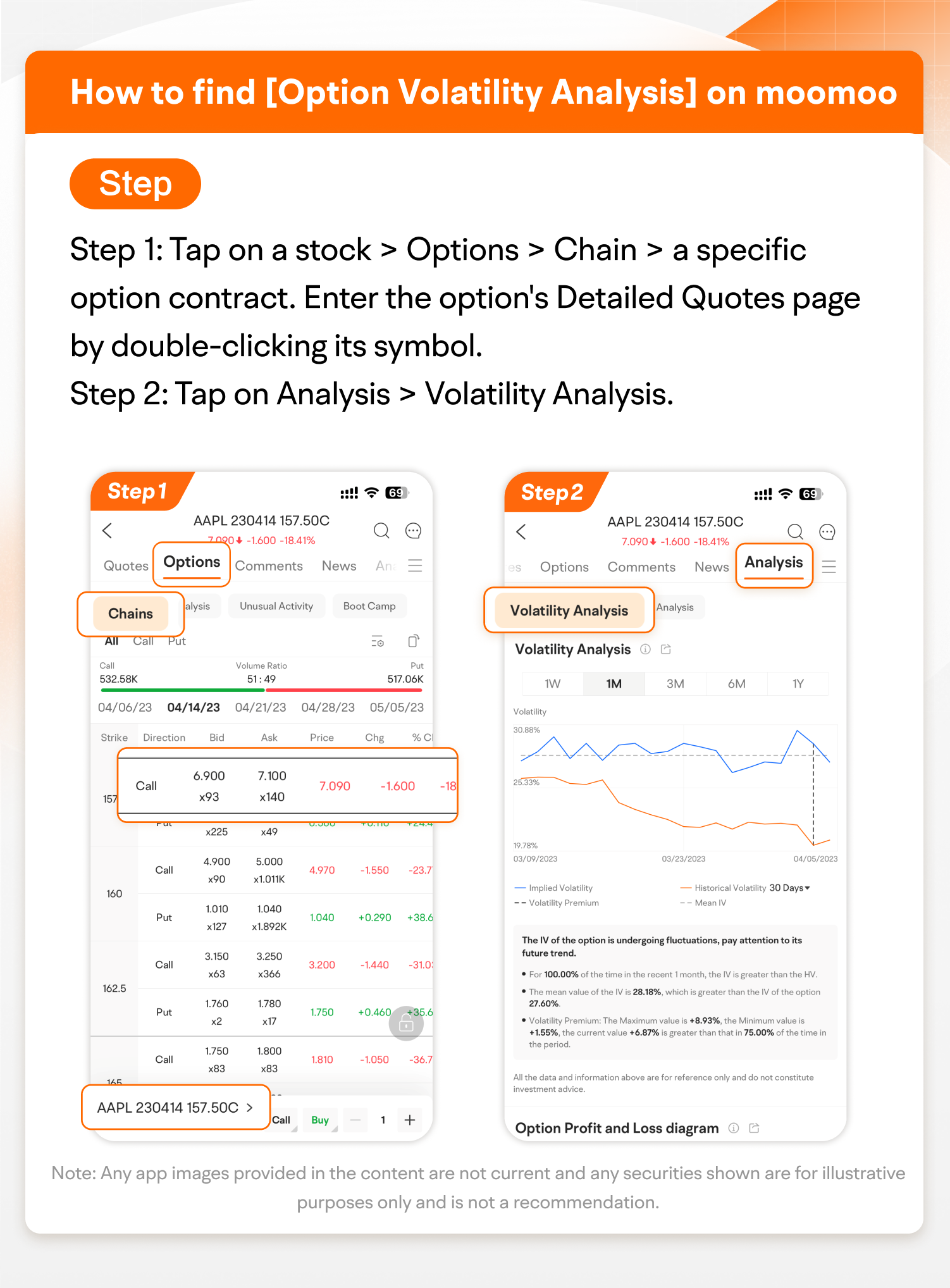
② How to find [Option Volatility Analysis] on moomoo
Step 1: Tap on a stock > Options > Chain > a specific option contract. Enter the option's Detailed Quotes page by double-clicking its symbol.
Step 2: Tap on Analysis > Volatility Analysis.
Let's now dive into the options tools on moomoo that offer key information about implied volatility.
③ Comparing implied volatility with historical volatility
Analyzing implied volatility of a single option contract can help us determine a potentially profitable trading direction and measure market sentiment.
The general consensus in the market is that:
Implied volatility has a nature of mean reversion, meaning that it tends to revert to its historical average over time.
The implication for investors is the opposite:
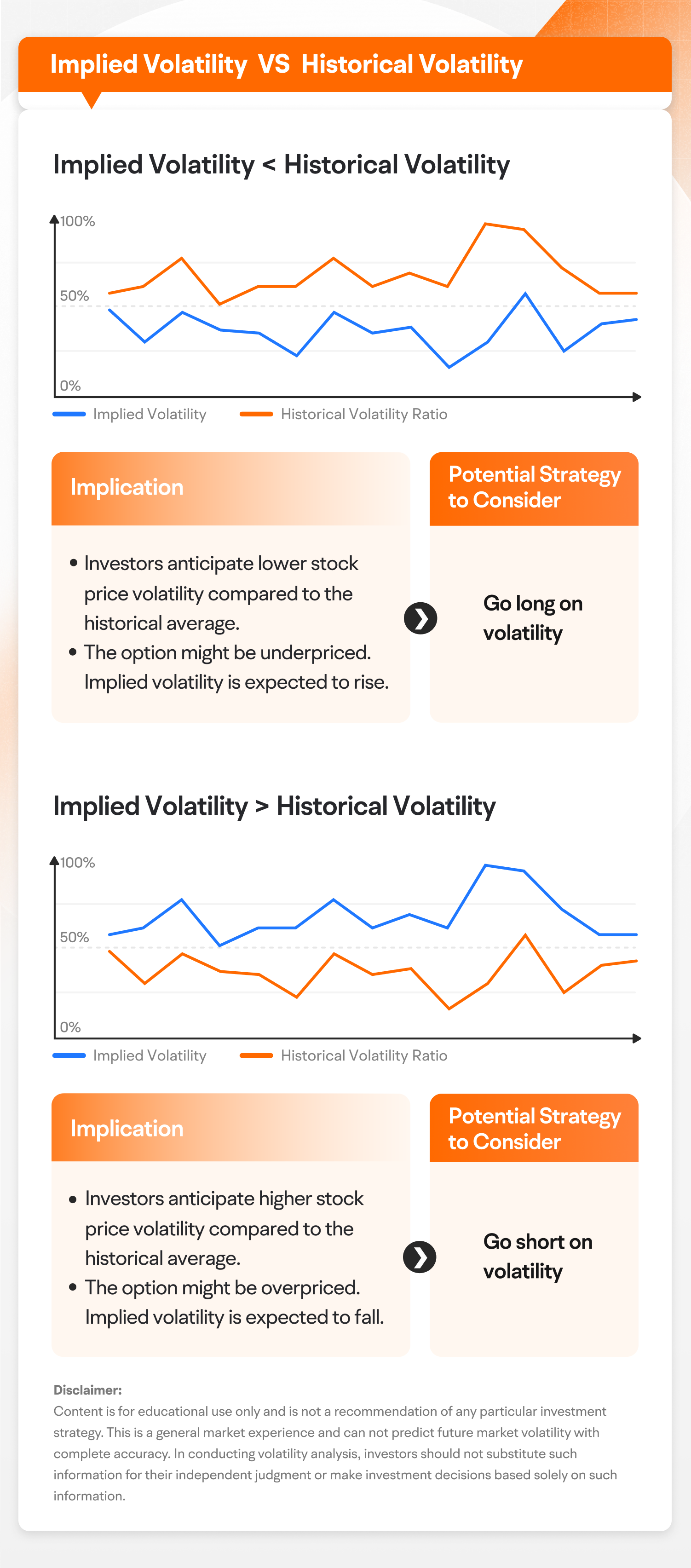
Without considering the direction (delta neutral). When the implied volatility is low, we may consider buying options. When the implied volatility is high, we may consider selling options.
So, how to determine the level of implied volatility? That will be compared with historical volatility.
As a general rule of thumb:
④ Using implied volatility with the underlying price trend to gauge market sentiment
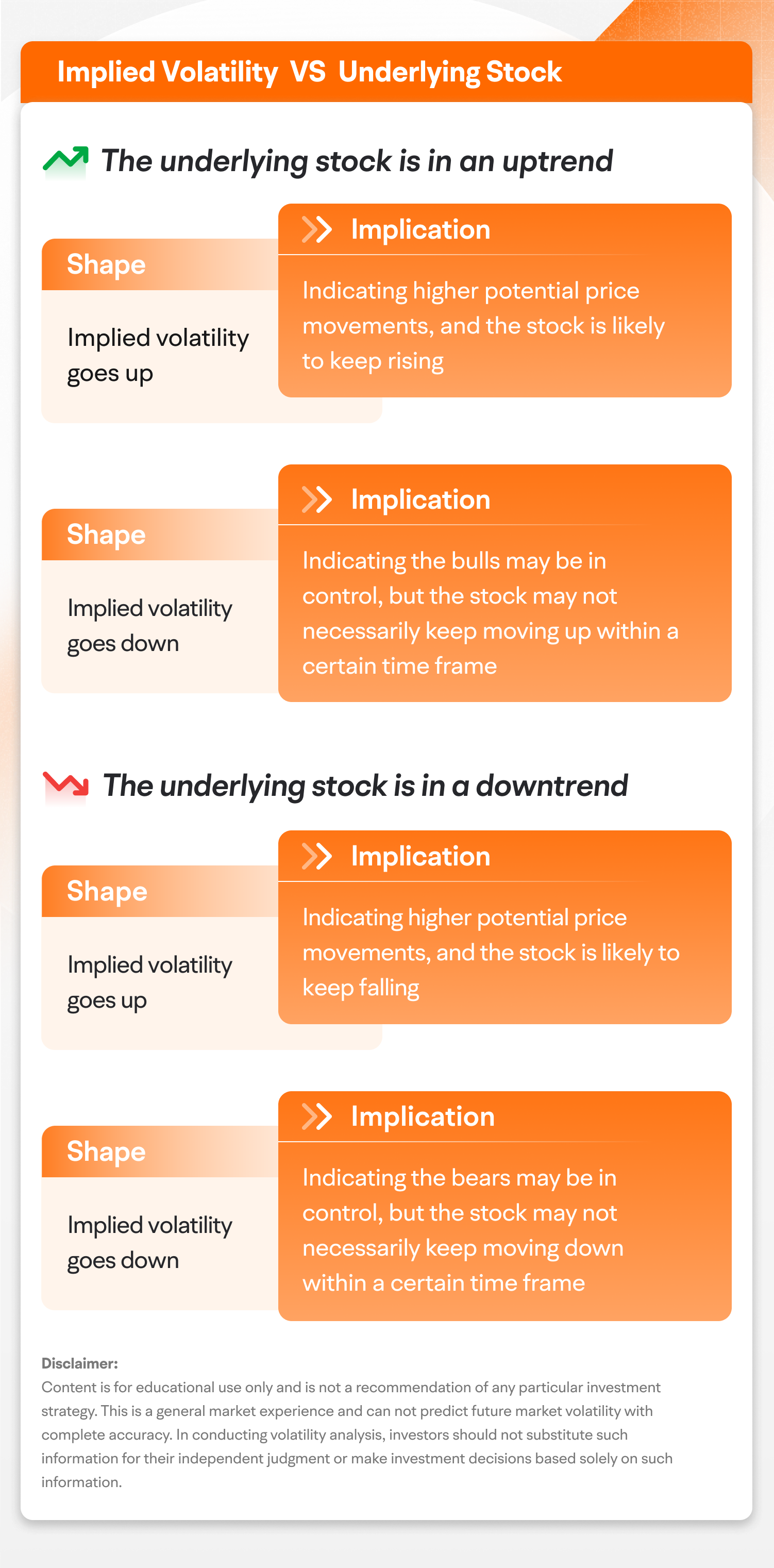
Since implied volatility reflects the market's expectations of the underlying stock's future price movements, it can be an indicator of market risk and uncertainty.
When used in conjunction with the underlying price trend, implied volatility can help us estimate where the market could be heading.
In many cases:
That's what today's lesson is all about. If you want to learn more about options, please follow [Moo Options Explorer] for timely updates!
This presentation is for informational and educational use only and is not a recommendation or endorsement of any particular investment or investment strategy. Investment information provided in this content is general in nature, strictly for illustrative purposes, and may not be appropriate for all investors. Read more
Recommend

Must-Read for Options Beginners: Get Better Pricing & Faster Fills
How to Find Winning Options Selling Trades in 3 Minutes Using Screeners
How to Boost Returns with Covered Calls

Options Trading Trap: More Premium = More Profit?
How to Generating Income While Waiting for a Better Price
Why Selling Options Has Better Probability of Profit
Trading with limited capital: why options can be more capital efficient than shares
Avoid the trap: don’t buy cheap options blindly
Top 0DTE Options by Volume: Start Trading Mag 7 Stock Options Today
Protective puts: how to protect your portfolio while staying invested
Understanding the Function of Call Options in Upward Trend
Avoid pitfalls: expiration choices explained
Gamma Exposure (GEX): Understanding Dealer Hedging Flows, and Key Levels
Understanding Call and Put Options
Position at Lower Entry, Avoid Getting Trapped: A Professional Entry Strategy Via Sell Put
Exercise, Let expire or Close. Three Smart Moves
Understanding balance sheets: how to assess a company’s risk
10-Minute Guide to Understanding Options
Analysing earnings: is this company worth a long term position?
Why trading options takes more than picking the right company
How to Place Option Orders on Moomoo Desktop
Understanding Options : A Beginner's Guide
Master these 5 terms to confidently read an options chain
Volatility Analysis: Volatility Term Structure / Volatility Smile
Options Ticks: Capture real-time options market actions
Volatility Analysis: IV / HV / IV Rank / IV Percentile
Options P/L Curve Tutorial: Simulate your Options Trade to Visualize Potential Profit and Loss
Open Interest Analysis: How to potentially grasp the market's capital flow?
Master 5 Terms to Read an Options Chain
Options Unusual Activity: how to potentially monitor the moves of institutional investors
Volatility Analysis: How to estimate an option's value more accurately?
Options Seller Dashboard:Quickly Find High-ROI Options Contracts
Options Price Calculator: How to calculate the future price of an option
Must-Read for Options Beginners: Get Better Pricing & Faster Fills
How to Find Winning Options Selling Trades in 3 Minutes Using Screeners
How to Boost Returns with Covered Calls
Options Trading Trap: More Premium = More Profit?
How to Generating Income While Waiting for a Better Price
Why Selling Options Has Better Probability of Profit
Trading with limited capital: why options can be more capital efficient than shares
Avoid the trap: don’t buy cheap options blindly
Top 0DTE Options by Volume: Start Trading Mag 7 Stock Options Today
Protective puts: how to protect your portfolio while staying invested
Understanding the Function of Call Options in Upward Trend
Avoid pitfalls: expiration choices explained
Gamma Exposure (GEX): Understanding Dealer Hedging Flows, and Key Levels
Understanding Call and Put Options
Position at Lower Entry, Avoid Getting Trapped: A Professional Entry Strategy Via Sell Put
Exercise, Let expire or Close. Three Smart Moves
Understanding balance sheets: how to assess a company’s risk
10-Minute Guide to Understanding Options
Analysing earnings: is this company worth a long term position?
Why trading options takes more than picking the right company
How to Place Option Orders on Moomoo Desktop
Understanding Options : A Beginner's Guide
Master these 5 terms to confidently read an options chain
Volatility Analysis: Volatility Term Structure / Volatility Smile
Options Ticks: Capture real-time options market actions
Volatility Analysis: IV / HV / IV Rank / IV Percentile
Options P/L Curve Tutorial: Simulate your Options Trade to Visualize Potential Profit and Loss
Open Interest Analysis: How to potentially grasp the market's capital flow?
Master 5 Terms to Read an Options Chain
Options Unusual Activity: how to potentially monitor the moves of institutional investors
Volatility Analysis: How to estimate an option's value more accurately?
Options Seller Dashboard:Quickly Find High-ROI Options Contracts
Options Price Calculator: How to calculate the future price of an option