Types of ETFs
Key Takeaways
Types of ETFs include indexed ETFs, bond ETFs, sector and industry ETFs, commodity ETFs, style ETFs, international ETFs, alternative investment ETFs, leveraged and inverse ETFs, etc.
We introduced What is an ETF in the last course and shared a piece of advice from the investing guru Warren Buffett.
In my view, for most people, the best thing to do is to own the S&P 500 index fund.-Buffett said in Berkshire Hathaway's virtual annual meeting on May 2, 2021.
The opinion of Warren Buffett may have merit, but we don't provide investment advice. Rather we believe before buying any securities; investors need to educate themselves and make decisions based on their circumstances.
In this course, we will focus on some different types of ETFs. But before we start, let's refresh with a basic definition: ETFs are a type of exchange-traded product that offers investors a way to pool their money in a fund that makes investments in stocks, bonds, or other assets and, in return, to receive an interest in that investment pool. ETF shares are traded on a national stock exchange and at market prices that may or may not be the same as the net asset value ("NAV") of the shares, that is, the value of the ETF's assets minus its liabilities divided by the number of shares outstanding. ETF share prices fluctuate all day as the ETF is bought and sold.
So what types of ETFs are there?
There are various types of ETFs available to investors, and the investment objectives and management style of a given ETF vary. The objective of passively managed ETFs is to replicate the performance of the index the ETF tracks. On the other hand, actively managed ETFs invest to achieve a particular investment objective by making investment decisions themselves. Some ETFs aim to earn a return that is a multiple or a reverse (inverse) multiple of the return of a particular stock index. These are referred to as leveraged or inverse ETFs. An ETF's investment objective is stated in its prospectus.
Below are several common types of ETFs. This list is not all-inclusive of the type of funds available.
Indexed ETFs
These ETFs seek to track a securities index like the S&P 500 or NASDAQ stock index.
Bond ETFs
Provide exposure to bonds. The following are some examples of bond sectors: Treasury, corporate, municipal, international, high-yield, and several more.
Sector and industry ETFs
Provide exposure to a particular industry, such as Energy, Health Care, Financials, Technology, etc.
Can buy and store the physical commodity itself or be structured to invest in commodity futures contracts. Some common commodity ETFs are investments in gold and silver.
Style ETFs
Pursue an investment style or market capitalization focus, such as but not limited to large-cap value or small-cap growth.
International ETFs
Own securities in companies headquartered outside the home country.
Alternative investment ETFs
Funds that follow alternative strategies, such as but limited to long-short equity and option writing.
Leverage & Inverse ETFs
Leveraged ETFs seek to deliver multiples of the performance of the index or benchmark they track. Inverse ETFs seek to deliver the opposite of the performance of the index or benchmark they track.
While a traditional ETF typically tracks the securities in its underlying index on a one-to-one basis, a leveraged ETF may aim for a 2:1 or 3:1 ratio.
How to find an ETF on Moomoo?
1. Markets—>US(example)—>ETF
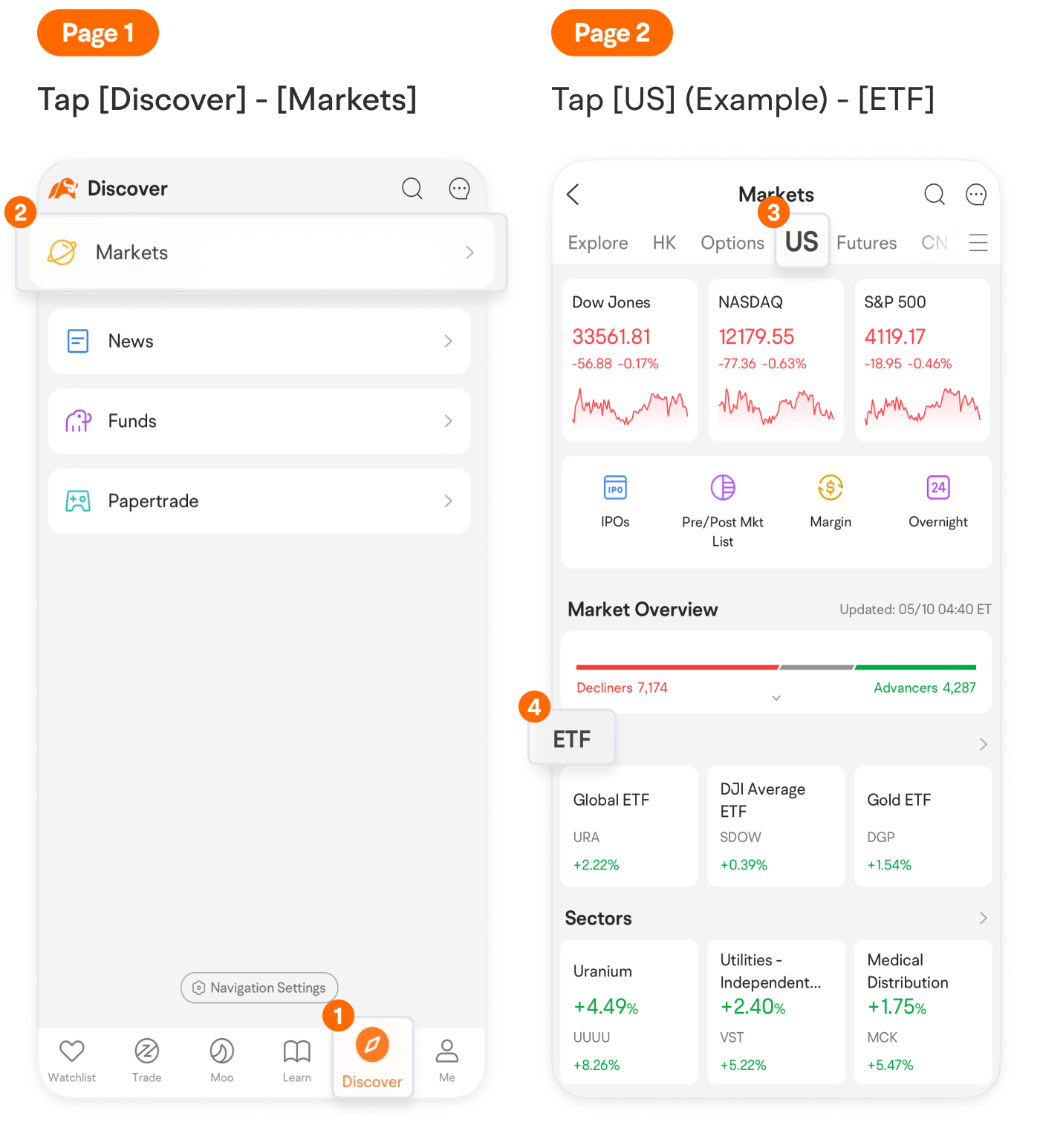
2. ETF page with different types
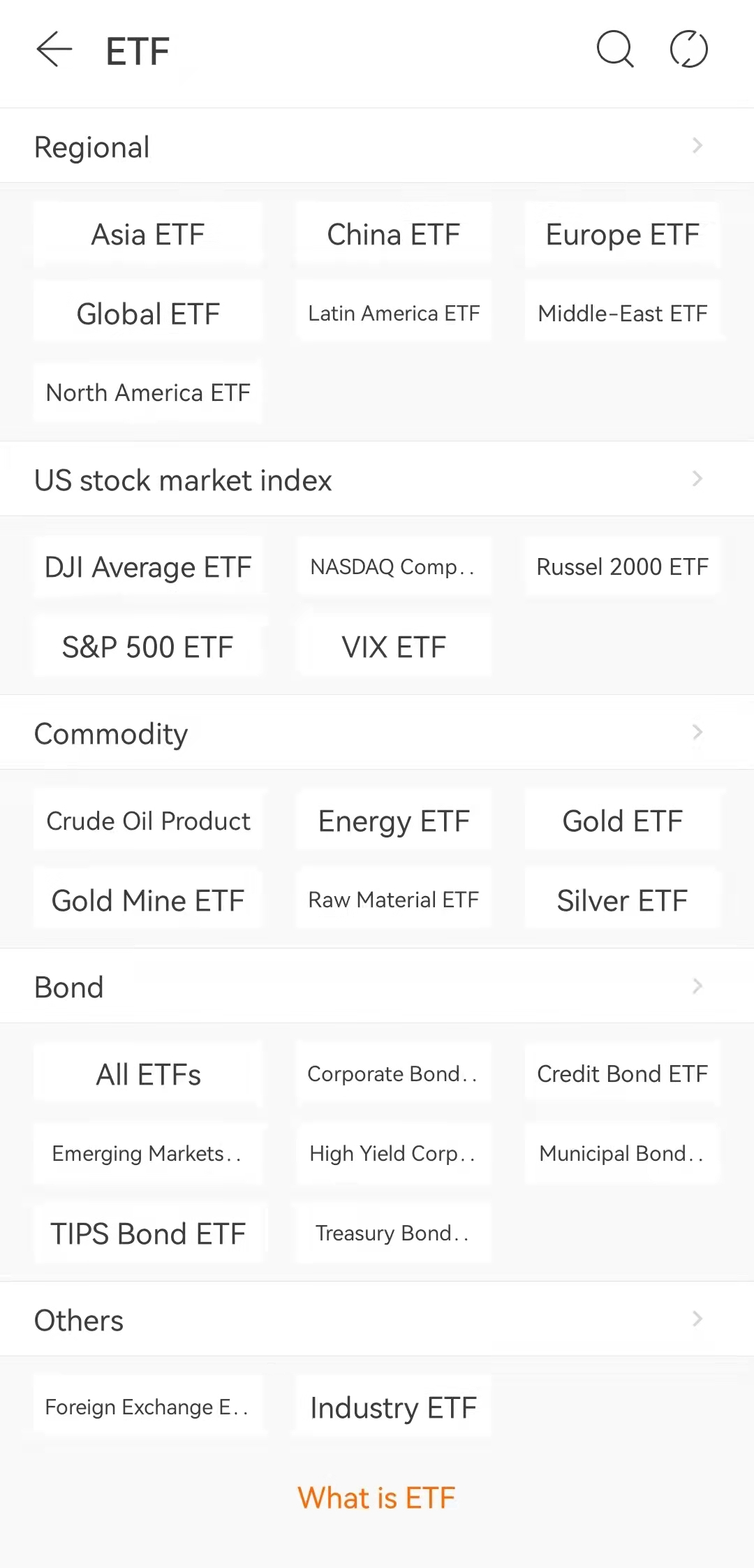
You can choose different ETF types according to your preference and allocation.
With the abundance of choices out there, it's important that you first determine your portfolio's allocation and then, based on those decisions, select ETFs to meet your investment goals.
Below we will explain in more detail indexed-based ETFs, which are popular among some investors.
There are two basic types of indexes: indexes that track the overall market, such as the S&P 500 Index, and indexes that track a much more targeted subset of the overall market, such as specific indexes designed for tracking investment sectors, industries, or investment styles for example.
An index-based ETF seeks to earn the return of the market or subset of the market that it aims to replicate, less the fees. Some index ETFs mimic an index in its entirety, and others use representative sampling, which deviates slightly by using futures, options, swap contracts, and the purchase of stocks sometimes not found in the index.
Of course, no investment is without risk. With index ETFs, investors are locked into the performance of the underlying index. If the index underperforms, so will the ETF.
This presentation is for informational and educational use only and is not a recommendation or endorsement of any particular investment or investment strategy. Investment information provided in this content is general in nature, strictly for illustrative purposes, and may not be appropriate for all investors. Read more