How to Practice Day Trading (Day Trading Simulator Guide)
Day trading in the U.S. stock market offers both significant opportunities and substantial risks. With access to the world's most liquid markets—including the NYSE and NASDAQ—American traders can capitalize on intraday price movements across thousands of securities. However, the fast-paced nature of day trading demands skill, discipline, and emotional control that can only be developed through practice.
Day trading simulators have become an essential tool for beginners looking to build these critical skills without putting real capital at risk. Whether you're interested in trading U.S. equities, ETFs, or options, a quality simulator allows you to experience authentic market conditions and test your strategies before committing actual funds. This guide will walk you through everything you need to know about practicing day trading effectively.
- Start with a Simulator to Minimize Risk: A day trading simulator lets you practice strategies and learn market mechanics without risking real capital, crucial for beginners.
- Focus on Realistic Practice: Use real-time U.S. market data and advanced tools like charting software and Level 2 data for authentic trading experiences.
- Develop Discipline and Emotional Control: Simulators help build the psychological resilience and rule-based approach needed for live day trading success.
- Transition Gradually to Live Trading: Achieve consistent profitability in simulation before trading real money, starting with small positions and a focus on capital preservation.
Why a Day Trading Simulator Is Your First Best Trade
Before risking real money in the U.S. markets, aspiring day traders should understand the fundamental benefits of using a simulator. The concept of risk-free learning is invaluable—simulators allow you to experience market volatility, test strategies, and learn from mistakes without losing real capital. Given the Pattern Day Trader (PDT) rule enforced by FINRA, which defines a Pattern Day Trader as a trader who executes four or more day trades within five business days in a margin account, and requires a minimum account balance of $25,000 (maintained at all times) for such frequent day trading, practicing in a simulator first is especially prudent for U.S.-based traders. Failure to maintain the $25,000 minimum balance will result in the account being restricted from executing any day trades until the balance is restored.
Master Market Mechanics Without Financial Risk
Simulators replicate real U.S. market conditions with remarkable accuracy, allowing you to practice during actual trading hours (9:30 AM to 4:00 PM Eastern Time) and even extended hours sessions. You'll learn to execute various order types—market orders, limit orders, stop-loss orders, and trailing stops—while understanding how they function within the structure of American exchanges.
A quality simulator familiarizes you with platform functionalities, including how to navigate watchlists, set price alerts, and monitor your positions. You'll gain hands-on experience with U.S. market mechanics such as T+1 settlement cycles, margin requirements, and how different order routing options can affect execution. This safe environment eliminates the financial consequences of beginner mistakes while building essential trading competencies.
Develop Crucial Trading Psychology and Discipline
Develop Crucial Trading Psychology and DisciplinePractice trading helps build the emotional resilience needed for live trading by allowing users to face simulated wins and losses. While the stakes aren't real, the experience of watching positions move against you—or seeing profits evaporate—helps develop the psychological fortitude required for success.
Beyond mindset and emotional control, new traders often struggle with learning sophisticated instruments like options without the pressure of real monetary risks. A paper trading account offers the perfect sandbox. For example, moomoo provides a virtual account with $1,000,000 in funds, allowing you to practice buying and selling options repeatedly in a live market environment without risking a single dollar. You can experiment with different strike prices and expiration dates, observe how P&L fluctuates with market movements, and refine your strategies for timing and position sizing. This hands-on experience helps build risk awareness and solid trading habits. Download and register moomoo to open your paper trading account. Start practicing with professional-grade tools and real-time data to build the confidence and skill needed to transition from simulation to live trading.
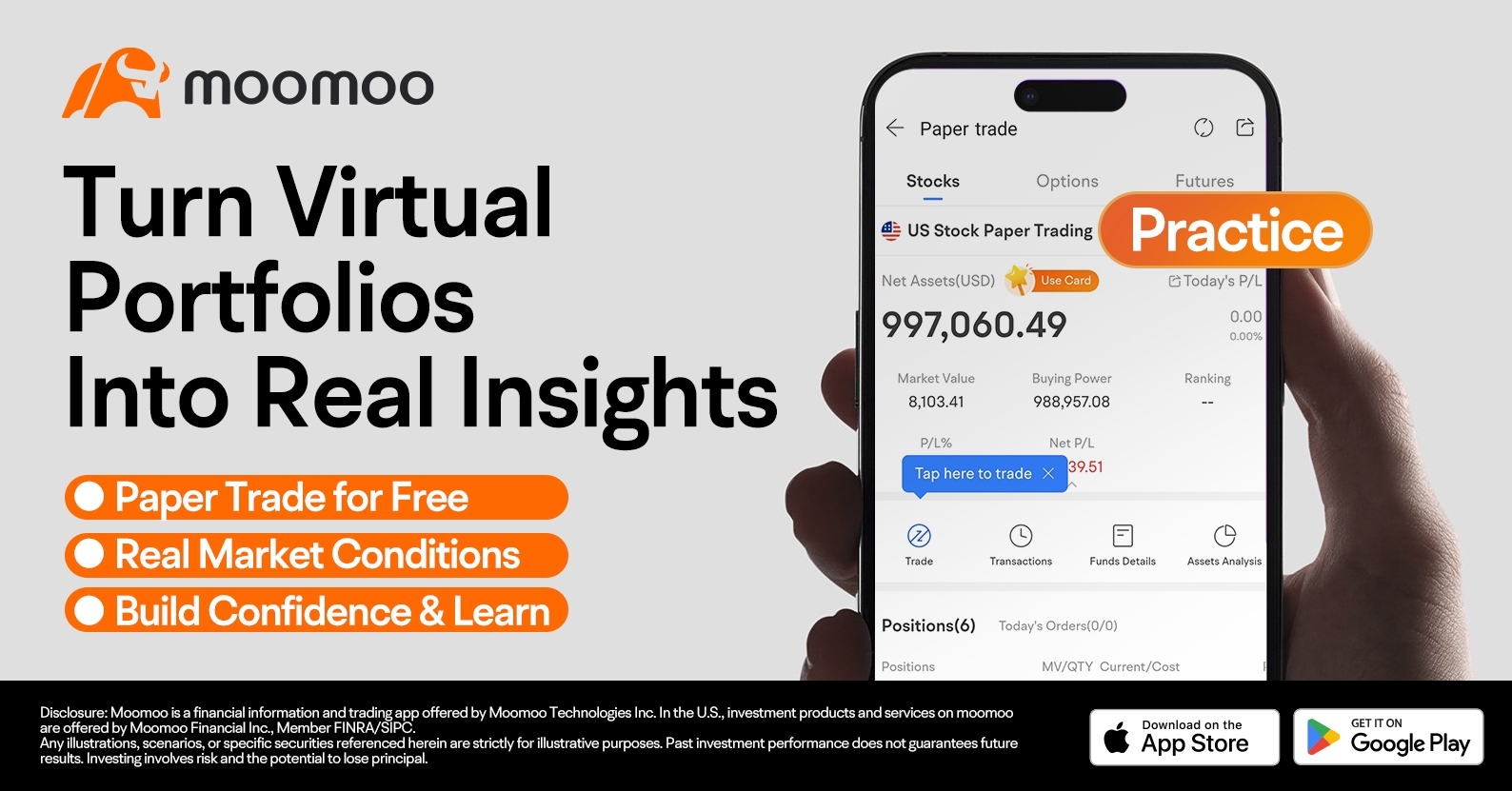
Simulators foster discipline and a rule-based approach to trading. You'll learn to stick to your trading plan, manage position sizes appropriately, and avoid the emotional decision-making that derails many new traders. This psychological preparation is particularly important given the high-pressure environment of U.S. markets, where rapid price movements can trigger impulsive reactions.
Selecting the Best Day Trading Simulator
Choosing the right simulator based on 2026 market standards is crucial for effective practice. Not all simulators are created equal—some offer basic functionality while others provide the advanced tools needed to truly prepare for live U.S. market trading. This section compares different types of simulators and highlights the features most important for realistic practice.
Real-Time Data vs. Delayed Feeds
Understanding the difference between real-time and delayed data feeds is critical for a realistic day trading practice experience. Real-time data reflects actual U.S. market prices as they occur, while delayed feeds typically lag by 15-20 minutes—an eternity in day trading.
For meaningful practice, access to live, accurate market data from U.S. exchanges is essential. Real-time quotes allow you to practice entries and exits at prices that reflect actual market conditions, making your transition to live trading much smoother. When evaluating simulators, prioritize those offering real-time data for NYSE, NASDAQ, and other major U.S. exchanges.
This need for real-time data is even more pronounced when trading options. Because options prices, implied volatility, and risk metrics are highly sensitive to underlying price movements, stale data is useless. Access to millisecond-level real-time bid/ask quotes on an options chain reveals the true bid-ask spread—a hidden cost that can erode profits. A wide spread indicates poor liquidity, and buying at the ask can put you at an immediate disadvantage. By seeing these quotes update in real time, traders can place more intelligent limit orders near the mid-price to improve execution and reduce costs. Download moomoo to experience its millisecond-level real-time Options Chain and learn how to use bid-ask spreads to your advantage, ensuring your practice is as cost-aware as live trading.
Charting Software and Level 2 Data
Advanced charting tools and technical indicators are indispensable for day trading practice. Look for simulators that offer customizable charts with multiple timeframes, drawing tools, and a comprehensive library of technical indicators including moving averages, RSI, MACD, and volume analysis tools.
Level 2 data—also known as market depth—shows the full order book for U.S. securities, revealing the bid and ask prices beyond the best available quote. This information is crucial for understanding supply and demand dynamics, identifying potential support and resistance levels, and making informed trading decisions. A simulator with Level 2 functionality prepares you for the reality of reading order flow in live markets.
Moomoo's Advanced Simulator
moomoo's paper trading simulator stands out as an ideal tool for both new and experienced traders preparing for the U.S. markets. The platform offers real-time market data, advanced charting capabilities, and Level 2 data access—all within a user-friendly interface designed for serious traders.
With moomoo, you can practice trading U.S. stocks, ETFs, and options using virtual funds while experiencing the same powerful tools available in live accounts. The platform's integration with comprehensive market analysis, including institutional-grade research and real-time news feeds, provides an authentic trading environment. Additionally, moomoo's partnership with the New York Mets reflects its commitment to the American trading community, while features like the cash sweep program demonstrate the platform's focus on maximizing value for U.S. clients when they're ready to transition to live trading.
A Step-by-Step Guide: How to Practice Day Trading Effectively
This core section provides a structured, actionable walkthrough for using a day trading simulator. Following these steps will help you build a solid foundation before risking real capital in the U.S. markets.
Step 1: Set a Realistic Virtual Starting Capital
Start with a virtual amount that mirrors what you realistically plan to invest in your live trading account. If you're planning to day trade actively in the U.S., remember that FINRA's Pattern Day Trader (PDT) rule defines a Pattern Day Trader as one who executes four or more day trades within five business days in a margin account, and requires maintaining at least $25,000 in your margin account at all times to avoid trading restrictions. If you do not meet the $25,000 minimum, your account will be restricted to no more than three day trades every five business days.
Setting realistic capital levels makes your practice experience directly relevant to your future live trading. If you plan to start with $30,000, practice with $30,000 in virtual funds. This approach ensures your position sizing, risk management, and profit expectations align with your actual trading circumstances.
Step 2: Formulate and Test a Specific Trading Plan
Create a comprehensive trading plan before placing your first simulated trade. Your plan should include:
Entry criteria: Specific conditions that must be met before entering a trade
Exit criteria: Predetermined profit targets and stop-loss levels
Risk management rules: Many successful traders follow the 1% rule, never risking more than 1% of their account on a single trade
Market focus: Specific U.S. stocks, sectors, or ETFs you'll concentrate on
Trading hours: Whether you'll trade the opening bell, midday, or closing session
Test your plan rigorously in the simulator, making adjustments based on results while maintaining the discipline to follow your rules consistently.
Step 3: Execute and Manage Your Practice Trades
With your plan established, begin placing different order types and actively managing open positions within the simulator. Practice using:
Market orders for immediate execution
Limit orders to control entry and exit prices
Stop-loss orders to manage downside risk
Bracket orders that combine profit targets with stop-losses
Emphasize the importance of following your pre-defined trading plan with every trade. The simulator is your opportunity to build the habit of disciplined execution before real money is on the line.
Step 4: Keep a Trading Journal and Analyze Performance
Log every simulated trade in a detailed trading journal. Record the date, time, security traded, entry and exit prices, position size, reasoning for the trade, and emotional state during execution. Include screenshots of your charts showing the setup.
Review your journal regularly to identify successful patterns, common mistakes, and areas for strategic improvement. Look for trends in your performance—are you more successful trading certain types of setups? Do you perform better during specific market hours? This analysis transforms random practice into purposeful skill development.
Popular Day Trading Strategies to Test in Your Simulator
Several common day trading strategies work well in the U.S. markets. A simulator provides the perfect environment to practice each approach and determine which strategy best fits your personality, schedule, and risk tolerance.
Practicing Scalping for Small, Frequent Profits
Scalping involves making rapid trades for small gains, typically holding positions for seconds to minutes. This strategy works best with high-volume U.S. stocks that offer tight bid-ask spreads and consistent liquidity.
Use your simulator to practice the quick decision-making and precise execution scalping demands. Focus on highly liquid securities like major tech stocks or popular ETFs such as SPY and QQQ. Pay attention to transaction costs, as frequent trading can accumulate significant fees that impact profitability. Note that scalping often involves multiple day trades, so practicing with a virtual balance of $25,000 or more will help you simulate the unrestricted trading allowed under the PDT rule.
A common challenge for scalpers is identifying which stocks or indices offer the best intraday opportunities. Without clear signals, it's hard to know where market activity is concentrated. Using a tool that highlights popular stocks and indices can solve this problem. For example, looking at leaderboards for options volume, open interest, and implied volatility helps you quickly identify securities with high liquidity and significant market attention. This allows you to focus your analysis on assets that are already in play, saving valuable time. Try moomoo's Options Market feature to explore the Popular Stocks and Indices lists. See how ranking by volume and open interest can help you identify top scalping candidates in seconds.
Simulating Momentum and Breakout Trading
Momentum and breakout trading involves identifying U.S. stocks showing strong price movement or breaking through established support and resistance levels. These strategies capitalize on the continuation of existing trends or the initiation of new directional moves.
Use your simulator's charting tools to practice identifying breakout patterns, confirming volume surges, and timing entries and exits. Scan for stocks making new highs, showing unusual volume, or breaking through key technical levels. The simulator allows you to refine your pattern recognition skills without financial consequences.
From Simulator to Live Market: Making the Transition
Bridging the gap between practice and reality requires understanding both the psychological and practical differences between simulated and live trading. This section provides a roadmap for a smooth transition to trading real capital in the U.S. markets.
Key Metrics to Know You're Ready for Live Trading
Before transitioning to a live account, establish specific benchmarks for success in your simulator:
Consistent profitability: Demonstrate positive returns over at least 2-3 months of active trading
Proven strategy: Your trading plan should show repeatable results across different market conditions
Disciplined execution: Follow your rules consistently, with minimal deviation from your plan
Appropriate win rate and risk-reward ratio: Understand your strategy's statistics and ensure they support long-term profitability
Meeting these benchmarks indicates readiness for a live account, though the transition should still be approached cautiously. If you plan to execute more than three day trades in five business days, ensure your live margin account maintains the $25,000 PDT minimum balance from the start.
Understanding Real-World Factors: Slippage and Emotional Pressure
Prepare for challenges that simulators cannot fully replicate. Slippage—the difference between expected and actual execution prices—occurs in live markets, especially during volatile periods or when trading less liquid securities. Your actual fills may differ from what you experienced in practice.
The emotional stress of having real money at risk fundamentally changes the trading experience. Decisions that felt easy in simulation become difficult when actual capital is on the line. Acknowledge this reality and prepare mentally for the psychological adjustment.
Starting Small: Your First Steps in a Live Account
Begin your live trading journey with a conservative approach:
Start with a small amount of capital you can afford to lose
Trade smaller position sizes than you practiced with in simulation
Focus on capital preservation rather than aggressive profit-seeking
Apply your proven simulator strategy while remaining adaptable to live market realities
Consider your live account's additional features, such as moomoo's cash sweep program, which helps your uninvested cash work for you while you wait for the right trading opportunities. This patient, measured approach gives you time to adapt while protecting your trading capital. If you do not yet meet the $25,000 PDT minimum, limit your day trades to no more than three every five business days to avoid account restrictions.
Conclusion
A day trading simulator is an indispensable tool for anyone serious about trading the U.S. markets. Through dedicated practice, you can develop essential skills, test and refine strategies, and build the confidence needed for live trading—all without risking real capital.
The path from beginner to competent day trader requires patience, discipline, and countless hours of practice. By following the structured approach outlined in this guide, you'll build a solid foundation that prepares you for the challenges and opportunities of live U.S. market trading.
Ready to start your day trading journey? Open a free paper trading account with moomoo today and begin practicing with professional-grade tools, real-time U.S. market data, and the comprehensive features you need to develop your trading skills. Your future as a day trader starts with your first simulated trade.
FAQs about Day Trading Simulators
How do I use a day trading simulator to prepare for real U.S. markets?
To effectively practice day trading with a simulator, you should follow a structured approach. First, set a realistic virtual starting capital that mirrors what you plan to invest, keeping in mind the latest FINRA Pattern Day Trader (PDT) rule: a PDT is defined as a trader who executes four or more day trades within five business days in a margin account, and the rule requires a minimum account balance of $25,000 (maintained at all times) to avoid trading restrictions. Second, formulate a specific trading plan with clear entry/exit criteria and risk management rules, like the 1% rule. Third, execute and manage your practice trades using various order types (market, limit, stop-loss) while strictly adhering to your plan. Finally, maintain a detailed trading journal to log every trade and regularly analyze your performance to identify patterns, mistakes, and areas for improvement. This disciplined process transforms practice into meaningful skill development.
How long should I practice on a day trading simulator before trading with real money?
There is no fixed timeline, but you should aim to meet several key performance benchmarks before transitioning to a live account. The goal is to demonstrate consistent profitability over a significant period, typically at least two to three months of active simulated trading. During this time, you should prove that your trading strategy is effective and that you can execute it with discipline under various market conditions. If your strategy involves frequent day trades (four or more in five business days), ensure you practice with a virtual balance of $25,000 to simulate the unrestricted trading allowed under the PDT rule.
What are the most important features in a day trading simulator?
First, prioritize a simulator with real-time market data for U.S. exchanges like the NYSE and NASDAQ, as delayed feeds are useless for intraday trading. Second, look for advanced charting software with a full suite of technical indicators (e.g., moving averages, RSI, MACD) and drawing tools. Finally, a high-quality simulator should offer Level 2 data (market depth), which shows the full order book of bids and asks. This feature is invaluable for understanding supply and demand dynamics and is a key tool for serious day traders. For traders preparing to comply with the PDT rule, a simulator that allows you to set a virtual balance of $25,000 or more is also beneficial.
Can I practice day trading in a simulator if I don't have the $25,000 for the PDT rule?
Yes, absolutely. A day trading simulator is the perfect tool for aspiring traders who have not yet met the $25,000 minimum required by FINRA's Pattern Day Trader (PDT) rule. Simulators allow you to practice without any real capital. However, for the most relevant practice, it is highly recommended to set your virtual account balance to at least $25,000. This allows you to practice trading without the restrictions of the PDT rule (which limits non-PDT accounts to three day trades every five business days), simulating the conditions you would need to trade freely in a live U.S. margin account. This helps you develop strategies and habits that will be directly applicable once you fund a live account at that level. If you plan to trade with less than $25,000 initially, you can also practice limiting your simulated day trades to three per five business days to adapt to the PDT restrictions.
What are the biggest differences between practicing in a day trading simulator and live trading?
While simulators are excellent for learning mechanics and strategy, two major differences emerge in live trading. The first is slippage, which is the difference between the price you expect a trade to execute at and the actual price it fills at. This occurs in live markets due to volatility or low liquidity and can impact your profitability in a way simulators can't fully replicate. The second, and more significant, difference is the emotional pressure of trading with real money, which can lead to fear, greed, and impulsive decisions not present in a risk-free environment. Additionally, live accounts are subject to the PDT rule—if you execute four or more day trades in five business days without $25,000 in your margin account, you will face trading restrictions, a factor not typically simulated unless you intentionally practice with a lower virtual balance.
What are some popular day trading strategies I can test in a simulator?
A simulator is ideal for testing various strategies. For scalping, you can practice making dozens of rapid trades on highly liquid U.S. stocks or ETFs (like SPY and QQQ) to capture very small, frequent profits. Since scalping often involves multiple day trades, practice with a virtual balance of $25,000 to simulate unrestricted trading under the PDT rule. For momentum and breakout trading, you can use the simulator's charting tools to identify stocks that are breaking through key support or resistance levels on high volume and practice timing your entries and exits.
This presentation is for informational and educational use only and is not a recommendation or endorsement of any particular investment or investment strategy. Investment information provided in this content is general in nature, strictly for illustrative purposes, and may not be appropriate for all investors. Read more