Trump's Presidency: Which to Invest in US Stock for Singapore Investors
Nowadays, as eyes turn to the potential of a Trump 2.0 era, Singapore investors are eager to decipher the implications and opportunities. In recent years, the Trump presidency has cast a long shadow over the global economic and financial arenas. From 2017 to 2021, Donald Trump's first tenure was rife with bold policy moves that sent shockwaves through markets.

How to buy US stocks in Singapore? This article delves into the multifaceted impacts of Trump's policies on various sectors, asset performances, and how moomoo Singapore can be a strategic tool for navigating the US stock market during this complex period.
An Introduction to Trump's Presidency
Donald Trump's presidency began on January 20, 2017, and ended on January 20, 2021. This was the period of his first tenure. It was a time marked by a series of bold and often controversial moves on both the domestic and international fronts.
Donald Trump's presidency has been characterized by significant policy shifts and intense public focus. From his initial entry into the political arena, Trump brought with him a set of bold ideas and promises that aimed to reshape the United States in multiple dimensions. In 2025, it is expected that Trump's presidency may have a substantial influence on Singapore investors.
Early Life and Career
Family and Education
Donald Trump was born on June 14, 1946, in Queens, New York, to Mary Anne MacLeod and Frederick Christ Trump. He was the fourth of five children. Trump's father was a successful real estate developer, and his mother was a homemaker. Growing up in a family with a strong business background, Trump was exposed to the world of real estate from an early age.
Trump attended the New York Military Academy, where he developed a reputation for being a disciplined and ambitious student. After high school, he enrolled at Fordham University but later transferred to the University of Pennsylvania. At Penn, Trump attended the Wharton School of Finance and Commerce, where he graduated with a degree in economics in 1968. This educational foundation laid the groundwork for his future business endeavors.
Business Ventures and Wealth
After graduating from college, Donald Trump joined his father's real estate company, Elizabeth Trump & Son, which later became the Trump Organization. He quickly made a name for himself in the real estate industry, building a reputation for his aggressive business tactics and ability to negotiate deals. Trump's early projects included the renovation of the Commodore Hotel and the development of the Grand Hyatt Hotel in New York City.
In the 1980s, Trump expanded his business empire, investing in casinos, hotels, and other ventures. He acquired properties such as the Trump Tower, Trump Plaza, and the Trump Taj Mahal. Trump's high-profile business deals and flamboyant personality made him a prominent figure in popular culture, leading to his appearance on television shows and in films.
Trump's business ventures and investments made him a wealthy man, with an estimated net worth of over $3 billion. His success in the business world set the stage for his eventual entry into politics.
Rise to the Presidency
Trump Announced His Candidacy
On June 16, 2015, Donald Trump announced his candidacy for the Republican presidential nomination at a rally in New York City. Standing in the lobby of Trump Tower, Trump announced his intention to run for president, promising to “Make America Great Again.” His announcement was met with skepticism by many in the media and the Republican establishment, who viewed him as a long-shot candidate.
However, Trump quickly gained traction with his populist message and unconventional campaign style. He tapped into the frustrations of many Americans who felt left behind by the political establishment, focusing on issues such as illegal immigration, trade, and national security. Trump's brash and unapologetic approach resonated with a significant portion of the electorate, propelling him to the forefront of the Republican primaries.
Elected President
On November 8, 2016, Donald Trump was elected the 45th President of the United States, defeating Democratic nominee Hillary Clinton in a surprise upset. Trump won 304 electoral votes to Clinton's 227, although Clinton received nearly 3 million more popular votes. Trump's victory was seen as a major upset, and it marked a significant shift in American politics.
Trump's election was driven by his ability to connect with voters who felt disillusioned with the status quo. His campaign promises to bring jobs back to America, renegotiate trade deals, and secure the nation's borders resonated with many. Trump's victory signaled a new era in American politics, characterized by his unconventional approach and willingness to challenge established norms.
In conclusion, Donald Trump's rise to the presidency was marked by his ability to tap into the frustrations of many Americans and his unconventional campaign style. His victory in the 2016 presidential election was a significant moment in American history, setting the stage for his presidency and the policy shifts that would follow.
Trump's Presidency: Key Policy and Economic Priorities for 2025
The economic policies proposed by Trump hold significant implications for the United States and the global economy. The Trump administration had a notable impact on various policies and national events, including health agency pressures during the COVID-19 pandemic, shifts in foreign relations, and controversial immigration policies. Trump's key policy and economic priorities for 2025 are designed to reshape the domestic economic landscape and influence international economic relations.
Domestic Tax Reduction and Regulatory Streamlining
Domestic tax reduction aims to relieve the financial burden on businesses and individuals. By cutting tax rates, it encourages spending and investment, which can potentially boost economic growth. Regulatory streamlining simplifies complex rules, making it easier for companies to operate and innovate, reducing administrative costs and time-consuming procedures. Federal judges have also played a role in shaping the regulatory landscape by issuing rulings against Trump's directives, such as the travel ban, which underscores their impact on the judiciary's independence and public confidence.
Promoting the Growth of Digital Currencies Actively
Actively promoting digital currency growth shows an adaptation to the changing financial landscape. It provides regulatory clarity to the cryptocurrency sector, which has been marred by uncertainty. This attracts institutional investors and mainstream financial institutions, bringing in much-needed capital.
With government support, research and development in blockchain technology can accelerate. This could lead to the creation of more efficient payment systems, decentralized financial platforms, and even new forms of digital money that could revolutionize the way we conduct transactions.
Diminished Geopolitical Tensions and Monetary Policy Adjustments
Diminishing geopolitical tensions is crucial for global economic stability. By resolving trade disputes and improving diplomatic relations, international trade can flow more smoothly, benefiting industries reliant on imports and exports.
On the monetary policy side, the Federal Reserve's adjustments, such as interest rate changes and quantitative easing tweaks, are designed to maintain a stable economy. They balance inflation control and economic growth, ensuring that the financial system has the right amount of liquidity.
Enhanced Tariff Measures and Aggressive Federal Reserve Signals
Enhanced tariff measures are a tool to protect domestic industries. By carefully adjusting tariffs on specific sectors facing tough foreign competition, like steel and aluminum, jobs can be safeguarded and domestic supply chains strengthened.
The Federal Reserve's aggressive signals, in coordination with trade policies, show its commitment to economic stability. It reacts to changes in inflation and trade disruptions, either raising rates to combat inflation or implementing expansionary policies to boost growth.
Growing Fiscal Deficits and Increasing Inflation Expectations
The implementation of stimulus packages and tax cuts often leads to growing fiscal deficits. The government needs to find innovative ways to address this, such as exploring new revenue sources or cutting wasteful spending.
As inflation expectations rise, a combined approach of monetary and fiscal policies is essential. The Federal Reserve tightens or loosens monetary policy while the government focuses on increasing domestic production to balance supply and demand and control price increases. The economic challenges we face today, including high unemployment rates, are reminiscent of the post-World War II era.
Trump 2.0 vs. Trump 1.0: What are the differences after the Presidential Election?
The Trump administrations, labeled as Trump 1.0 and Trump 2.0, present different policy landscapes. These differences span across several key areas, including tax policies, trade stances, energy and environmental approaches, digital currency promotion, and fiscal and inflation management.
Tax Policy: Trump 1.0 cut corporate tax to 21% and adjusted individual taxes. Trump 2.0 proposes more cuts, especially for the middle class and businesses.
Trade Policy: Trump 1.0 started trade disputes, taxing steel, aluminum, and engaging with China. Trump 2.0 plans broader tariffs, like 10% on all imports and 60% on China, plus more on other countries' goods.
Energy & Environmental Policy: Trump 1.0 backed domestic fossil fuels and relaxed environmental rules. Trump 2.0 aims to end green subsidies and boost oil and gas extraction.
Digital Currency Policy: Trump 1.0 brought regulatory uncertainty. Trump 2.0 actively promotes crypto, offers clarity, and speeds up blockchain R&D.
Fiscal & Inflation Policy: Trump 1.0's stimulus and tax cuts caused some deficit growth. Trump 2.0 may see bigger deficits, needing new ways to manage coordinated policies for inflation.
Popular US Stocks Under Trump's Policy Influence
*T&Cs and other fees apply
The financial market is a complex and dynamic arena, constantly influenced by various factors such as political decisions, economic policies, and global events. Under the influence of Trump's policies, certain sectors of the market can achieve remarkable growth.
US Bank Stocks
After Trump’s election victory, the financial sector, especially bank stocks, is likely to benefit from tax cuts and deregulation. The share prices of Goldman Sachs (GS), JPMorgan Chase (JPM) and Citigroup (C) all witnessed significant increases. The U.S. government's actions during the COVID-19 pandemic, including its engagement with the World Health Organization, also had significant implications for the financial sector.
Goldman Sachs
Goldman Sachs Group, Inc. is a leading global investment banking, securities, and investment management firm. The company's performance is closely tied to the health of the financial markets and the level of corporate activity.
JPMorgan Chase
JPMorgan Chase & Co. is a major American financial institution that provides a comprehensive range of financial services. The company's stock is influenced by factors such as loan growth, deposit levels, the performance of its investment banking operations, and changes in the regulatory landscape.
Citigroup
Citigroup Inc. is a global financial services corporation with a diverse range of offerings. The performance of its stock depends on factors such as its ability to manage credit risk, the success of its international expansion and diversification strategies, and changes in regulatory requirements that impact its operations across different regions.
Small-Cap Stocks: Russell 2000 Index
Trump's tax cut policies are particularly advantageous for small-cap stocks. Reducing the corporate tax rate to 15% may drive the earnings growth of these companies.
The Russell 2000 Index (RUT.US) is a well-known benchmark in the financial world. It is a stock market index that measures the performance of the smallest 2,000 companies in the Russell 3000 Index. The Russell 2000 companies are generally considered small-cap stocks.
After Trump's election victory, the Russell 2000 Index (RUT.US) hit a record high, with an increase of more than 10%.
Trump-Related Stocks
Trump-related stocks were also affected. As Trump takes office, one can continue to pay attention to stock opportunities in Trump-related trades. Notably, bitcoin-related stocks also experienced significant increases. After announcing his candidacy, Trump accepted the Republican nomination in July 2016, highlighting the competitive nature of the process.
Tesla (TSLA)
Tesla, Inc. is an American multinational automotive and clean energy company. Its stock performance is often influenced by factors like the production and delivery numbers of electric vehicles, the progress of new product research and development, and Elon Musk's statements and actions.
Trump Media & Technology Group (DJT)
Trump Media & Technology Group Corp. is an American media and technology company majority-owned by former U.S. president Donald Trump. The company's stock performance is affected by the development and user activity of Truth Social, as well as legal and regulatory issues.
Peabody Energy (BTU)
Peabody Energy Corporation is the world's largest private-sector coal company. It is listed on the New York Stock Exchange under the ticker symbol "BTU" and is headquartered in St. Louis, Missouri.
Cryptocurrency-related Stocks
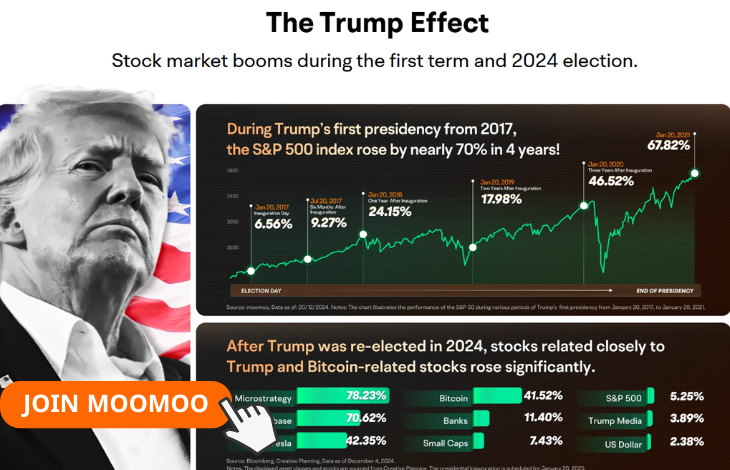
In contrast to his initial tenure, Trump's stance on Bitcoin today appears to be positive. The vigorous promotion of cryptocurrencies by the US has drawn global attention. Following Trump's re-election, the price of Bitcoin witnessed a remarkable surge. During the period from November 5th to December 26th, its cumulative growth surpassed 41%. The following are stocks related to cryptocurrencies.
MicroStrategy (MSTR)
MicroStrategy Incorporated. is a leading business intelligence and analytics software firm. The company has been in the spotlight due to its significant investment in Bitcoin. Its stock performance is closely tied to the value of Bitcoin and the overall demand for its software services in the data analytics market.
Coinbase (COIN)
Coinbase Global, Inc. is a well-known cryptocurrency exchange platform in the United States. The company's stock value is highly influenced by the volatility of the cryptocurrency market, regulatory developments in the digital asset space, and its own trading volumes and user growth.
MARA Holdings (MARA)
Marathon Digital Holdings, Inc. is a digital asset-focused company, with a primary emphasis on Bitcoin mining. The stock's performance is significantly affected by the cost of mining operations, the price of Bitcoin, and technological advancements in the field of cryptocurrency mining.
Top 5 Sectors in the Trump Era for Singapore Investors
The Trump era brought about a complex web of economic policies, geopolitical shifts, and market dynamics that rippled across the globe. For Singapore investors, seeking lucrative opportunities abroad, understanding the top-performing sectors during this period was of paramount importance.
Finance Sector: Crypto

Trump's stance on cryptocurrency has sent ripples through the financial world. His pro-cryptocurrency approach is seen by many as a potential game-changer. By vowing to halt restrictive policies like "Operation Chokepoint 2.0", which he associates with the Democrats, Trump aims to create a more favorable environment for crypto-related businesses.
Trump's proposed policies emphasize regulatory clarity, which is crucial for both the security and growth of the cryptocurrency market. With enhanced financial innovation on the agenda, the industry could witness a new wave of development. Moreover, the potential replacement of Gary Gensler as the SEC chair suggests a significant shift in regulatory strategy. If implemented, this could lead to a more crypto-friendly regulatory regime.
Singapore investors can consider investing in large financial institutions such as JPMorgan Chase, Goldman Sachs, and Wells Fargo, as well as some emerging fintech companies.
How to Invest Crypto via Moomoo?
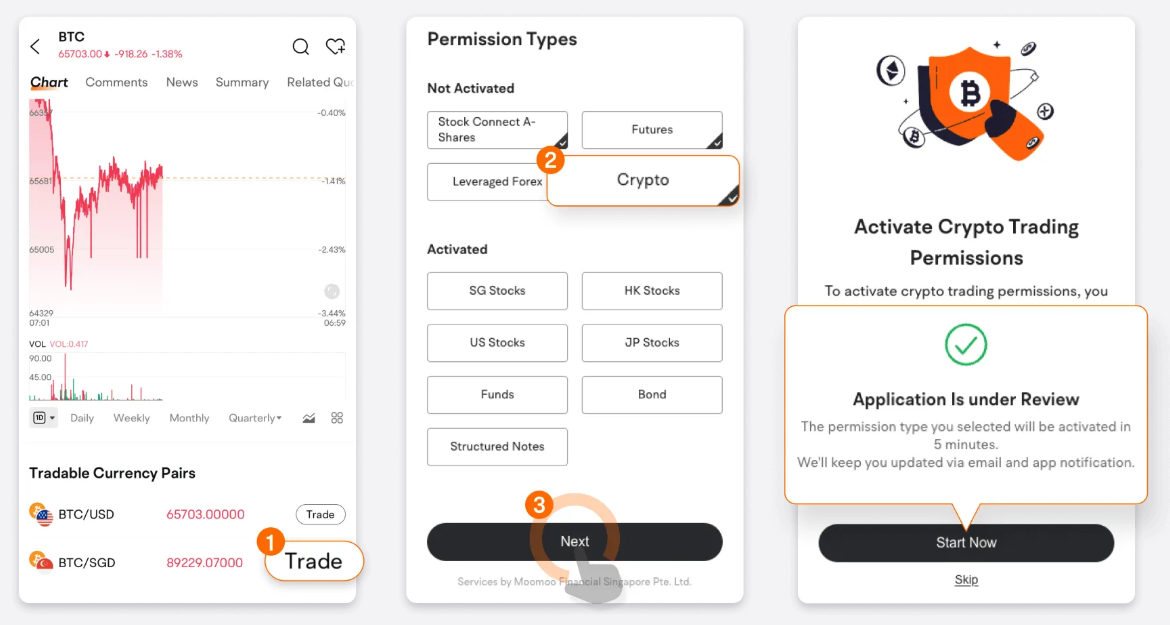
Go to "Trade" > "Crypto" > "Next" > "Start Now", and your application is submitted.
Go to "Accounts" > Select your crypto account > "Transfers"> Select your preferred currency > Enter Amount.
After completing the above steps, return to the detailed quotes page and click on "Trade" again.
Technology and Artificial Intelligence Sector
Trump has shown a friendly stance towards the technology and AI industries, promising to abolish some regulations on AI development and deployment, which will create a more relaxed business environment. The global AI investment in 2024 reached $22 billion and is expected to increase to $26.7 billion in 2025, indicating a huge market potential. AI will also drive the development of related fields such as semiconductors, cloud services, and data centers.
Singapore investors can focus on companies that develop AI technology, provide AI solutions, and have related hardware manufacturing capabilities, such as Nvidia, Microsoft, and Google.
Nvidia Corporation (NVDA)
Nvidia Corporation (NVDA), founded in 1993 and headquartered in Santa Clara, California, is a global leader in high-end graphics processing units (GPUs). The company has seen significant growth due to the increasing demand for GPUs in AI and machine learning.
Microsoft Corporation (MSFT)
Microsoft Corporation is known for its Windows operating system, Office suite, LinkedIn, and Xbox gaming platform. Its $13 billion investment in OpenAI solidified its position in the AI sector, and the company aims to integrate AI into various initiatives to reshape user interactions.
Alphabet Inc. (GOOG)
Alphabet Inc. (GOOG), the parent company of Google, is a global technology leader. Google's search engine is the most widely used in the world, and the company also has a dominant position in online advertising through Google Ads.
Semiconductor Sector
AI-Driven Demand: The development of AI requires a large amount of computing power, which in turn drives the demand for semiconductors. As AI technology enters the new application stage, the semiconductor industry will continue to benefit.
Although Trump's trade policies may have some impact on the semiconductor industry's global supply chain, they also create opportunities for domestic semiconductor companies in the United States to expand production and improve their competitiveness.
Singapore investors can focus on leading semiconductor companies such as $英特尔 (INTC.US)$ and $美国超微公司 (AMD.US)$ , as well as some companies that develop semiconductor materials and equipment.
Intel Corporation (INTC)
Intel Corporation (INTC) is a pioneer in the semiconductor industry, with a long history of manufacturing microprocessors and other chips. Intel is also investing in areas such as artificial intelligence and 5G to diversify its business and regain its competitive edge.
Advanced Micro Devices (AMD)
Advanced Micro Devices (AMD) is a 1969 Silicon Valley company that has evolved into a prominent semiconductor technology firm. It focuses on high-performance and adaptive computing solutions, competing with industry giants like Intel. The introduction of the MI300X chip for AI computations positions it as a contender in the AI chip race.
Utilities and Power Sector
The widespread application of AI and economic recovery will lead to an increase in power demand. Utility companies will benefit from this trend and are expected to receive stable returns.
Trump's stance on increasing energy production may inadvertently lead to an investment boom in clean energy. Although he has criticized subsidies for wind energy and electric vehicles, the power demand of data centers and the need for various power sources may drive the development of renewable energy.
Singapore investors can invest in some large utility companies with stable operations and good growth potential, such as Duke Energy and NextEra Energy.
Duke Energy (DUK)
Duke Energy is a major electric power holding company in the United States. The company's operations include generation, transmission, and distribution of electricity. Duke Energy is also involved in renewable energy initiatives, which could impact its long-term growth prospects as the energy sector transitions towards cleaner sources.
NextEra Energy (NEE)
NextEra Energy is a leading clean energy company. It is well-known for its significant investment in renewable energy sources such as wind and solar power. NextEra Energy's stock performance has been strong, driven by growth in its renewable energy portfolio and increasing demand for clean energy.
Real Estate Sector

With the Fed's interest rate cut cycle, mortgage rates are expected to continue to decline, which will stimulate the release of housing demand and is a major positive for the US real estate market.
The housing inventory in the United States is still far below the 6-month balance point, and the housing supply is in short supply, which will support housing prices.
However, Trump's policy of deporting a large number of illegal immigrants may lead to a shortage of construction labor and an increase in housing costs, and his tariff policy may also have an impact on building materials prices.
Singapore investors can choose some real estate investment trusts (REITs) with stable income and low risk to invest in the US real estate market, or invest in some high-quality real estate development companies with strong competitiveness.
How to Invest REITs via Moomoo?
1. Go to the "Market" > "REITs" icon on the screen.
2. From the list of REITs, choose the one you wish to trade.
3. Click the 'Trade' button at the bottom of the "REIT" page to start trading.
1. Go to the "Market" > "REITs" icon on the screen.
2. From the list of REITs, choose the one you wish to trade.
3. Click the 'Trade' button at the bottom of the "REIT" page to start trading.
Key Asset Performance in Trump's Presidency
During Donald Trump's tenure as the president of the United States, the financial markets experienced a series of fluctuations, significantly influencing the performance of various key asset types.
More than half of moderate and liberal Republicans preferred Trump to exit the political stage, contrasting with the majority of conservatives who wanted him to remain a significant figure in politics.
Crypto
Crypto, such as Bitcoin, represents a new and emerging asset class. They offer the potential for high returns but also come with significant risks due to their speculative nature and the evolving regulatory environment.
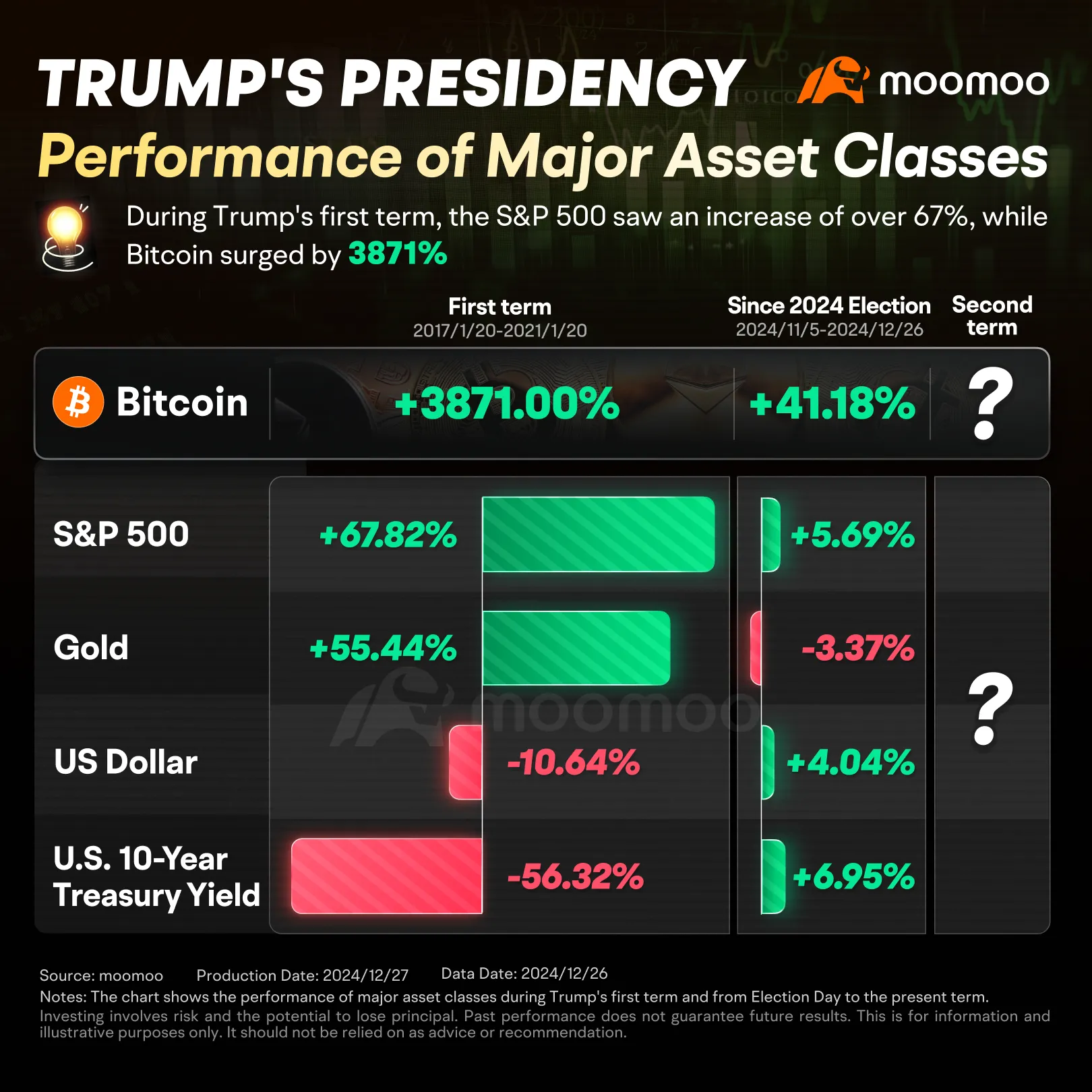
In Trump's first term (2017/1/20 - 2020/12/26), it had a 3871% increase, due to its decentralization, limited supply, and growing investor interest. From 2024/11/5 to 2024/12/26, it rose by 41.18%, perhaps because of market optimism and maturing infrastructure. This ongoing growth suggests that Bitcoin maintained its appeal, possibly due to continued market optimism and the maturing of the cryptocurrency market infrastructure.
S&P 500
The S&P 500 is a well-established equity asset class. It represents the stock performance of 500 large-cap companies listed on stock exchanges in the United States. It is widely used as a benchmark for the overall health of the U.S. stock market.
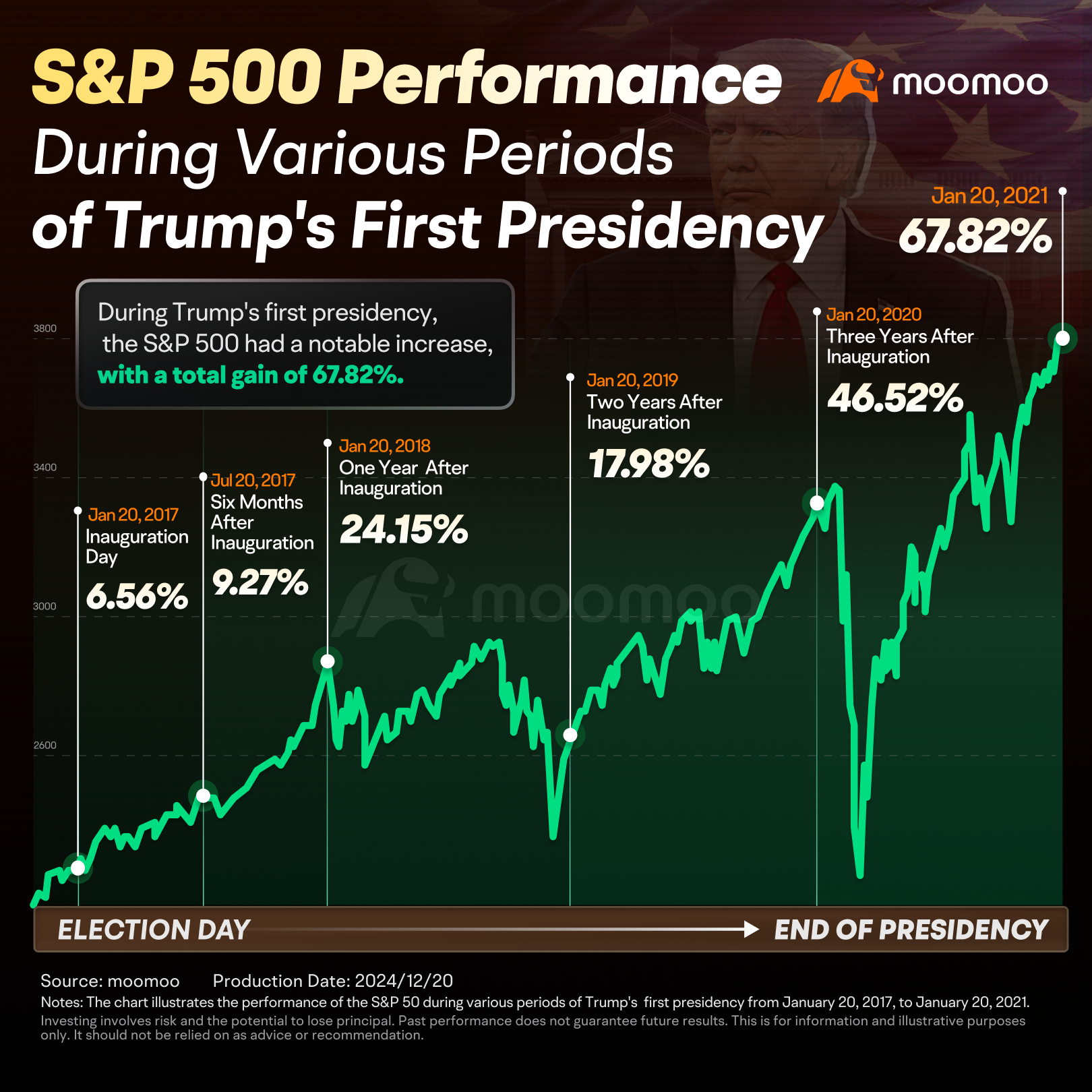
In Trump's first term, the S&P 500 increased solidly by 67.82%. Trump's economic policies, such as corporate tax cuts, initially boosted corporate profits, leading to higher stock prices. The business-friendly environment encouraged companies to expand and invest, positively impacting the stock market.
U.S. 10-year Treasury Yield
During Trump's first term, the U.S. 10-year Treasury Yield had a 10.64% decline. The Federal Reserve's monetary policy during that period, including interest rate adjustments, affected the yield of Treasury bonds.
From 2024/11/5 - 2024/12/26, it rose 6.95% perhaps because of inflation and policy expectations.
The widening fiscal deficit and surging inflation expectations in the US have increased the volatility of US Treasury yields. Under the global financial market interconnection, Singapore investors' sentiment will be perturbed. For sectors like real estate and utilities, erratic rates mean share price swings and market structure changes.

Invest US Stocks via Moomoo in Trump's Presidency
Investing in US stocks via Moomoo Singapore during Trump's Presidency provides these valuable advantages, empowering investors to make more successful trades.
1. Opportunities to Explore Hot Sectors:
With moomoo, investors can tap into emerging and popular sectors in the US stock market. Whether it's concept sectors or industrial chains, it provides a platform to discover potential growth areas. This allows you to stay ahead of trends and position your investments strategically.
2. Comprehensive Stock Fundamental Analysis:
Moomoo offers detailed and easy-to-understand fundamental analysis of individual stocks. You don't need to be a financial expert to make sense of a company's financial health. Clear data and insights are presented, helping you make informed decisions when choosing which stocks to invest in.
3. Real Simulation Trading:
The real simulation trading feature is a game-changer. It enables investors to practice trading strategies in a risk-free environment. You can test your ideas, learn from mistakes, and gain confidence before committing real money. This way, you're better prepared to navigate the complex US stock market.

How to Invest US Stocks in Only 3 Steps
Step 1: Go to the 'Market' tab at the bottom of the moomoo app, and navigate to the "US" icon on the screen.
Step 2: On the "US" page, you may choose stocks from "Dividend Rankings", "Featured Lists", "Economic Calendar" etc. Choose the US stock you want to trade with.
Step 3: Click the 'Trade' button at the bottom of the screen to start trading.
Conclusion: Trump's Presidency Impact on Investments
In conclusion, Donald Trump's presidency, both in its first term and the envisioned second term, has undeniably been a period of profound transformation for the global financial landscape. For Singapore investors and those eyeing opportunities in the US market, policy shifts and economic priorities have opened up a plethora of investment avenues.

*T&Cs and other fees apply
Key assets like crypto (with Bitcoin's remarkable growth), the S&P 500, and the U.S. 10-year Treasury Yield all experienced notable fluctuations. Across various sectors such as finance, technology, semiconductors, utilities, and real estate, there were diverse prospects.
Moomoo proved useful, enabling investors to explore sectors, analyze stocks, and practice trading risk-free. It made accessing Trump-era investment options easier. Don't miss out on these lucrative opportunities! Open an account with Moomoo Singapore now and start your journey to smarter investing in the dynamic Trump-era market.
This presentation is for informational and educational use only and is not a recommendation or endorsement of any particular investment or investment strategy. Investment information provided in this content is general in nature, strictly for illustrative purposes, and may not be appropriate for all investors. Read more