Circle เผยกำไร (EPS) ไตรมาส 2 ดีกว่าคาด แต่รายได้พลาดเป้า — Arc Blockchain จะเป็นแรงส่งให้ไปต่อได้หร

Circle Q2 2026 Earnings Preview: Stablecoin Issuer Faces Pivotal Quarter After First Public Miss
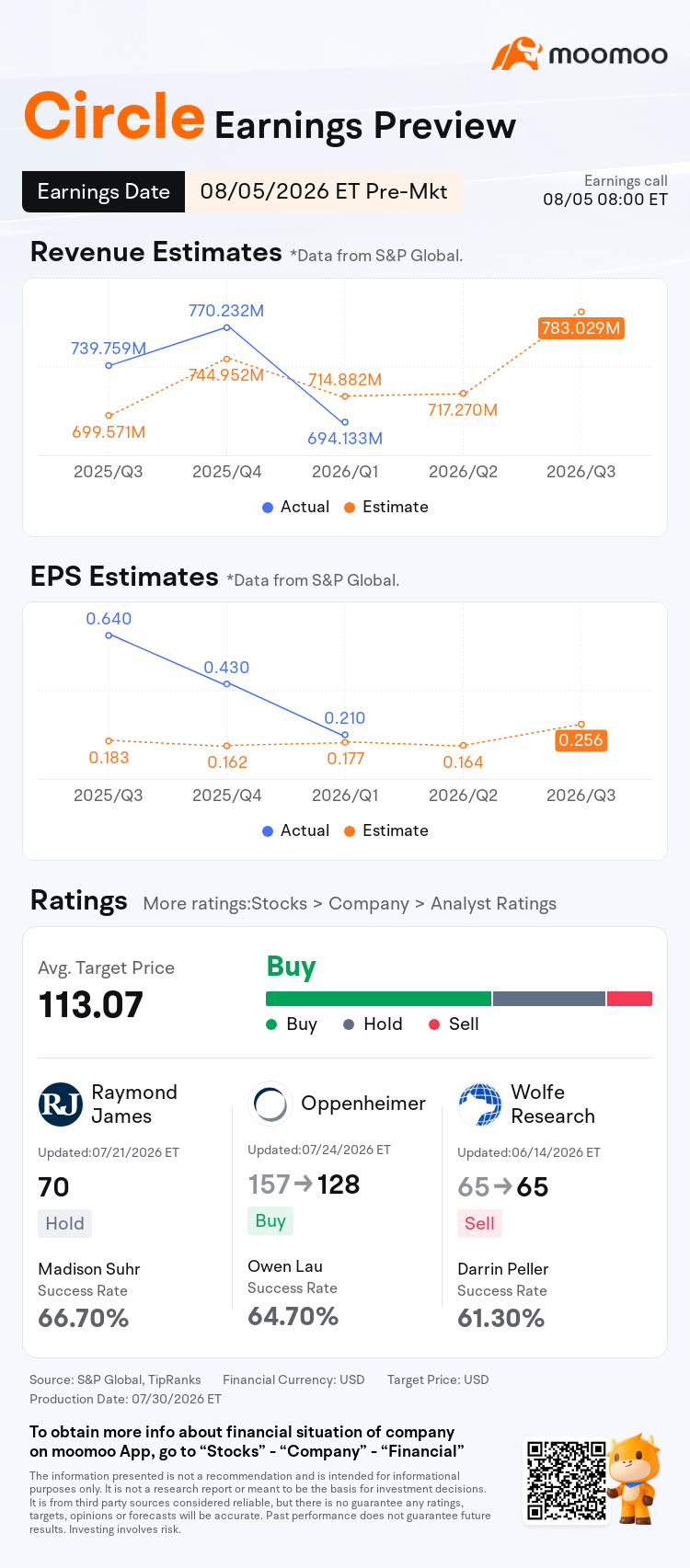
$Circle (CRCL.US)$ will report second-quarter 2026 results before the market open on August 5, with a management call at 8:00 AM ET. The report arrives at a critical juncture. Its first revenue miss as a public company last quarter rattled investor confidence, analyst price targets span nearly $100 from bear to bull, and forward rate expectations threaten to complicate the outlook.
The Model: Elegant but Exposed
Circle's economics are anchored to a simple mechanism: issue USDC, hold reserves in short-dated Treasuries and repos, retain the interest. Unlike yield-bearing stablecoins, USDC carries no native yield at the holder level, though platforms such as $Coinbase (COIN.US)$ offer rewards and DeFi protocols provide additional earning avenues. What matters for equity investors is that reserve income flows overwhelmingly to Circle's income statement.
Circle’s core revenue model is relatively clear: it is essentially a function of stablecoin issuance and prevailing interest rates. The larger the USDC base, and the higher the yield on reserve assets, the stronger the revenue backdrop. That makes the top-line setup easier to frame than the earnings outcome.

The real uncertainty for Q2 lies below the revenue line. Partner distribution shares, transaction costs, operating expenses, and public-company costs will determine how much of that revenue converts into EPS. As a result, the market’s focus is likely to be less on the basic revenue mechanics and more on margin durability, cost discipline, and whether Circle can deliver operating leverage.
Over the longer term, the more important question is whether Circle can create new core revenue streams beyond reserve interest, reducing its dependence on short-term rates and Fed policy.
Fed funds futures currently price 50–75 basis points of easing by mid-2027, and Circle has disclosed that every 100 basis points of rate movement translates to roughly $400–500 million in annualized revenue impact.
That sensitivity explains why analyst targets span from Wolfe's $65 sell to Oppenheimer's $128 buy, and why the stock trades, in some respects, like a leveraged rate expression, sharing a macro dependency similar to what faces the broader $Invesco QQQ Trust (QQQ.US)$ complex, though more direct and mechanistic.
Q1 Context: Idiosyncratic or Structural?
First-quarter revenue missed consensus by approximately 3%, marking Circle's first shortfall since listing. Management attributed the miss to seasonal USDC circulation softness and renegotiated Coinbase revenue-sharing terms. The EPS beat cushioned the blow, but the stock drifted lower in subsequent sessions.
The bull case rests on regulatory tailwinds: MiCA and evolving U.S. stablecoin legislation structurally favor fully-compliant, transparently-reserved issuers. Bears counter that Tether's USDT still dominates market share while $PayPal (PYPL.US)$ 's PYUSD scales distribution, compressing Circle's growth runway.
Circulation: The Crypto Cycle Link
While rates dominate the narrative, USDC circulation (the other revenue lever) tracks broader digital asset activity. $Bitcoin (BTC.CC)$ and $Ethereum (ETH.CC)$ serve as rough proxies for ecosystem engagement: rising prices drive on-chain volumes, DeFi TVL, and dollar-settlement demand, all pulling USDC circulation higher. Q2 saw constructive crypto price action, suggesting a supportive backdrop. Whether this translated into average USDC above $45 billion, a threshold that would signal re-acceleration, is a key data point tomorrow.
Diversification: Arc and the Compute Connection
Circle's "Other Revenue" segment, encompassing CCTP fees, Circle Mint services, and programmable wallets, grows but remains subscale. The Arc blockchain, targeting institutional settlement for tokenized capital markets, represents the most substantive push toward durable fee income.
Notably, the infrastructure demands behind Arc and similar blockchain scaling projects continue to underpin demand for high-performance compute. $NVIDIA (NVDA.US)$ has cited this convergence of crypto and AI workloads on similar GPU and memory architectures as a sustained tailwind in recent earnings calls.
Evidence that fee-based revenue is compounding independently of rate assumptions would strengthen the case for a premium multiple. Absent that, the stock remains a quasi-fixed-income proxy.
Street Positioning
Consensus holds a Buy rating with a $113.07 mean target, but the distribution is more revealing than the average. Oppenheimer cut its target from $157 to $128 (Outperform) on SBC-related margin headwinds. Raymond James initiated at Hold/$70. Wolfe Research maintains Sell/$65, arguing Circle lacks pricing power.
For context, the $Roundhill Magnificent Seven ETF (MAGS.US)$ cohort ( $Amazon (AMZN.US)$ , $Alphabet-C (GOOG.US)$ , $Microsoft (MSFT.US)$ ) trades at 25–30x forward earnings with demonstrable recurring revenue visibility. Circle must convince the market it deserves a comparable multiple despite a revenue base that could contract in an easing cycle.
What to Watch
Key metrics beyond headline EPS: average Q2 USDC circulation; Coinbase revenue-share stabilization commentary; full-year guidance revisions; and Arc/CCTP v2 adoption data. A beat with constructive guidance likely re-rates shares toward the upper target range. A second consecutive miss risks a more fundamental valuation discussion about what investors should pay for rate-sensitive crypto infrastructure heading into a potential cutting cycle.
Results expected approximately 6:30 AM ET.

ข้อความสงวนสิทธิ์: Moomoo Technologies Inc. นำเสนอเนื้อหานี้เพื่อวัตถุประสงค์ในการให้ข้อมูลและการศึกษาเท่านั้นอ่านเพิ่มเติม


ความคิดเห็น (3)
เพื่อแสดงความคิดเห็น
31
4