Covered Calls: How to Earn Passive Income 2025

Key Takeaways:
- Covered calls let you earn extra money from stocks you own by selling call options, giving someone else the right to buy them at a specified strike price by a certain expiration date.
- This options strategy works best for stable stocks in calm markets, though big price drops can lead to losses.
- Moomoo MY's tools, like the Option Seller Dashboard, make setting up covered calls easy for beginners.
- Covered calls let you earn extra money from stocks you own by selling call options, giving someone else the right to buy them at a specified strike price by a certain expiration date.
- This options strategy works best for stable stocks in calm markets, though big price drops can lead to losses.
- Moomoo MY's tools, like the Option Seller Dashboard, make setting up covered calls easy for beginners.
Why is the Covered Call Ideal for Passive Income?
For many Malaysians, a passive income is a goal worth pursuing. While stocks and dividends are familiar ways to grow wealth, many investors also explore alternative strategies like short puts. There's another approach that lets you earn extra cash while holding shares — the covered call strategy.

Covered calls let you earn extra cash from stocks you own with little daily effort. You sell a call option on your shares and get paid a premium (cash) upfront. This income comes whether the stock price stays flat, rises a bit, or dips slightly. It's like renting out your stocks for extra money.

Here is why the covered call is ideal for passive income:
- Low effort: Set up the trade and monitor it occasionally, like checking the stock price or option expiration date to decide your next move.
- Extra income: You earn a premium from selling the call option, which is separate from any dividends the stock might pay (not all stocks pay dividends).
- Works in calm markets: Best when stock prices are stable or rise slowly.
How much passive income you can earn from covered calls will vary depending on the stock, market conditions, and the specific options contract you choose.
>> Accessible in Malaysia: Moomoo MY lets you trade US options with low fees.

What is a Covered Call?
A call option is a deal that lets someone else buy your shares at a set price (called the strike price) by a certain date (the expiration date). A covered call involves holding a long position in the underlying stock while selling a call option on those shares.
A covered call is when you:
1. Own at least 100 shares of a stock (one option contract covers 100 shares), which means you have a long position in the underlying
2. Sell a call option on those shares.
1. Own at least 100 shares of a stock (one option contract covers 100 shares), which means you have a long position in the underlying
2. Sell a call option on those shares.
It's like renting your shares. You own the stock (a long position in the underlying) and are selling a call option on the underlying asset, so someone pays you for the chance to buy it later.
Step-by-Step: How to Execute a Covered Call for Passive Income

A covered call involves owning at least 100 shares of a stock and selling one call option against those shares. The call option allows the buyer to purchase your shares at a specified strike price by the expiration date, and you collect a premium as passive income. This strategy suits investors seeking steady income while holding stocks, especially in flat or slightly bullish markets.
Scenario 1: Without the underlying stock
If you haven't owned the stock yet, you need to first purchase no fewer than 100 shares and then sell a call option, which is how you initiate a covered call.
Here's how to do it step-by-step:
1. Choose a Stock:
Select a stock you're comfortable owning, ideally one with stable price movement and high options liquidity for better premiums.
Look for stocks with moderate volatility to balance passive income potential and risk.
2. Research the Options Market:
Check the options chain for the stock to find call options with different strike prices and expiration dates.
Choose a strike price above the current stock price (out-of-the-money) for higher income potential and a lower chance of the option being exercised.
Select an expiration date (e.g., 1–3 months out) to balance premium size and flexibility.
3. Buy 100 Shares:
Purchase at least 100 shares of the stock through your brokerage account. Each call option contract typically covers 100 shares.
Ensure you have enough capital, as this is the foundation of the covered call strategy.
4. Sell a Call Option:
Sell one call option contract against your 100 shares. This generates an immediate premium, which is your passive income.
For example, if the premium is $2 per share, you'll receive $200 (100 shares x $2) minus fees.
5. Monitor the Trade:
Track the stock price as it approaches the expiration date. If the stock price stays below the strike price, the option expires worthless, and you keep the premium and shares.
If the stock price exceeds the strike price, your shares may be called away, but you still keep the premium.
6. Repeat for Ongoing Income:
If the option expires worthless, sell another call option to generate more passive income. This can be repeated monthly or as desired.
On Moomoo MY simplify the process for scenario 1:
Method 1: Options Chain:
1. Open the Moomoo MY app and navigate to the stock's Options Chain.
2. Go to the Strategy tab and select “Covered Stock.”
3. The platform automatically buys 100 shares and sells one call option in one step, streamlining the process.
Method 2: Option Seller Dashboard:
1. Access the Option Seller Dashboard, which lists covered call opportunities with details like premiums and expiration dates
2. Choose a stock and option, then execute the trade. The platform handles buying shares and selling the call.
3. Visual tools display premium amounts and probabilities to aid decision-making.
Method 1: Options Chain:
1. Open the Moomoo MY app and navigate to the stock's Options Chain.
2. Go to the Strategy tab and select “Covered Stock.”
3. The platform automatically buys 100 shares and sells one call option in one step, streamlining the process.
Method 2: Option Seller Dashboard:
1. Access the Option Seller Dashboard, which lists covered call opportunities with details like premiums and expiration dates
2. Choose a stock and option, then execute the trade. The platform handles buying shares and selling the call.
3. Visual tools display premium amounts and probabilities to aid decision-making.
Scenario 2: Already own the underlying stock
If you already own at least 100 shares of a stock, the process is simpler since you don't need to buy shares.
1. Select the Stock:
Choose a stock you already own with at least 100 shares. Ensure it has an active options market for better premium opportunities.
2. Analyze the Options Chain:
Review the options chain to find a call option with a strike price and expiration date that suits your goals.
Out-of-the-money options (strike price above the current stock price) are often preferred for passive income, as they're less likely to be exercised.
3. Sell a Call Option:
Sell one call option contract against your 100 shares. The premium is credited to your account immediately, providing passive income.
For example, a $1.50 premium per share yields $150 for one contract.
4. Manage the Position:
If the stock price remains below the strike price, the option expires worthless, and you retain your shares and premium.
If the stock price exceeds the strike price, your shares may be sold, but you keep the premium and any profit up to the strike price.
5. Repeat the Process:
After the option expires or is exercised, sell another call option to continue generating passive income.
On Moomoo MY simplify the process for scenario 2:
1. Open the app and go to the Options Chain for your stock.
2. Tap the Strategy tab and select “Single Options” to sell a call.
3. The platform links your existing shares to the call option, creating a covered call seamlessly
1. Open the app and go to the Options Chain for your stock.
2. Tap the Strategy tab and select “Single Options” to sell a call.
3. The platform links your existing shares to the call option, creating a covered call seamlessly
When to Use a Covered Call?
Try covered calls when:
You own a stock you think will stay calm or rise a bit.
You want extra money on top of dividends.
You're okay selling your shares at a higher price if the stock goes up.
The market is steady or slightly higher.
Don't use them if:
You expect the stock to jump a lot (gains are capped at the strike price).
You think the stock will drop a lot (premium won't cover big losses).
Applying the Covered Call Strategy for Passive Income
Covered calls let you earn more from stocks you already own by selling call options. This options strategy can be used in three main ways: to generate steady income, to set a target selling price for your shares, or to provide limited protection against small losses.
1. Earning extra income
Covered calls are widely used to create additional income from long-term holdings. You sell call options against your stock, collecting premiums that act as instant income. If the stock stays below the strike price at expiration, the option expires worthless and you keep both the premium and your shares. If the stock rises above the strike, your shares may be sold, but you still keep the premium and any gains up to the strike price.
How to earn passive income with covered call strategy:
Use moomoo's Option Seller Dashboard to find call options with premiums and expiration dates that suit your goals.
Choose near-term, out-of-the-money calls (e.g., 30-45 days, strike 5-10% above current price) to increase the chance of keeping your shares while earning a premium.
If you expect the stock price to stay flat or dip slightly, select at-the-money (strike near current price) or slightly in-the-money calls for higher premiums, but the closer the stock price is to or above the strike, the higher the chance your shares will be sold if the option is assigned at expiration.
If the stock price is above the strike at expiration and the option is assigned, you sell your shares at the strike price, keeping the premium and any gains up to the strike.
If the stock price stays below the strike at expiration, the option expires worthless, so you keep your shares and premium, then decide whether to sell another call option.
2. Exiting at a Target Profit Price
This strategy is also used as a planned exit tool. By selecting a strike price that matches the level you are happy to sell at, you set a target profit point while still collecting a premium. If the option is assigned, your stock is sold at the strike price plus you keep the option income; if not, the option expires worthless and you can sell another call.
How to exit at a target profit price:
Sell calls at a strike price where you are comfortable selling your shares.
Use analyst price targets or your own valuation to select the strike.
If assigned, you sell the shares at the strike price, keeping both the premium and gains.
If not assigned, you retain your shares and premium, and can write another option.
3. A Limited Hedge on Risk
Although covered calls do not provide complete downside protection, the premiums earned reduce your breakeven point, offering partial risk reduction. This cushions small declines but cannot eliminate large losses if the stock falls significantly.
How:
Selling calls lowers your breakeven (e.g., $100 stock – $5 premium = $95 breakeven).
If assigned, your shares are sold at the strike price, and you keep the premium plus gains up to that level.
If not assigned, the option expires worthless, the premium cushions small losses, and you may sell another call.
Sharp price declines still cause losses, though reduced by the premium amount.
Case Study: Passive Income Success Stories with Covered Calls
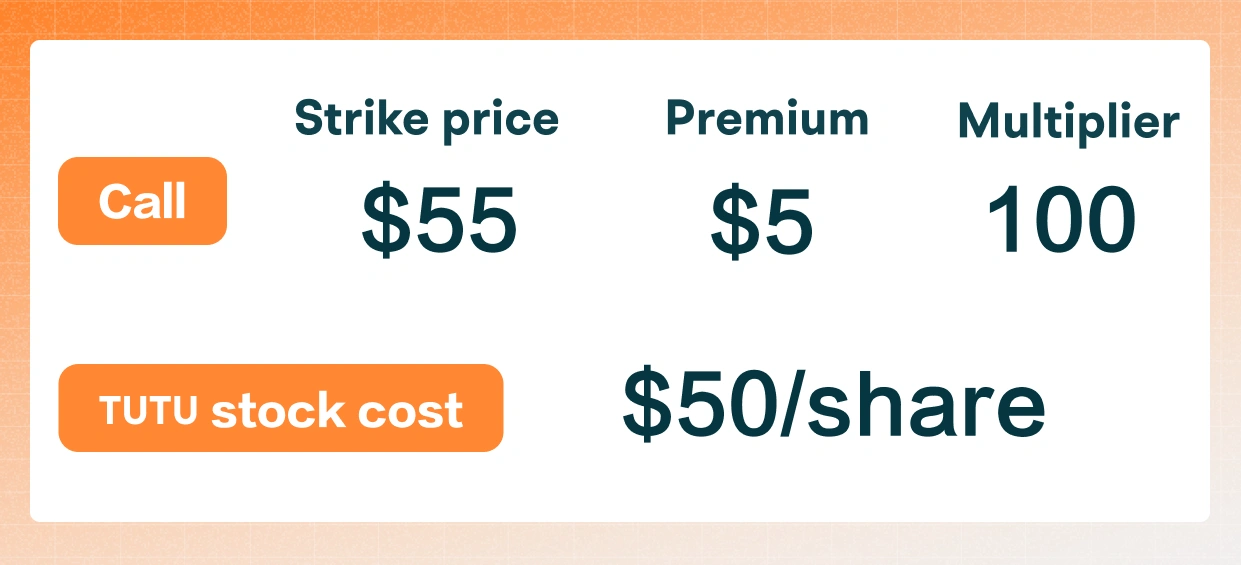
Let's use a made-up stock called TUTU to show how covered calls work. You believe TUTU is a good company for the long term, but its price might stay steady in the short-term due to market conditions. Setup:
Stock: TUTU (fictional for this example).
Cost: You buy 100 shares at $50 each, totaling $5,000.
Action: Sell one call option with a $55 strike price, earning a $5 premium per share ($500 total).
Note: Owning the shares means no extra margin is needed to sell the call.
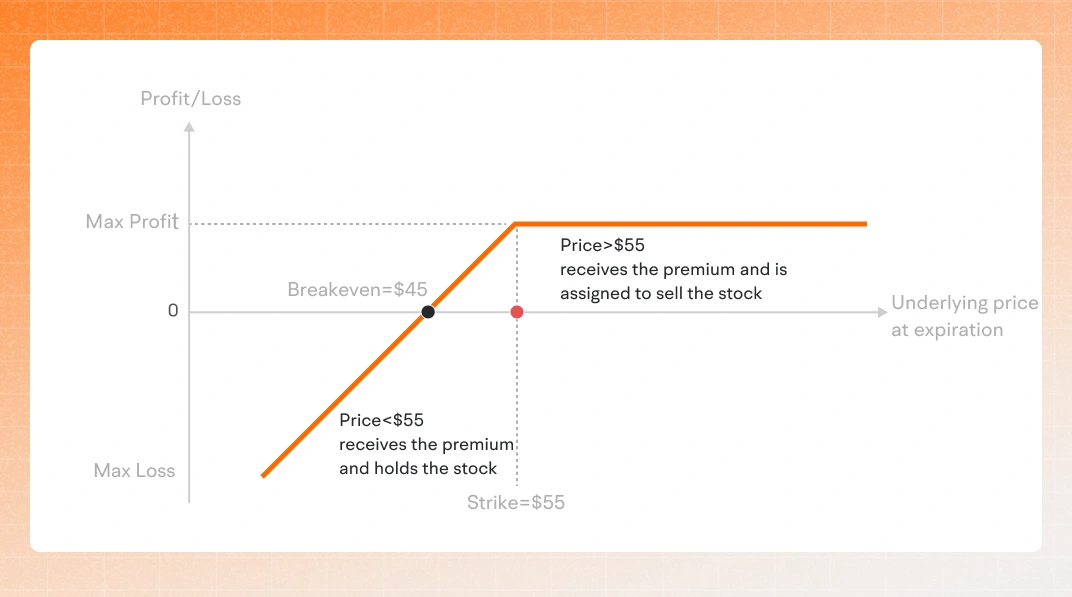
Scenario | Stock Price Movement | Option Status | What Happens | Outcome |
Stock rises above $55 | Price > $55 | In-the-money (ITM) | You sell your shares at $55 (obligation). | Premium kept: $500 Stock gain: $500 Total profit = $1,000 (max profit) |
Stock stays below $55 | Price ≤ $55 | Out-of-the-money (OTM) | Option expires worthless, you keep your shares. | Premium kept: $500- Breakeven: $45/share Max loss: $4,500 ($5,000 cost – $500 premium) Small drops cushioned by premium |
Features of the Covered Call Strategy
The covered call is a strategy that balances income potential with risk management. However, this approach also comes with certain trade-offs, such as capped upside and continued exposure to stock declines. To understand whether this strategy suits your outlook, it's important to look at its key features:
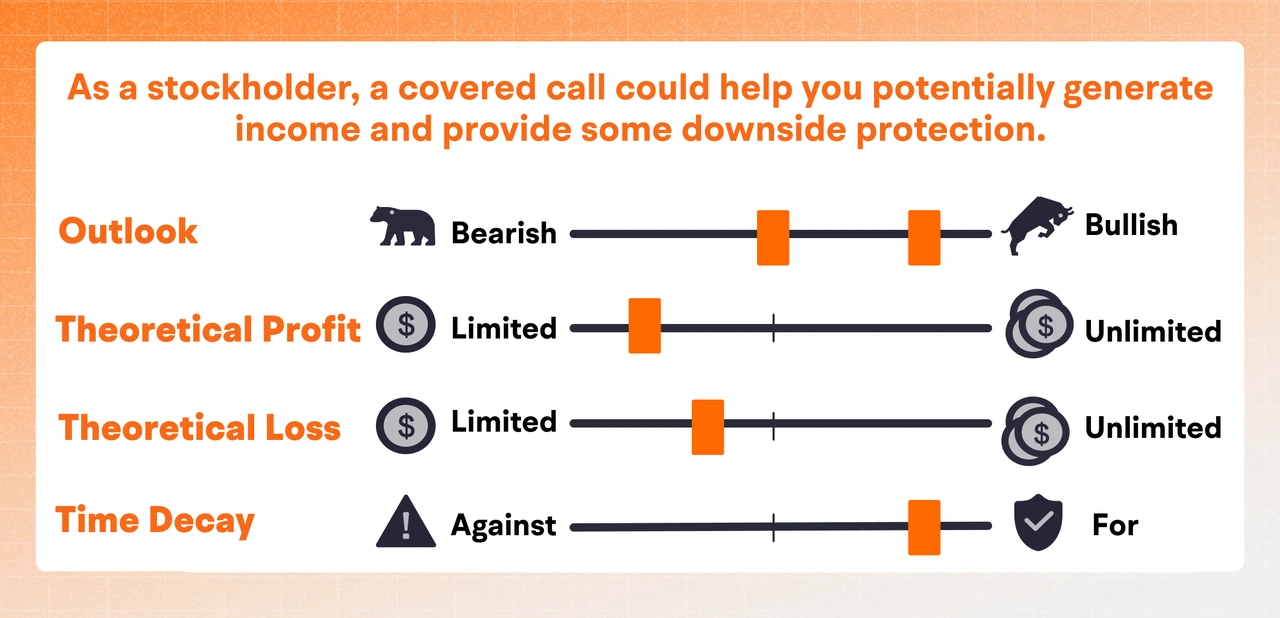
Ideal Conditions: Works best in low to medium volatility markets when you have a neutral to mildly bullish outlook on the stock.
Capped Profit: Maximum profit is limited. If the stock price rises above the strike price, you may be required to sell your shares, missing out on further upside gains.
Limited Loss: Losses are reduced but not eliminated. Since you own the stock, you're still exposed to downside risk. If the stock falls to zero, the entire investment in the shares is lost, offset only slightly by the premium received.
Time Decay Advantage: As the option seller, time decay (theta) works in your favor, since the option loses value as expiration approaches.
Advantages and Disadvantages of Covered Calls
Like any strategy, covered calls have both strengths and trade-offs. They can generate a steady income, but also come with limits on upside and risks on the downside. Here are the key advantages and disadvantages:
Advantages | Disadvantages |
Earn extra money from premiums when you sell call options. | Gains are limited if the stock price rises far above the strike price. |
Premiums reduce the stock's cost, helping with small price drops. | Need to own 100 shares per call sold, which ties up money. |
Works well in calm or slightly up markets. | Premiums don't protect against big stock price drops. |
Safer than selling options without owning the shares. | If the stock soars, you miss out on extra profits above the strike. |
Trade Covered Call with Moomoo MY for Passive Income
Moomoo MY offers tools to make covered calls easy for beginners:
Option Seller Dashboard: Shows a list of covered call opportunities with details like premiums, strike prices, and expiration dates. It includes visuals, such as premium amounts and the chance the option expires worthless, to help you choose stocks and calls. Useful for picking a stock if you don't own one yet or checking a company suggested by the dashboard.
12 Option Strategies with Custom: Provides 12 strategies with custom, including covered calls, that you can adjust to fit your needs. This helps you set up covered calls or try related strategies.
Analyst Rating: Shows expert price targets (low, average, high) to help you pick a stock or decide on a strike price for your call option.
Morningstar Research: Offers detailed reports on stocks, including ratings, estimated value, and company health. It also has “Bull” and “Bear” views to show different perspectives. You can tap to read the full report, making it easier to check if a stock is good for covered calls, whether you own it or are choosing a new one.
Comparison: Covered Calls vs. Other Investment Strategies
When it comes to generating passive income, investors have several strategies to choose from. Covered calls stand out as a flexible way to earn extra income from the stock you already own, but how do they compare to other popular options?
Dividend stocks are a classic choice for those seeking regular income from their investments. By holding shares in companies that pay dividends, you can receive payouts on your holdings, but the amount and frequency depend on the company's performance and dividend policy.
Real estate investment trusts (REITs) offer another way to earn income from real estate without the hassle of managing properties. REITs pay out a portion of their rental income to shareholders, providing a steady stream of income from the real estate market.
Peer-to-peer lending is a more modern approach, allowing you to lend money directly to individuals or businesses and earn interest on your capital. While this can offer attractive returns, it also comes with higher risk if borrowers default.
A covered call is unique because it lets you generate immediate income by selling call options on the stock you already own. You collect the premium upfront, which can boost your returns regardless of whether the stock price moves a lot. However, if the stock price rises above the strike price, you may be required to sell your shares at that price, potentially limiting your upside.
To start, consider your goals: if you want to earn a regular income from your investments, covered calls can be a great way to supplement dividends or REIT payouts. Just remember, each strategy has its own risks and rewards, so it's important to choose the one that fits your needs and comfort level.
Tips for Successful Covered Call Implementation
To make the most of a covered call strategy and generate reliable passive income, it's important to follow a few key steps. First, you need to select the right stock—look for companies with a stable stock price and a solid track record, ideally those that also pay dividends. This helps ensure your investment is less likely to experience sudden drops.
Next, carefully choose the strike price for the call option. You want to set the strike price slightly above the current stock price, so you can earn a premium while still leaving room for some capital gains if the stock rises. The right strike price balances your desire to keep the stock with your goal to earn extra income.
Pay attention to the expiration date of the option. Longer expiration dates usually mean higher premiums, but they also tie up your shares for a longer period. Consider your investment timeline and how often you want to generate income from covered calls.
It's also wise to monitor the stock's volatility. Higher volatility can increase the premium you receive, but it also raises the chance that the option will be exercised and you'll have to sell your shares. By keeping an eye on these factors and adjusting your strategy as needed, you can use covered calls to earn steady passive income and make the most of your investments.
FAQs on Covered Calls and Passive Income
How does a covered call work?
You get a premium (cash) when you sell the call, in exchange for granting the buyer the rights of the call, which allows them to buy your shares at the strike price.
If the price of the underlying stock stays below the strike price, the option ends, and you keep your shares and the premium.
If the price of the underlying stock goes above the strike price, your shares might be sold at that price. You keep the premium and any gains up to the strike price.
Is a covered call bullish or bearish?
It's mildly bullish to neutral. You make money if the stock price goes up a little or stays flat, keeping the premium and your shares. If the stock jumps a lot, you can sell a call at a higher strike price for a bigger premium and profit, but your shares may be sold, and gains are capped at the strike price. If the stock drops and the option expires worthless, you keep the premium and shares and can sell another call. Big drops can lead to losses.
If stock surges and the sold call shows significant unrealized loss, will I still receive the option premium?
Yes, you get the premium when you sell the call option, and you keep it whether the option expires or is exercised at expiration. If the stock price surges, your account might show a paper loss on the call option because its value rises, but this is offset by the gain in your stock's value. If the option is exercised at expiration, you sell your shares at the strike price and keep the premium. You can check the premium in your Moomoo MY account under “Funds Details.”
Which stocks should I choose for a covered call strategy?
Choose stocks or ETFs that are stable and don't have big price swings, where you expect steady or slightly rising prices. Stocks with lots of ups and downs can lead to bigger losses or limit your gains if the price soars. Covered calls work best for long-term investors. Use Moomoo MY's tools, like the Option Seller Dashboard or Morningstar Research, to find suitable stocks or ETFs.
What are the common mistakes to avoid when executing covered calls?
Covered calls can be a great way to generate passive income, but there are some common pitfalls to watch out for. One mistake is not fully understanding the risks—if the stock price rises sharply, you might have to sell your shares at the strike price, missing out on bigger gains. It's important to be comfortable with this trade-off before you sell a call option.
Another error is failing to keep track of the stock price and the option's expiration date. If the stock moves unexpectedly, the option could be exercised, and you might be forced to sell your shares at a less-than-ideal time.
Overwriting calls—selling too many call options or doing so too frequently—can also backfire, especially if the stock price drops. This can lead to larger losses than you anticipated. Additionally, not adjusting your strategy when market conditions change can hurt your returns. Covered calls can be a way to generate income, but you need to stay alert and flexible.
By avoiding these mistakes and staying informed about your investments, you can use covered calls to build a reliable stream of passive income and make the most of your stock holdings.
What is the potential for long-term growth when using covered calls?
While covered calls are often used to generate immediate income, they can also play a role in building long-term growth. By combining covered calls with other investment strategies, such as holding dividend-paying stocks or investing in real estate investment trusts, you can create a portfolio that delivers both income and capital appreciation over time.
For example, you can use covered calls to generate income from stocks that regularly pay dividends. The combination of dividend payments and option premiums can boost your total returns and help your investment grow steadily. Similarly, using covered calls on REITs allows you to earn income from real estate while still benefiting from potential property value appreciation.
Over time, the income from covered calls, along with dividends or real estate gains, can compound and contribute to your long-term financial goals. By thoughtfully integrating covered calls with other strategies, you can build a portfolio that not only generates passive income but also has the potential for significant growth in the years ahead.
Conclusion: Earn Passive Income with Covered Calls

Covered calls are a practical way for investors to turn their stock holdings into a source of regular income. By collecting premiums, you can supplement returns while holding onto your shares, making this strategy especially appealing for Malaysians looking for passive income opportunities. With Moomoo's tools, such as the Option Seller Dashboard and Analyst Ratings, it's easy to find suitable strikes, set up trades, and track results.
That said, covered calls are not risk-free. Premiums only offer limited protection, so large price drops can still lead to losses, and if the stock rises far above the strike, your profit is capped. This means covered calls work best in stable or slightly bullish markets where you don't expect extreme price swings. When used thoughtfully, they can be an effective strategy to balance income generation with manageable risk.

This presentation is for informational and educational use only and is not a recommendation or endorsement of any particular investment or investment strategy. Investment information provided in this content is general in nature, strictly for illustrative purposes, and may not be appropriate for all investors. Read more