
Why Hyperscalers May Win the Next Phase of AI
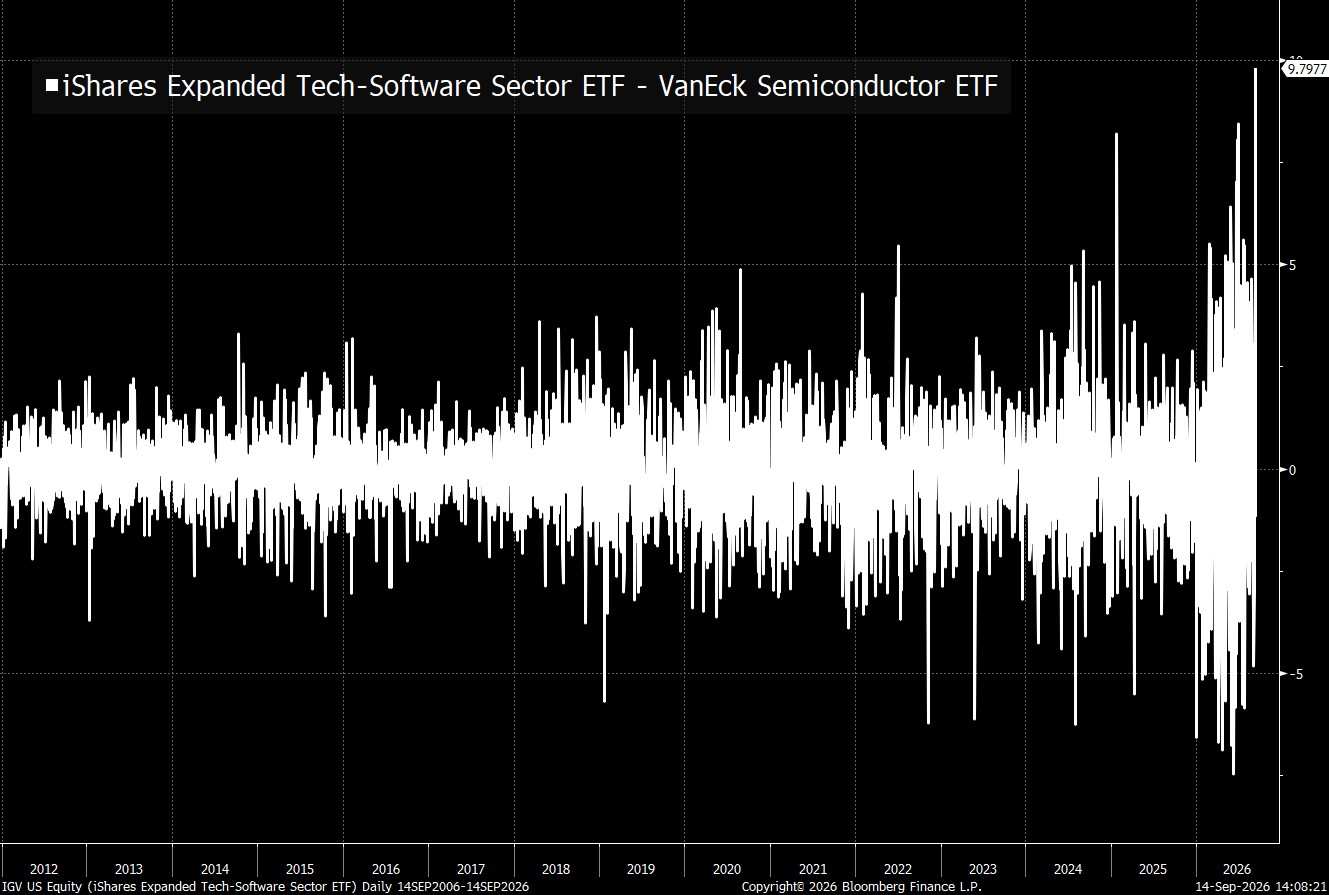
Semiconductors fell about 6%, while software/internet gained roughly 3%, pushing the one-day Semis-vs.-Software spread close to 10 percentage points. Optics, memory and neoclouds were hit hardest, while large platforms held up better.

A Frontier Slowdown Hits the Growth Slope, Not AI Demand
The current discussion is not a call to stop training models or slash AI CapEx.
Bernstein notes that the proposals center on safety standards, independent review and coordination rather than halting model development. Near term, some GPU capacity could simply shift toward alignment, monitoring and evaluation rather than disappear. TMTB likewise argues that the immediate compute impact may be modest.
The real risk sits further out.
If major model releases become less frequent, the market may lower assumptions for AI-lab ARR growth and, in turn, the slope of future inference demand. That matters most for the highest-beta parts of the infrastructure chain — GPUs, optics, HBM and neocloud capacity built around ever-larger training clusters.
But a slower frontier does not mean enterprises stop deploying AI.
They may simply use more existing models, smaller models, open models or private models for workloads that do not require the absolute frontier.
Hyperscalers Have Both Hardware Upside and Software Stickiness
AWS, Azure, GCP, and Meta are not just sellers of GPUs. They control much of the stack around the model:
compute → networking → storage → databases → security → developer tools → enterprise distribution.
If frontier models keep improving quickly, they capture the infrastructure spend.
If model progress slows or enterprises diversify toward open, private or first-party models, the workload can still remain on the same cloud platform.
And if models become cheaper and more interchangeable, value may migrate upward toward the data, software and customer relationships around them — exactly where hyperscalers are strongest.
That is why the advantage is broader than pure compute exposure.
Barclays’ Numbers Show the Toll-Road Economics
Barclays recently quantified how much AI-lab economics already flow through hyperscalers.
For every $100 of AI-lab revenue in 2026, it estimates roughly:
$35–40 goes to hyperscalers
producing around:
$10–20 of operating income
at approximately:
35%–45% operating margins.
That is not just GPU rental. It includes inference compute, cloud infrastructure, distribution fees and, in some cases, strategic revenue sharing.

Barclays estimates AI-lab revenue at roughly $137 billion in 2026, versus around $124 billion of hyperscaler AI revenue. By 2028, hyperscaler AI revenue could reach $502 billion — more than 4x the 2026 level — even as its share of AI-lab revenue falls from about 90% to 73%.
Disclaimer: Moomoo Technologies Inc. is providing this content for information and educational use only.Read more


Comments (2)
to post a comment
22
12