Broadcom Beats Q3 as AI Revenue Soars 221%, but Soft Q4 Guide Weighs

Weekly Setup | Jackson Hole Pulled the Pin. Earnings and Payrolls Decide the Fallout
Two clocks defined last week. $NVIDIA (NVDA.US)$ reset the AI supply chain with a FY28 framework nobody expected; Warsh reset the rate path with a Jackson Hole tone nobody wanted. $S&P 500 Index (.SPX.US)$ closed up 0.49% and $Nasdaq (NDAQ.US)$ up 0.43% on the week, but $PHLX Semiconductor Index (.SOX.US)$ s fell 2.20% and $Russell 2000 Index (.RUT.US)$ 1.57%. September hike odds sit at 50/50. This week's question: does the supply chain narrative extend beyond a single name, and do payrolls give Warsh permission to move?
The Data That Makes or Breaks September
The data window is compressed. Between Jackson Hole and the September FOMC, only one CPI print lands, which raises the bar for any move. This week's cascade (JOLTS, ADP, ISM services, then August payrolls Friday) either confirms soft-landing stabilization or signals a second leg of labor weakness. Consensus sits around 58K nonfarm payrolls and 4.1% unemployment, against July's shocking 23K contraction. A second consecutive miss locks in a September hold and re-opens cut pricing; an upside surprise keeps the hike case live and validates Warsh's asymmetry.
Geopolitics has shifted from noise to variable. Direct US-Iran exchanges near the Strait of Hormuz over the weekend re-introduce an inflation risk premium and could feed back into the very energy and shipping components Warsh claims to be watching. Oil's reaction will tell whether the trade is about growth demand or risk premia.
Warsh's Asymmetric Trap
Warsh's Jackson Hole message was unequivocal: inflation must move toward target clearly, and at sufficient speed. September hike odds jumped from 36% pre-speech to roughly 60% intraday before settling at 50/50. His bar is asymmetric. With only one CPI left before the meeting, he has set a threshold he has almost no time to clear, yet markets cannot dismiss his willingness to act.
The buy-side consensus is counterintuitive: a single September hike may be less disruptive than continued hesitation. Growth-driven tightening cycles historically do not break equity valuations. Supply-driven one-offs typically produce brief selloffs followed by recoveries within 1 to 1.5 months. The danger, desks argue, is inaction. A third hold after hawkish rhetoric would hand markets a credibility event, forcing long-end yields higher with no clean exit. BofA's structural read is blunter: until $U.S. 30-Year Treasury Bonds Yield (US30Y.BD)$ breaks below 5.0%, $Roundhill Magnificent Seven ETF (MAGS.US)$ and semis underperform $The Health Care Select Sector SPDR® Fund (XLV.US)$ and $Financial Select Sector SPDR Fund (XLF.US)$ . The 30-year sits at 5.3-5.4%. Warsh needs a bull flattening, with credible short-end hawkishness paired with long-end relief, to re-open risk appetite.
The Supply Chain Relay Passes to Broadcom
$NVIDIA (NVDA.US)$'s print reset expectations, but the forward question matters more than the quarter. Management guided 70% YoY FY28 revenue growth against 40% sell-side consensus, Rubin mass production began in August, and gross-margin compression to 71-72% was framed as active de-risking rather than degradation. The strategic pivot toward open-source AI platform infrastructure, including the Hugging Face acquisition, extends the moat beyond silicon. What remains unresolved is whether demand concentrates at NVIDIA or distributes across the ecosystem.
$Broadcom (AVGO.US)$ Wednesday becomes the relay pass. Street consensus sits near 29.4 billion in revenue with AI revenue at 16 billion, roughly 54% of the mix and up 200% YoY. A constructive guide with long visibility would graduate the thesis from one-stock event to systemic supply chain. $Dell Technologies (DELL.US)$ , $Hewlett Packard Enterprise (HPE.US)$ , and $Credo Technology (CRDO.US)$ Tuesday give the first read on AI-server backlog conversion and optical demand. Software's bottom is already locked in by institutional positioning. $MongoDB (MDB.US)$ , $Snowflake (SNOW.US)$ , $Palo Alto Networks (PANW.US)$ , $Zscaler (ZS.US)$ , and $DocuSign (DOCU.US)$ this week test AI monetization across data, security, and applications. Anthropic's IPO prospectus, expected around September 7 at a 2 trillion valuation, would anchor AI sector multiples for weeks.
Crypto: Bitcoin at the 80K Pivot
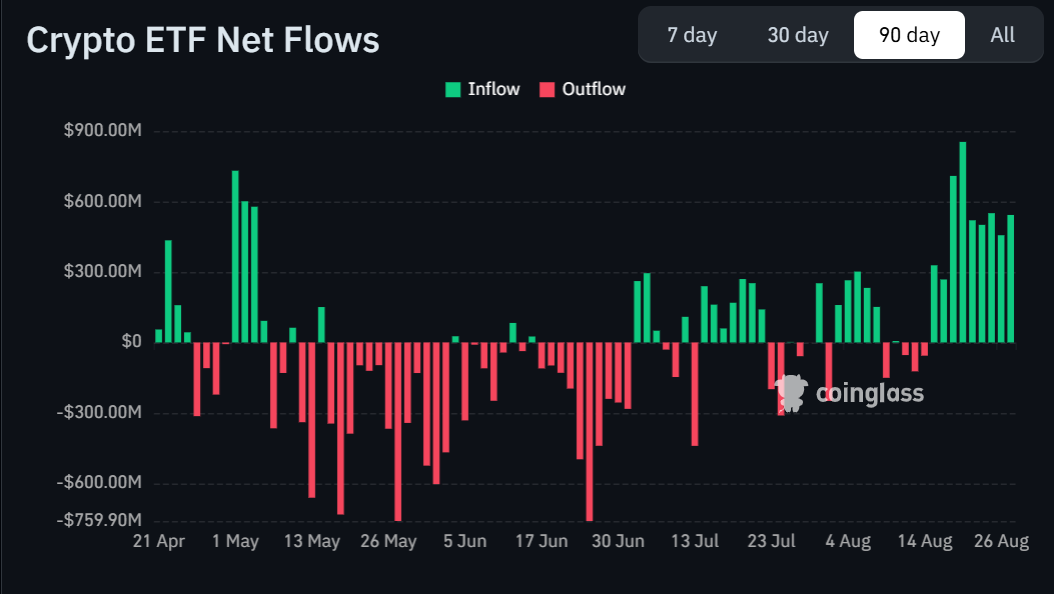
$Bitcoin (BTC.CC)$ consolidated near 79-80K after a roughly 9% weekly rally that touched 81,300. US spot ETFs saw nine consecutive sessions of inflows and Coinbase Premium turned positive for the first time since May. Support sits at 73-75K, the pivot at 80K, resistance at 84-86K. The September 15 CLARITY Act procedural vote is the next policy catalyst.

Your Navigation Guide
Two variables decide the week: Friday's August payrolls (the first clean read after July's shock) and Wednesday's Broadcom earnings (the test of whether NVIDIA's demand narrative extends downstream). Cross-asset vol sits at multi-week lows across equities, bonds, and FX even as the Trade Policy Uncertainty index prints fresh highs. $S&P 500 Index (.SPX.US)$ is pinned at 7711, with the 7700 call and put walls neutralizing dealer positioning; long-gamma exposure should suppress realized vol through Wednesday, leaving Thursday and Friday as the first real window for directional follow-through.
Two scenarios frame the positioning. First, near-end pressure: if seasonal weakness, FOMC uncertainty, and soft payrolls compound, defined-risk bear put spreads on $SPDR S&P 500 ETF (SPY.US)$, sized to expire before the September FOMC, capture downside without naked exposure. One-month 25-delta put/call skew near historic lows makes the structure unusually cost-effective. Second, catalyst breakout: if geopolitical risk eases and payrolls support the disinflation path, bull call spreads on $Invesco QQQ Trust (QQQ.US)$ extended through October-November capture the midterm election window with asymmetric upside as $Roundhill Magnificent Seven ETF (MAGS.US)$ leadership resumes. September FOMC carries the largest single-event expected move at roughly 1.11%.

$Broadcom (AVGO.US)$ 's setup deserves attention. The market is pricing a move of about 7.79% against an 8.17% historical average, reasonable but not generous. Post-earnings IV crush has averaged 8.52%, meaning straddle-style buyers will be fighting the vol collapse regardless of direction. Defined-risk spreads isolate the directional view without overpaying for volatility that compresses after the print.

The Setup
Tuesday after close: $Dell Technologies (DELL.US)$ , $Palo Alto Networks (PANW.US)$ , $Credo Technology (CRDO.US)$ , $MongoDB (MDB.US)$ . Wednesday after close: $Broadcom (AVGO.US)$ , $Snowflake (SNOW.US)$ . Friday pre-open: August payrolls. The week runs two parallel tracks: the AI supply chain's earnings cascade from hardware into software, and the macro data sequence that either gives Warsh permission to move or shelves September. Payrolls have the final word on both.
General ETF disclosure: Before investing in an ETF, you should read both its summary prospectus and its full prospectus, which provide detailed information on the ETF's investment objective, principal investment strategies, risks, costs, and historical performance (if any). You can find prospectuses on the websites of the financial firms that sponsor a particular ETF, as well as through your broker. Investment returns will fluctuate and are subject to market volatility, so that an investor's shares, when redeemed or sold, may be worth more or less than their original cost. ETFs are subject to market volatility and the risks of their underlying securities, which may include the risks associated with investing in smaller companies, international securities, commodities, fixed income, and more. An ETF may trade at a premium or discount to its net asset value (NAV).
Disclaimer: Moomoo Technologies Inc. is providing this content for information and educational use only.Read more


Comments (2)
to post a comment
32
7