

Weekend Read | The Teaser Period: Why the AI Boom Is Hitting a Reset Wall

Groundbreaker, August 2026
Think about the last time you signed a deal with a deferred payment. A 0% APR credit card for 18 months. A gym membership where the first two months are free. A mortgage that adjusts upward after three years. You knew the payment was coming. But while the teaser rate held, everything felt fine — the balance sheet looked healthy, the math was manageable, and the future was someone else's problem.
Now scale that logic to $2.3 trillion. And add a calendar that starts ticking in 2027.
Why the Numbers Look Great Right Now (And Why That's the Problem)
Here's what most people think when they see the AI infrastructure buildout: record revenue growth, booming backlogs, hyperscalers reporting strong earnings, AI startups raising at stratospheric valuations. The numbers confirm the thesis. Build more. Sign more. This is working.
But here's the thing about teaser periods — they structurally produce exactly this kind of data. That's not a coincidence. That's how they work.
When a cloud provider signs a $12 billion compute contract with an AI lab, they book it immediately as backlog. Revenue recognized: zero. Expense incurred by the buyer: zero. Cash moving between accounts: zero. What moves is sentiment. The seller announces secured demand. The buyer announces secured capacity. Investors read both press releases and conclude the market is healthy.

The payments are real. They're contractual. They're scheduled. They just aren't due yet. And when they come due — roughly $732 to $820 billion worth in 2027 alone — everything changes.
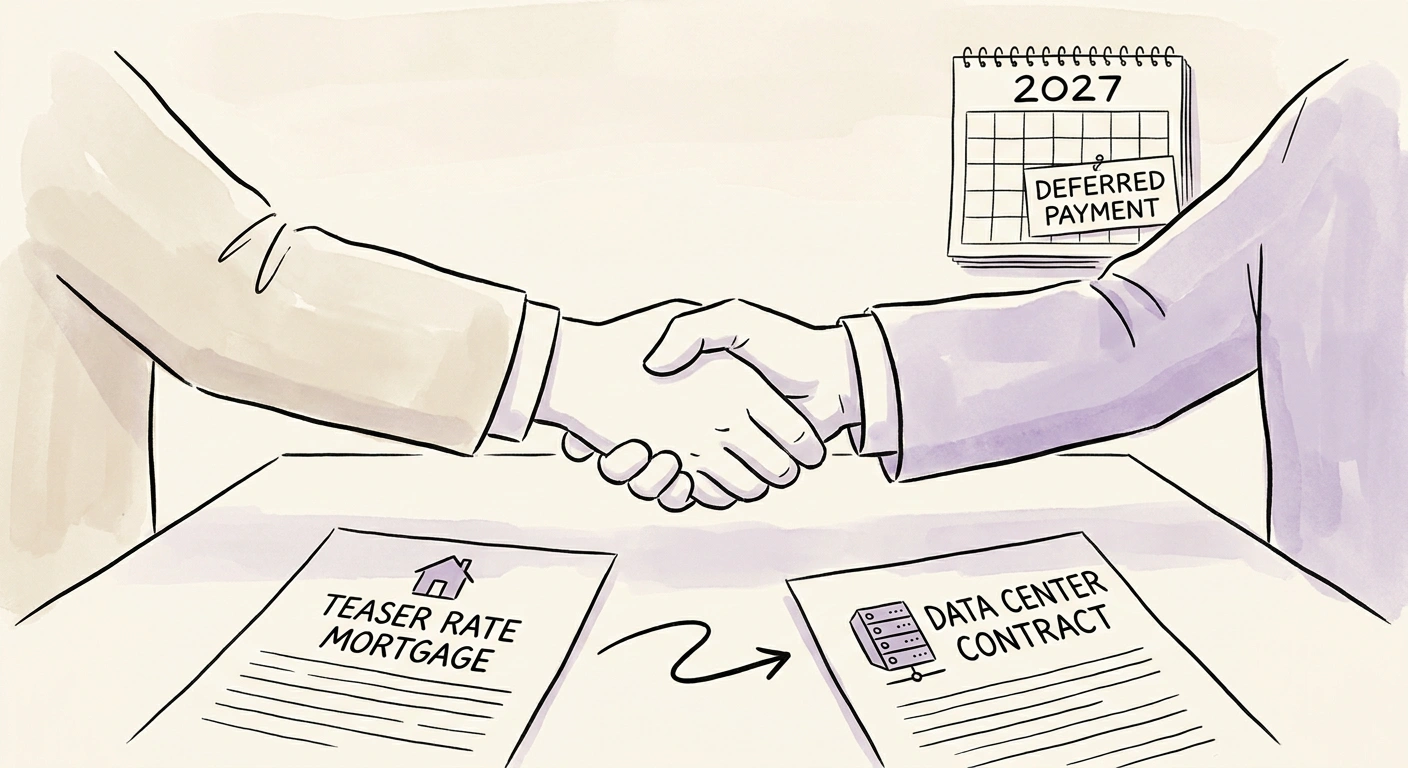
The take-or-pay contract structure mirrors subprime mortgage mechanics: obligations deferred, incent
What the Data Actually Shows
OpenAI's math doesn't close without heroic assumptions. Between June and December 2025, OpenAI signed approximately $1.2 trillion in compute commitments. It currently carries somewhere between $665 billion and $750 billion in non-cancellable obligations — meaning even if OpenAI wanted to walk away, it can't.
Under OpenAI's own internal projections, compute costs will peak at roughly 200% of revenue in 2027. Read that again. Not 20%. Not 80%. Two hundred percent. For every dollar OpenAI earns at the projected peak, it will owe two dollars just in compute costs, before you count salaries, offices, research, or anything else.
To survive through 2030 under management's own scenario, OpenAI needs approximately $400 to $500 billion in cumulative external funding. That's not a pessimistic read. That's the bull case.

The invisible leverage is enormous. Ask most analysts how leveraged the AI complex is, and they'll point to reported gross debt: roughly $470 billion. Manageable. Not alarming. But add the present value of take-or-pay commitments ($1.66 trillion) and total economic obligations reach $2.1 trillion — roughly comparable to the peak of subprime mortgage exposure in 2007.
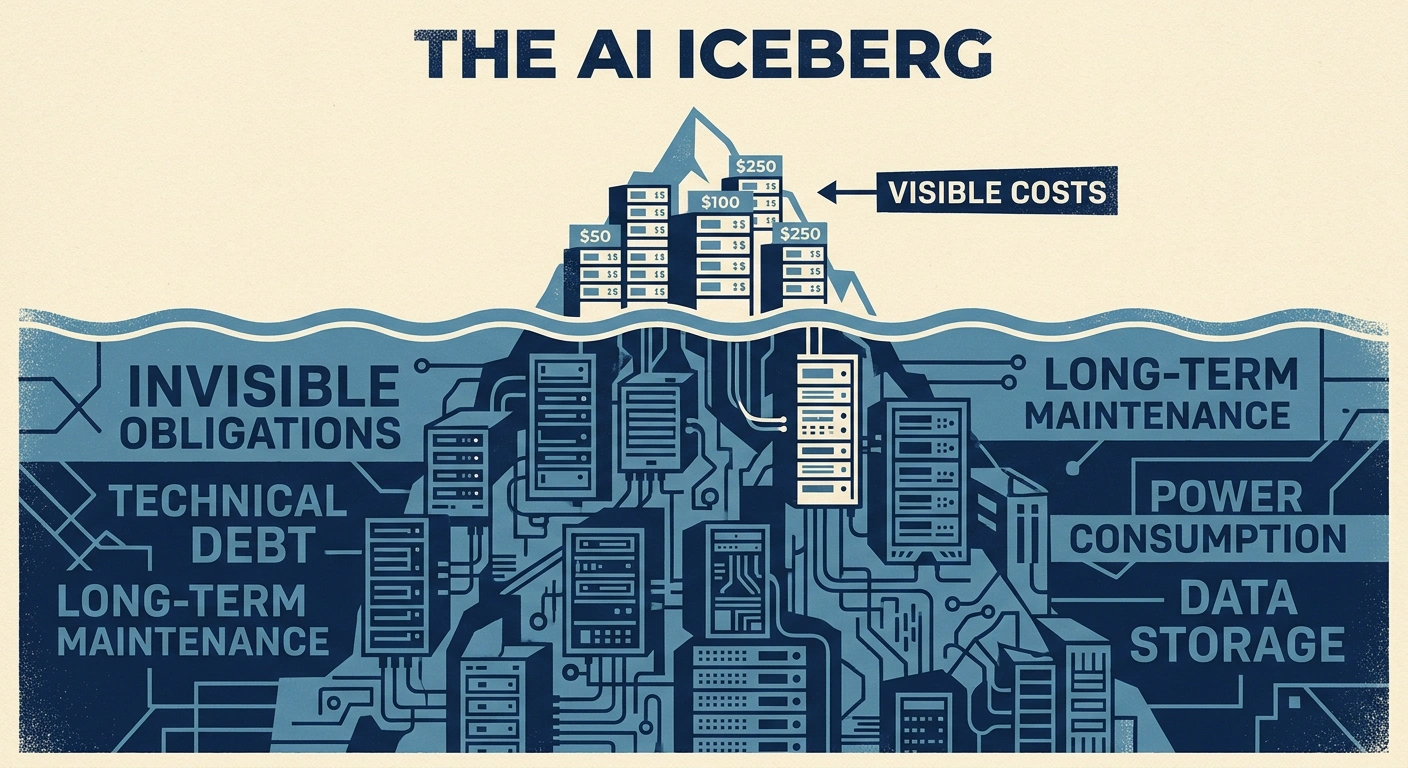
Reported debt of ~$470B is just the tip. The take-or-pay present value adds $1.66T below the waterli
How the Teaser Period Actually Works
Imagine you're a mortgage originator in 2005. You're writing 3/27 adjustable-rate mortgages: three years of a low teaser rate, then 27 years of a floating rate that resets to whatever the market demands. Your job is to originate volume. Your bonus is tied to originations. Every incentive you have points toward writing more mortgages, not toward asking whether the borrowers can handle year four.
Now imagine you're running a hyperscaler in 2025. You're signing 36-month take-or-pay contracts: no payments for 36 months while the data center is built, then the meter starts running. Every optical incentive points toward signing more contracts, not toward asking whether the counterparties can handle 2027. The mechanisms are different. The incentive structure is identical.
Think of it like planting a field of corn. You can photograph the seeds in the ground and call it a harvest. The data is accurate. The photograph is real. But the harvest is a future event that depends on rainfall you haven't received yet.
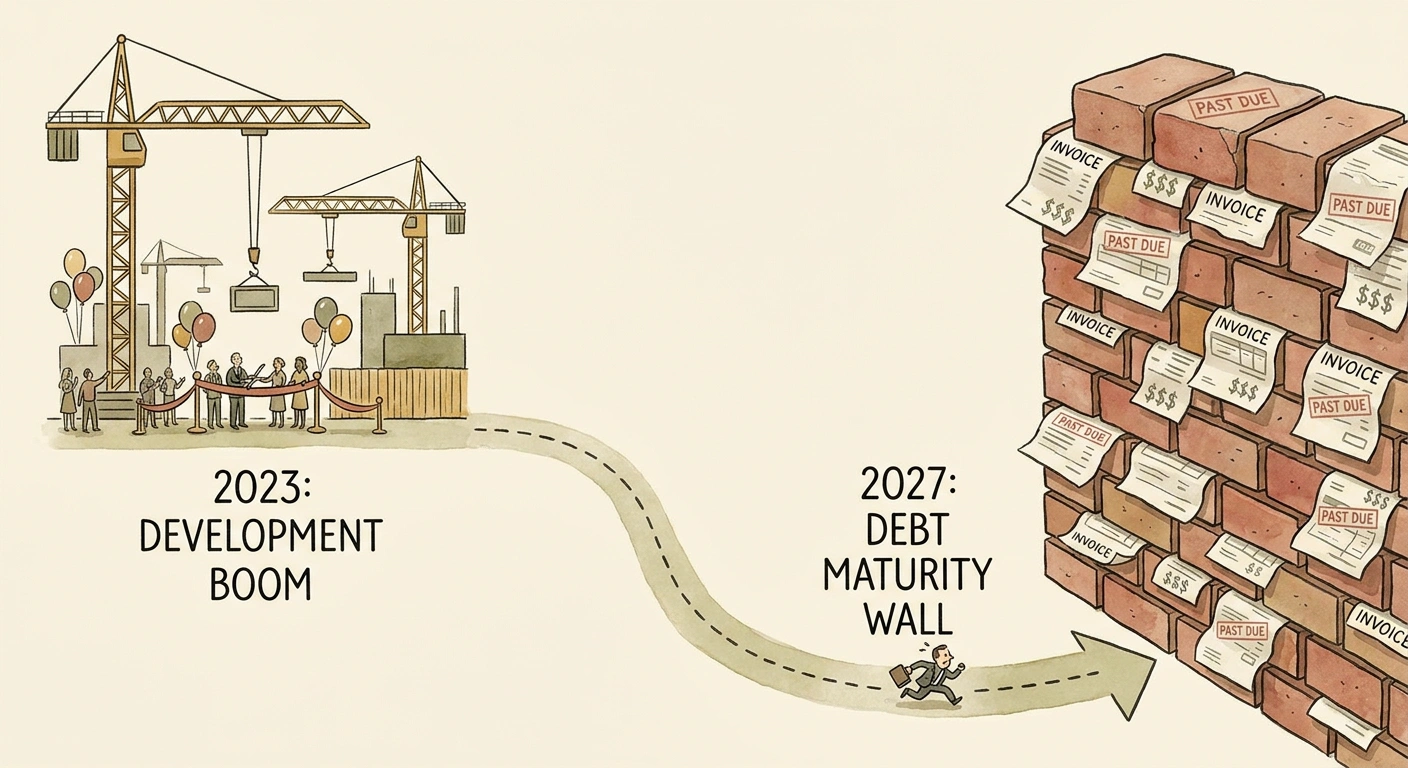
From construction phase euphoria to the 2027–2028 billing commencement wall — a contractual schedul
The Structural Problem Nobody Wants to Name
The teaser period has an epistemological problem baked in: it produces exactly the data that confirms the bull thesis. During a teaser phase, delinquencies are low by definition. In the AI context: of course hyperscalers are reporting strong earnings — deferred billings haven't hit yet. Of course AI labs are raising at high valuations — no expense is hitting their P&L while capacity is being built.

You don't need a pessimistic scenario for this to matter. You need demand to decelerate below the underwritten rate. Not collapse. Not crash. Just grow more slowly than the contracts assumed when they were signed. Fixed costs — depreciation, power, staffing — comprise roughly 80% of monthly data center expenses. A 30% drop in utilization can turn a profitable asset into an unprofitable one overnight.
What You Should Do Differently
Stop treating "AI exposure" as a monolithic positive. If you own index funds — and you probably do — you have substantial exposure to this reset dynamic whether you know it or not. AI-exposed stocks now represent 45% of S&P 500 market capitalization. The top ten companies account for 40% of the index's weight, versus 27% during the dot-com peak.
Distinguish between the AI labs and the hyperscalers — but understand the chain. Hyperscaler returns on AI infrastructure are entirely dependent on the AI labs making their payments. If OpenAI needed to renegotiate a material portion of its $1.2 trillion in commitments, the first amendment would reprice the entire $2.3 trillion asset class.
Watch the first renegotiation. It won't be called a default. It'll be called "strategic partnership restructuring" or "efficiency-linked pricing adjustments." And it reprices the whole sector's assumptions anyway.
The Honest Caveats
Here's where I'd push back on the most aggressive version of this argument. The AI revenue growth being projected isn't crazy. Enterprise AI adoption has been genuinely accelerating. If adoption materializes faster than contracts assumed, this reset becomes a bump rather than a crisis. The technology is real. The productivity gains are real.
Hyperscalers have diversified cash flows that can absorb underperformance longer than a monoculture lender could. The renegotiations, when they come, will be between parties with long-term strategic relationships. And this isn't a default forecast — it's a synchronization observation.
The One Thing to Remember
The 2008 mortgage crisis wasn't primarily a story about bad loans. It was a story about a structure — the teaser-rate mortgage — that was perfectly calibrated to produce confirming data during its construction phase and catastrophic data at its reset date.
The AI compute boom isn't primarily a story about bad technology. It's a story about a structure — the take-or-pay contract with deferred commencement — that is perfectly calibrated to produce confirming data during its construction phase. Record backlogs. Strong earnings. Booming valuations. All real. All reflecting the teaser period.

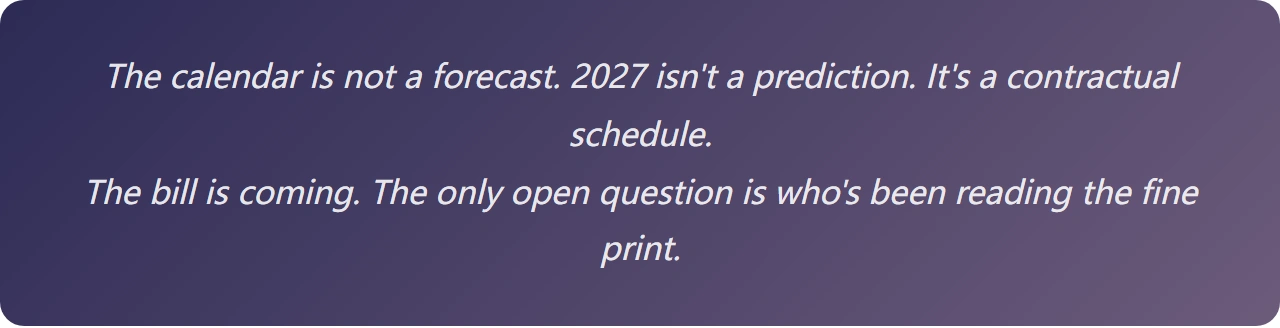
Source: Groundbreaker, "The Teaser Period" (August 20, 2026)
For informational purposes only. Not investment advice.
Disclaimer: Moomoo Technologies Inc. is providing this content for information and educational use only.Read more


Comments (13)
to post a comment
71
65