
Wall Street Targets S&P 500 as High as 8,100 — Can the Rally Hold in H2 2026?
The first half of 2026 has been a case of the U.S. equity market defying gravity. Even against a backdrop of Middle East geopolitical tension and lingering inflation concerns, the tape has shown remarkable resilience and upside momentum.
Year-to-date, the $S&P 500 Index (.SPX.US)$ is up roughly 8%, holding firmly above 7,400 and printing new all-time highs along the way.
The performance is not entirely surprising. Coming into the year, most Wall Street shops shared the same base case: an AI capex build-out, easier macro liquidity expectations, and a broadening in earnings growth would keep the uptrend intact.
Targets Ratcheted Higher — Top Call Now 8,100

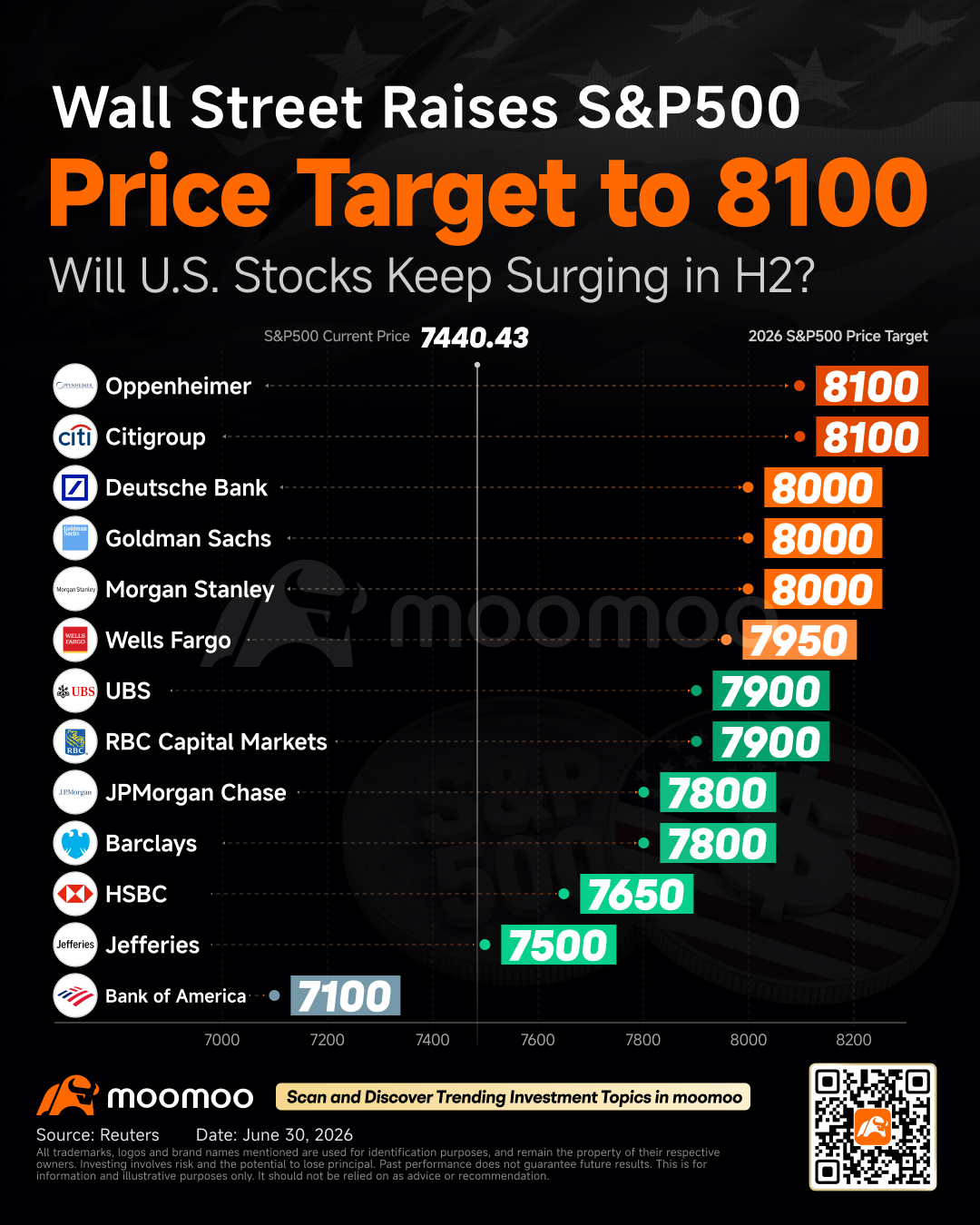
With earnings validating the bull case and macro risks partly receding, major Wall Street firms have used their mid-year outlooks to raise their year-end 2026 targets for the S&P 500. The bulk of current forecasts now cluster in the 7,500–8,000 range:
– Most bullish (8,100): Citigroup, Oppenheimer, and BCA Research all sit at the top of the range.
– Core bulls (8,000): Goldman Sachs, Deutsche Bank, and Morgan Stanley anchor at the 8,000 mark.
– Steady upgrades (7,500–7,950): Wells Fargo at 7,950, UBS and RBC at 7,900, JPMorgan and Barclays at 7,800, HSBC at 7,650, and Jefferies at 7,500.
– Defensive outlier (7,100): Bank of America is the most cautious among mainstream desks, with its technical strategy team flagging downside risk.
What's Driving It: Real Earnings + the AI "Supercycle"
The common thread behind the upgrades is straightforward — genuine earnings improvement, layered on top of an AI capex supercycle.
This leg higher isn't a pure multiple-expansion story. It's underwritten by real profit growth flowing through semiconductor and data center capex. Add in a temporary cooling of geopolitical risk and a recent pullback that reset sentiment from overheated back toward neutral, and the tape has the room to keep grinding higher.
Citi, Oppenheimer, and BCA Research are the most constructive. Citi argues the current expansion has moved beyond a normal business cycle and into a rare "capex supercycle," with the U.S. only at the mid-innings — leaving room for continued earnings upside. BCA is even more direct: the higher target is built entirely on actual earnings improvement, not on the market paying a richer multiple.
Goldman Sachs sees this year's steady earnings expansion as the core engine of the move. Elevated operating costs and soft consumer spending remain macro headwinds, but AI-infrastructure-linked names are on track to deliver roughly half of the index's earnings growth this year — enough of a moat to absorb the drag. That said, Goldman also cautions that semiconductors, the epicenter of the AI trade, have already priced in a fair chunk of forward gains.
Wells Fargo frames it as macro-risk relief cooling the earlier selling and letting sentiment reset — clearing the runway for a fresh round of AI trades. Under a scenario of easier policy, "hedging inflation via equities" plays well; stocks become the preferred inflation hedge. UBS and RBC lean on the fundamental case: the sheer scale of capital needed to build out AI data centers.
The Bear Case Inside the Bull Case
Also constructive but more attentive to the risks below the surface: JPMorgan, Barclays, and Stifel.
JPMorgan reminds clients that economic resilience and the AI wave have pushed earnings higher — but the run of strong beats has also lifted the bar. Clearing that bar gets harder from here, and "the path higher won't be linear." Rising equity supply over the next few quarters and the prospect of tighter policy could both pressure current multiples.
Stifel strategist Thomas Carroll goes further: market concentration has climbed to the highest level in 40 years. Under the surface, he's seeing money quietly rotate out of the crowded mega-cap leaders and into equal-weight and cyclical names.
Beyond the consensus bullishness, some desks are outright cautious. HSBC and Ameriprise sit at more conservative targets, with concern centered on how narrow the leadership has been. HSBC: "Earnings are still strong, but sentiment is unstable" — and the recent rally has been thin on breadth.
The sharpest warning comes from BofA's head of technical research, Paul Ciana. The S&P is up roughly 17% off its March low, but since the June 2 peak, the price action shows fading momentum and signs the market is "overextended." His base case: a sharp three-wave correction through the summer, with the index potentially retracing as deep as 6,850. He urges clients to move to a defensive posture from July through September and to be wary of bull-trap "false breakouts."
Risks to Watch in H2
As JPMorgan put it: "The path higher won't be linear — the market has obstacles to clear." Heading into the back half of 2026, the risks worth monitoring:
Inflation rebound and Fed policy tug-of-war: Geopolitics have eased, but the underlying risk hasn't gone away. Barclays warns that an overheating labor market and a potential inflation rebound could force the market to re-price Fed hikes — and that "yields are once again becoming the key risk factor for equities."
Extreme market concentration: Stifel's Thomas Carroll flags that stock-level concentration is at a 40-year high, with dispersion at a peak. If the AI trade cools or profits get taken in mega-cap tech, index-level volatility could spike.
U.S. midterm elections: The back half brings the midterms. Pre- and post-election policy jockeying and the fiscal budget path are exogenous macro variables that will meaningfully lift sentiment volatility.
Bottom Line
H2 2026 is shaping up as a tug-of-war between an AI earnings boom and macro/inflation risk. Solid corporate fundamentals give the S&P 500 room to keep working higher — but on the way to 8,000 and beyond, investors need to stay alert to inflation risk, concentration risk, and the possibility of a technical pullback.
Disclaimer: Moomoo Technologies Inc. is providing this content for information and educational use only.Read more


Comments (6)
to post a comment
22
16