SpaceX Falls Below Its IPO Price as 319M Shares Unlock. Is the Rally in Trouble?

SpaceX Q2 Review: AI Turns Profitable as the $1 Trillion Target Moves Forward
$SpaceX (SPCX.US)$ delivered a broad-based Q2 beat, but the earnings report arrived just before one of the largest post-IPO supply events in recent history.
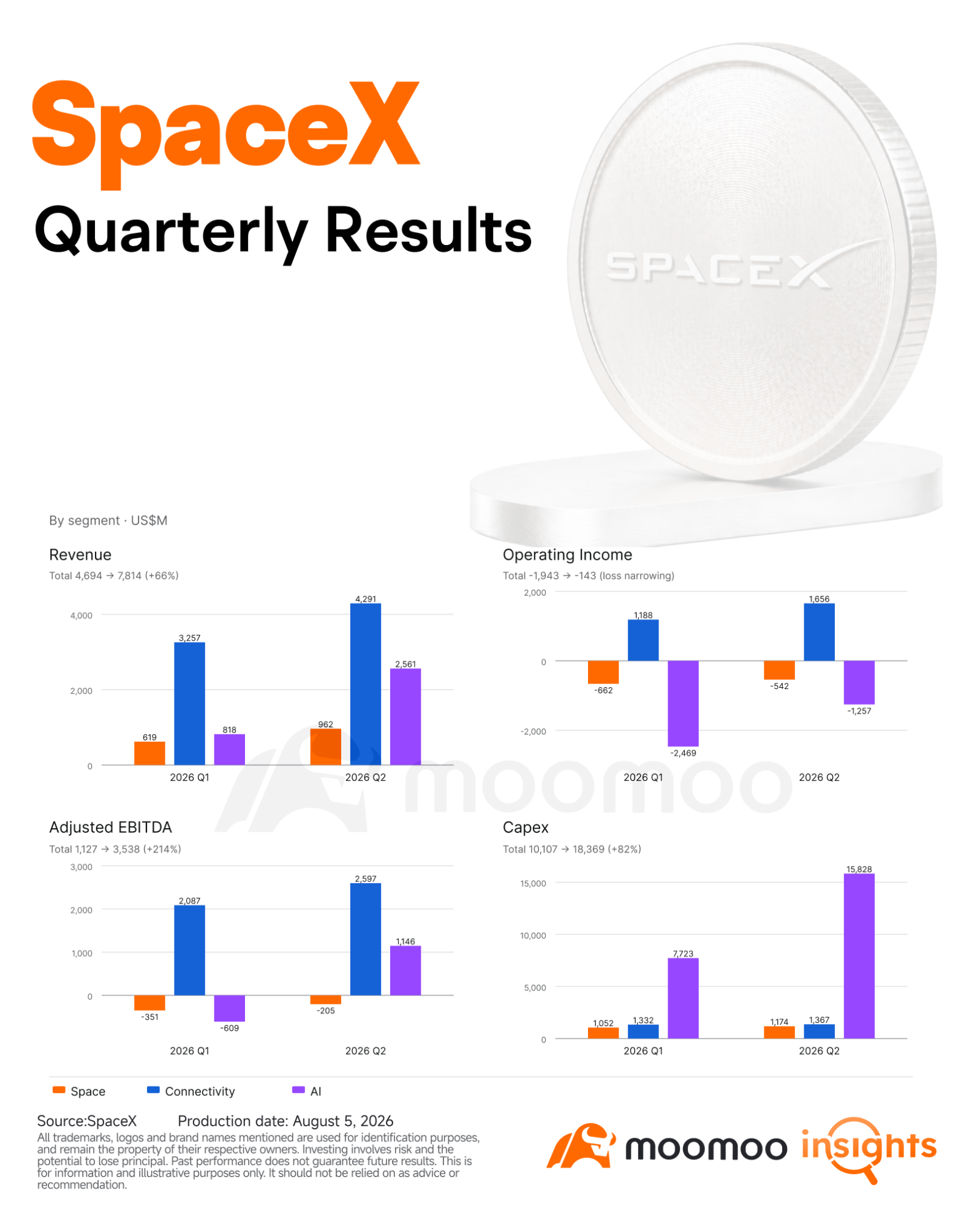
Revenue increased 66% quarter over quarter to US$7.81 billion, while adjusted EBITDA rose 214% to US$3.54 billion. Operating loss narrowed by 93% sequentially, from US$1.94 billion to US$143 million.

All three major segments exceeded forecasts. AI generated the largest upside, turning what had been the company’s biggest earnings drag into a meaningful EBITDA contributor.
Management is sketching an unusually steep growth curve:
although not formal guidance, SpaceX is targeting at least US$100 billion in total-company annualized revenue by December 2026.
From there, it has pulled forward its roughly US$1 trillion annual revenue ambition from 2031 to 2030—and potentially as early as 2029.
With its 5–10GW compute target, it could push 2027 capex well above the current US$128B model, potentially toward US$150–200B. Bulls see sub-one-year paybacks and accelerating cloud demand; bears see deeper cash burn, execution risk and an imminent share unlock.
AI Turned the Quarter, but Capex Doubled
AI revenue increased 213% quarter over quarter to US$2.56 billion. Adjusted EBITDA swung from a US$609 million loss to a US$1.15 billion profit, while operating loss narrowed by 49% to US$1.26 billion.

The result materially exceeded expectations. AI adjusted EBITDA was approximately US$1.45 billion above visible consensus, which had expected a US$300 million loss, and roughly US$1.05 billion above the covering analyst’s forecast.
SpaceX signed US$14.1 billion of contracted cloud sales, generating US$1.6 billion of incremental infrastructure revenue during Q2. Compute capacity increased 40% sequentially to 1.4GW.
Management said incremental AI capex is currently paying back in less than one year. The company now targets 5–10GW of operational compute by the end of 2027, above the analyst model’s 4.2GW, with projects covering roughly 20GW under development.
The caveat is that adjusted EBITDA excludes heavy depreciation and stock compensation. AI generated a 44.7% adjusted EBITDA margin, but its operating margin remained negative 49.1%, after US$1.89 billion of depreciation and amortization and US$516 million of share-based compensation.
Meanwhile, AI capex increased 105% quarter over quarter to US$15.83 billion, pushing total company capex up 82% to US$18.37 billion. AI accounted for 86% of quarterly investment.
Starlink Funds the Build; Starship Provides the Next Catalyst
Connectivity remains SpaceX’s financial foundation.
Revenue increased 32% quarter over quarter to US$4.29 billion, adjusted EBITDA grew 24% to US$2.60 billion, and operating income rose 39% to US$1.66 billion.
Starlink subscribers increased 16.5% sequentially to 12 million, while monthly ARPU remained unchanged at US$66. Enterprise and Government revenue rose 63% quarter over quarter to US$1.81 billion.

Management also outlined plans to use EchoStar spectrum as part of a terrestrial mobile network, potentially connecting small cells through Starlink broadband terminals. This could materially expand Starlink’s addressable market, although required capex has not been disclosed and execution may require additional spectrum, tower infrastructure and an MVNO partnership.
The Space segment also improved. Revenue rose 55% sequentially to US$962 million, while adjusted EBITDA loss narrowed by 42% to US$205 million.
The next major catalyst could be Flight 14, which may attempt the first recovery of Starship’s second stage using the launch tower’s “chopsticks.” Management expects both stages to be caught by year-end and believes it may have solved the heat-shield problem, one of the key remaining barriers to rapid reusability.
A $114 Billion Unlock Could Pressure Near-Term Trading
On August 6, employees and certain early investors will become eligible to sell up to 911.5 million shares. This would represent an approximately 140% increase over the currently tradable share count, although eligibility to sell does not mean all those shares will immediately enter the market.
At the August 4 closing price of US$125.33, the tranche has a notional value of approximately US$114.2 billion. For comparison, SpaceX’s IPO involved roughly 638.9 million shares.
A separate tranche of approximately 455.8 million shares required the stock to close at or above US$175.50 on at least five of the ten trading days before earnings. That condition was not met, limiting the immediate release. Further staggered unlocks remain, and up to roughly 40% of total shares could become tradable by December 8.
This creates a potential disconnect between fundamentals and trading. Employees and early investors may sell for diversification, taxes or liquidity even if they remain optimistic about SpaceX’s prospects.
Key Takeaway
Q2 strengthened the long-term bull case: AI monetization arrived earlier than expected, Starlink maintained strong profitability, and Starship is approaching major reusability milestones.
At the same time, SpaceX fell over 10% premarket as its 5–10GW AI buildout could push 2027 capex well above the current US$128B estimate. Bulls see sub-one-year paybacks; bears see heavier cash burn, execution risk and an imminent share unlock, and up to US$114 billion of restricted shares will become eligible for sale immediately after earnings.
Disclaimer: Moomoo Technologies Inc. is providing this content for information and educational use only.Read more


Comments (8)
to post a comment
54
70