
Sandisk Earnings Preview: Supercycle or Hype Cycle—One Call Decides It
U.S. market's most explosive high-volatility name, $SanDisk (SNDK.US)$ , will report FY2026 Q2 results after the close on Jan 29 (corresponding to calendar 2025 Q4). After a steep run-up, sentiment now feels like “fear of heights + divergence”: bulls want confirmation that fundamentals can keep delivering, while bears are waiting for any sign of a softer guide or an approaching cycle inflection.
The key for this print may not be whether Q2 “beats”—but whether management can more forcefully confirm a structural shift: AI inference is pushing eSSD/NAND from a “storage medium” into a layer closer to performance and efficiency in the inference stack. On top of that, the market will focus on Q3 guidance and the tone of longer-dated commentary—whether management stays sufficiently constructive.
Key Financial Setup
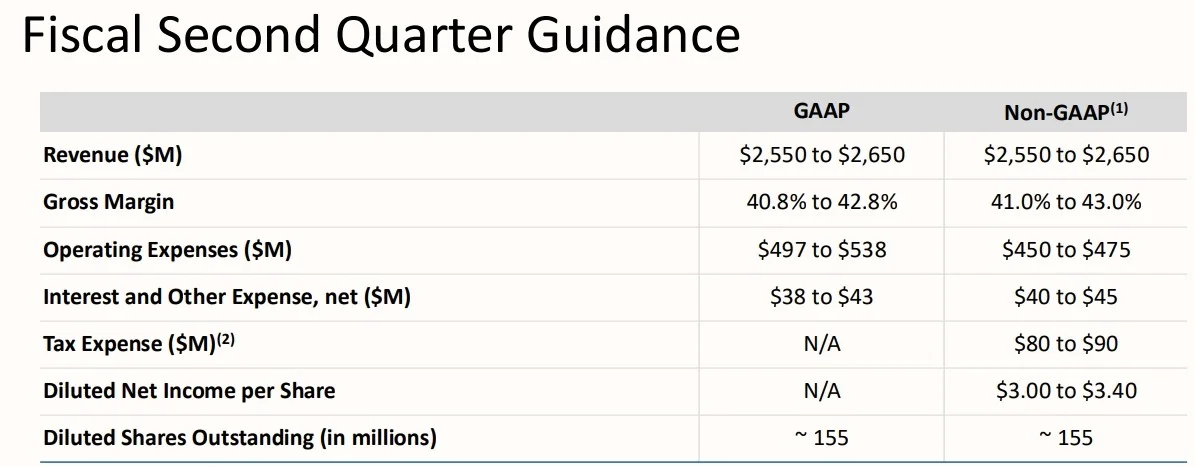
Management’s Q2 guidance from last quarter:
– Revenue: +12% QoQ, +39% YoY to $2.6B
– Non-GAAP gross margin: up from ~30% in Q1 to ~41%
– Growth driver: management indicated Q2 revenue growth would be driven primarily by “double-digit price increases,” while bit (unit) growth would be low-single-digit

Consensus (Bloomberg) expectations are broadly slightly above the top end of guidance:
– Revenue: ~$2.66B (+42% YoY), modestly above company guidance
– Non-GAAP gross margin / operating margin: ~42% / 24%, broadly consistent with guided framework


On valuation, BofA forecasts FY26 EPS ~ $16 and FY27 EPS ~ $27. At roughly $500 per share, that implies ~31x / 16x FY26 / FY27 P/E. Translation: the market is increasingly focused on whether the earnings curve can be revised higher again, rather than the quarter itself.

Three Things to Watch
1) From “Storage Medium” to an “Inference Performance Layer”: How big is the volume upside?
At CES 2026, NVIDIA’s CEO Jensen Huang laid out the concept of ICMS (Inference Context Memory Storage) in a more systematic way: as context / KV cache (think of it as the AI’s “working notebook”) keeps getting longer, HBM becomes increasingly constrained (and expensive). In the Rubin era, NVIDIA’s architecture—via components such as BlueField-4—enables part of the context to be placed into rack-level SSDs.
This narrative further fueled SNDK’s growth expectations and helped catalyze a +27% post-CES rally.
Some sell-side analysts have published aggressive quantification. For example, Bernstein estimates NAND TB/GPU could rise ~5x:
– Historically, NVL72 shipped with roughly ~1TB SSD per GPU (and with customer add-ons, roughly 3–4TB/GPU)
– Under the Rubin framework, incremental “context storage” could be around ~16.67TB/GPU
There’s also an underappreciated “second-order” driver: during inference, KV cache is continuously written / migrated / evicted. More frequent writes can imply faster wear-out → more frequent replacements, potentially making long-term demand more elastic than traditional “cold storage.”
2) Pricing: How long can NAND’s upcycle last? The key is supply discipline
Near-term pricing momentum looks solid. TrendForce previously suggested:
– 2025 Q4 NAND pricing: +33–38% QoQ
– 2026 Q1 NAND pricing: +33%+ QoQ

On supply, many believe discipline still holds: incremental capacity additions appear limited; aside from YMTC, there is seen to be little meaningful new NAND capacity, and even if CapEx rises, it may still remain below the 2021–2022 peak. If demand ramps while supply stays tight, pricing could remain supported.
Bernstein further forecasts the NAND ASP upcycle could extend into around 2027 before peaking and gradually easing, and models gross margin rising toward ~50% in 2026, then potentially up to ~76% in 2027.

3) Product + Execution: The pace of data-center volume ramp
With the macro supply/demand backdrop relatively favorable, the real determinant of earnings delivery is execution and product mix.
Enterprise / data-center eSSD is currently the largest growth engine, with emphasis on BiCS8-based eSSD and the next-gen platform often referred to as “Stargate.” The core path is:
new platform ramp → qualification → mass production volume → higher enterprise mix → gross margin leverage
Last quarter, management disclosed:
– Two hyperscale data-center operators are in the qualification phase
– One additional hyperscaler and a top-tier storage OEM are expected to join in 2026

Risk: The “Reflexivity” of a Supercycle
Memory (especially DRAM and NAND Flash) is a classic cyclical commodity: in upcycles, price drives an earnings surge; in downcycles, capacity release plus demand volatility can quickly reset pricing. For this supercycle to persist, two conditions must hold:
1. Demand-side structural growth is real and durable (AI inference / data-center penetration continues)
2. Supply-side capacity expansion stays disciplined (CapEx doesn’t spiral)
Historically, because of a “prisoner’s dilemma” dynamic, supply eventually tends to over-expand and push the industry back into oversupply. Even with a relatively optimistic demand backdrop, investors should closely track supply changes. BofA highlights key downside risks including rapid price declines under oversupply and competition / capacity expansion from players such as YMTC.
Options Playbook
Current put/call ratio ~1.13, suggesting sentiment is slightly bearish. Implied volatility ~113% is elevated (both IV rank and percentile are high), and the market is pricing a ±20% post-earnings move—an unusually wide range.
As a result, short-volatility structures may look more attractive—but risk should be defined, with protection on both wings (e.g., iron condor).


Disclaimer: Moomoo Technologies Inc. is providing this content for information and educational use only.Read more

Comments (2)
to post a comment
18
22