
[This Week's Outlook] Signs of Recovery in AI and Semiconductor Stocks! Bottoming Out or Just a Dead Cat Bounce? 3 Option Strategies to Prepare for the Next Market Shift
Key Market Points from Last Week into the Start of This Week
In the US stock market on the 7th, expectations of rate hikes receded following a disappointing July US employment report, leading to broad-based buying, particularly in tech stocks.
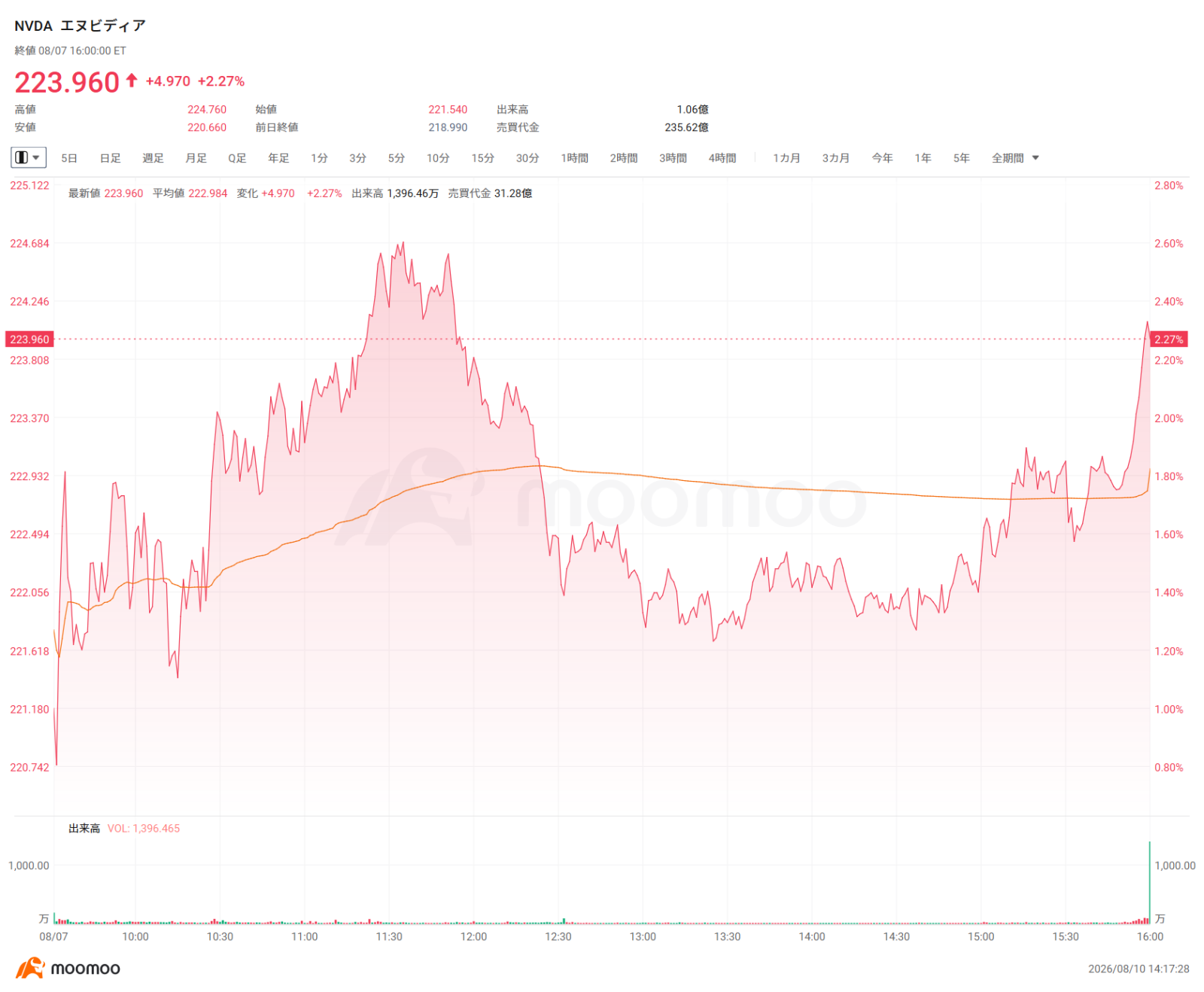
$Invesco QQQ Trust (QQQ.US)$ rose 1.17%, while AI semiconductor giant $NVIDIA (NVDA.US)$ gained 2.27%.
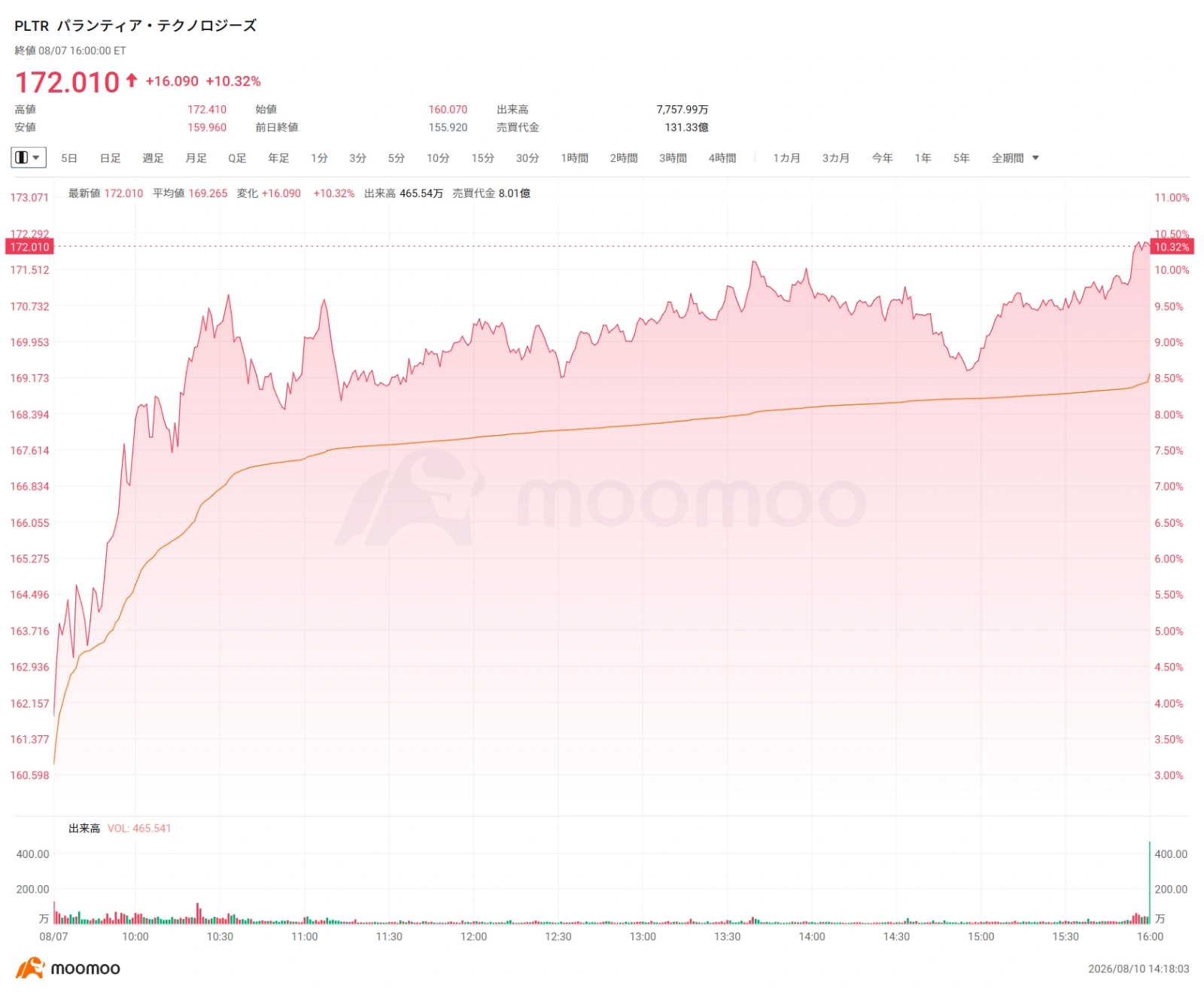
having cleared its earnings release, $Palantir (PLTR.US)$ surged approximately 10.3%, and $Nasdaq Composite Index (.IXIC.US)$ also rose 5% on a weekly basis, ending the week with its largest gain since April.
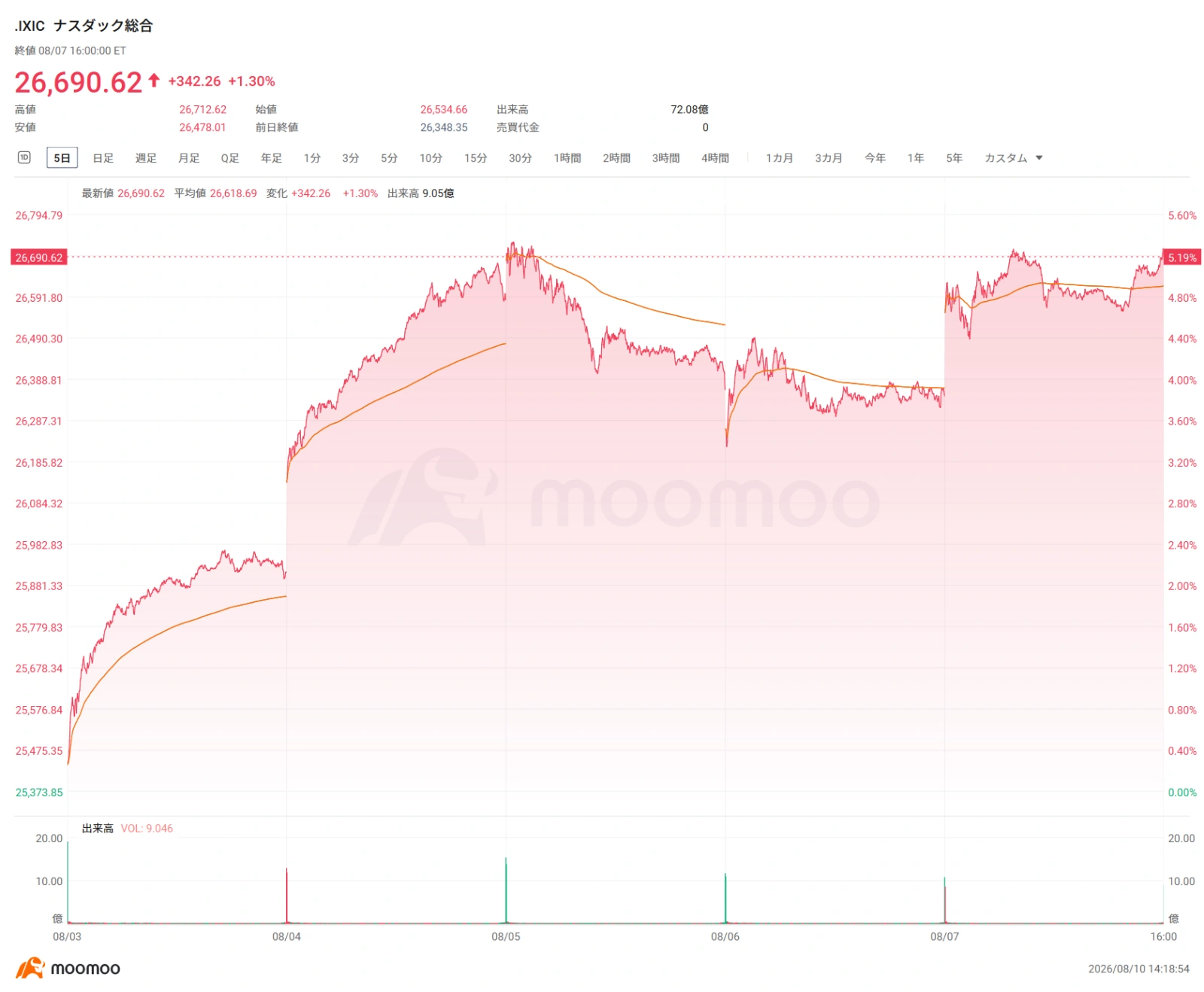
In the July US employment report, nonfarm payrolls unexpectedly decreased by about 23,000 from the previous month, while the unemployment rate fell to 4.1%. Amid signs of a cooling labor market, expectations for rate hikes diminished, and US long-term interest rates declined. This drop in rates supported valuations for high P/E stocks, triggering buying across the tech sector.
However, not all AI-related stocks rose uniformly. Looking at the options market, there are clear differences in implied volatility and investor positioning between the index and individual stocks, as well as between stocks that have already reported earnings and those yet to do so.
For $Palantir (PLTR.US)$ , which reported strong earnings, implied volatility (IV) dropped after the event, while call-heavy supply and demand dynamics persisted. Meanwhile, $NVIDIA (NVDA.US)$ Consequently, bullish call options have become dominant, and signs of rising implied volatility (IV) are also evident in contracts with expirations close to earnings announcements.
Key Points to Watch This Week
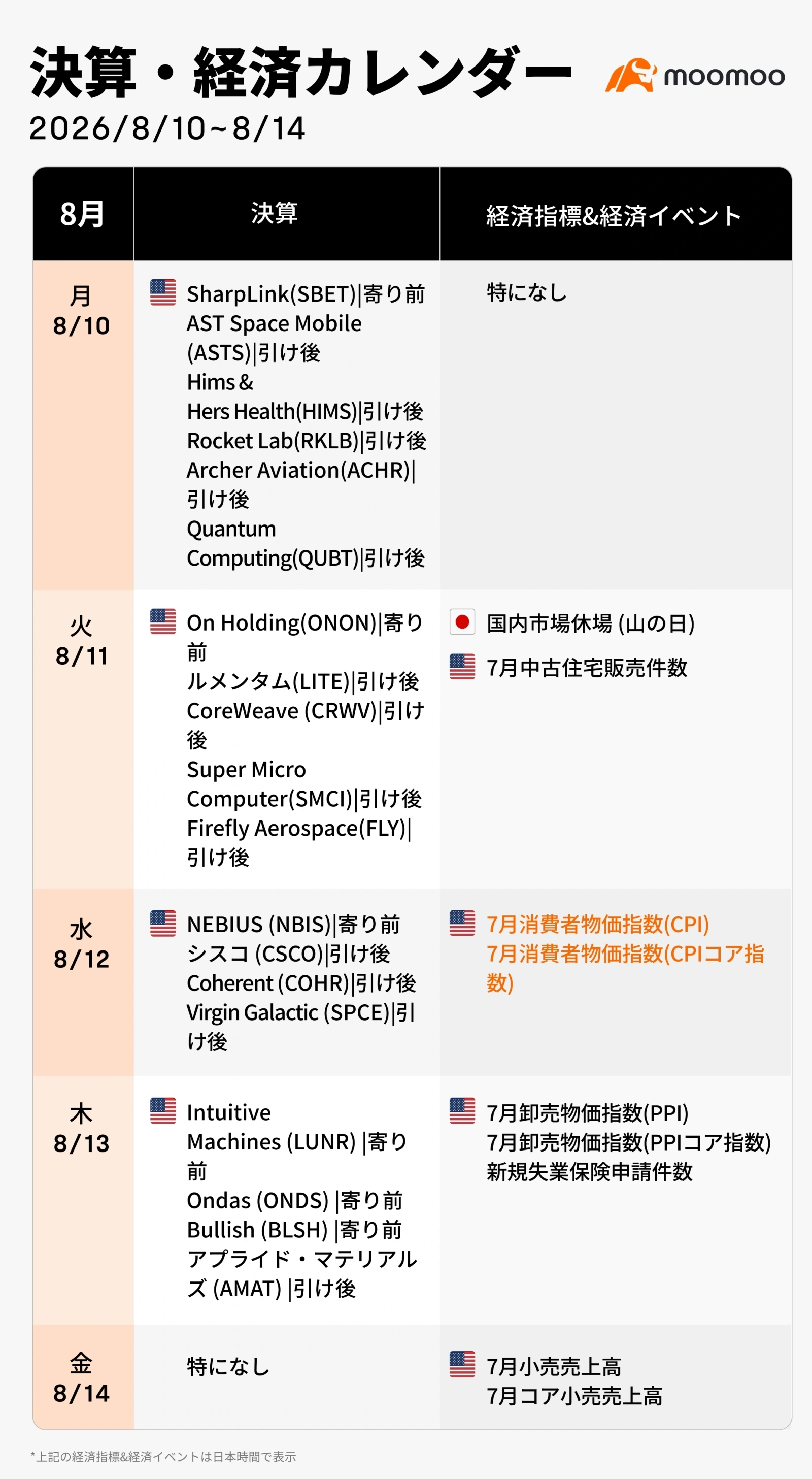
In the U.S. stock market this week, the main focus will be on whether the sharply fallen AI hardware and semiconductor stocks can bottom out, and on big tech earnings that will validate the monetization of AI investments. Last week saw broad short covering driven by falling interest rates after a weaker-than-expected U.S. jobs report. However, for semiconductor and AI hardware stocks, the market is now at a critical juncture to see if the post-correction improvement in supply and demand will persist.
On the other hand, $Palantir (PLTR.US)$ Building on the strong demand for AI software demonstrated by robust earnings results, this week marks a phase where the market evaluates the broadening monetization from AI infrastructure to semiconductors. $NVIDIA (NVDA.US)$ Ahead of NVIDIA's earnings, the sustainability of demand and investment payback capabilities will be key evaluation metrics for AI infrastructure-related companies. Additionally, inflation data, starting with the U.S. CPI on the 12th, will sway interest rate outlooks and serve as crucial catalysts supporting the valuations of high-P/E tech stocks.
Options Analysis
In the US stock market, falling interest rates triggered by the July US jobs report spurred widespread bargain hunting, particularly in AI-related stocks.
On the other hand, even among AI-related stocks, differences have emerged in investor positioning and priced-in volatility between companies that have already reported earnings and those approaching major events.
By observing the options market, investors can gauge the magnitude of price movements anticipated by the market and identify which direction positions are leaning toward.
This time, we analyze current supply and demand dynamics and market sentiment through three tickers: QQQ, representing the index; Palantir, which surged after its earnings release; and NVIDIA, which is approaching its earnings announcement.
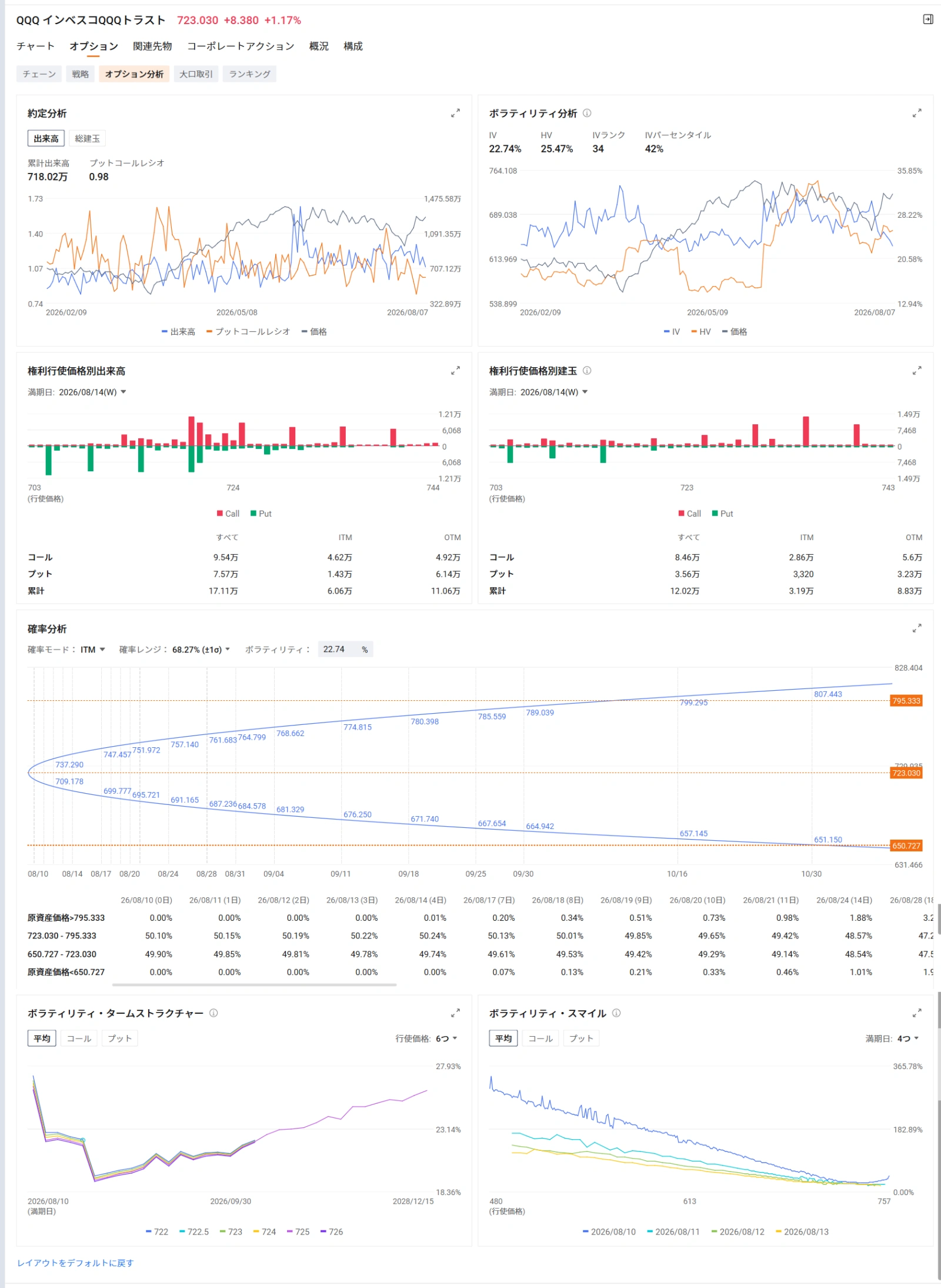
QQQ — IV is at a medium level, with calls dominating in the short term
Reflecting the overall movement of the index $Invesco QQQ Trust (QQQ.US)$ In the options market, current caution is limited.
Reflecting the overall movement of the index $Invesco QQQ Trust (QQQ.US)$ In the options market, current caution is limited.
IV stands at 22.74%, with an IV Rank of 34 and an IV Percentile of 42%, all positioning in the middle range compared to the past year. The expected move (EM) for the next week, implied by IV, is approximately ±3%, indicating that the index market is not heavily pricing in sharp price swings. The aggregate put/call ratio based on daily volume across all expirations is 0.98, showing a near balance between calls and puts.
On the other hand, based on open interest for the August 14 expiration, the ratio is approximately 0.42, with call open interest exceeding put open interest for the nearest expiration. In the short term, positioning is skewed toward the upside.
The term structure maintains a contango trend, where IV increases with longer-dated expirations. No backwardation, which would strongly price in imminent volatility risk, has been observed.
Although a put skew remains, where IV rises as strike prices decrease, this is generally considered within the normal range of downside hedging demand for the overall index.
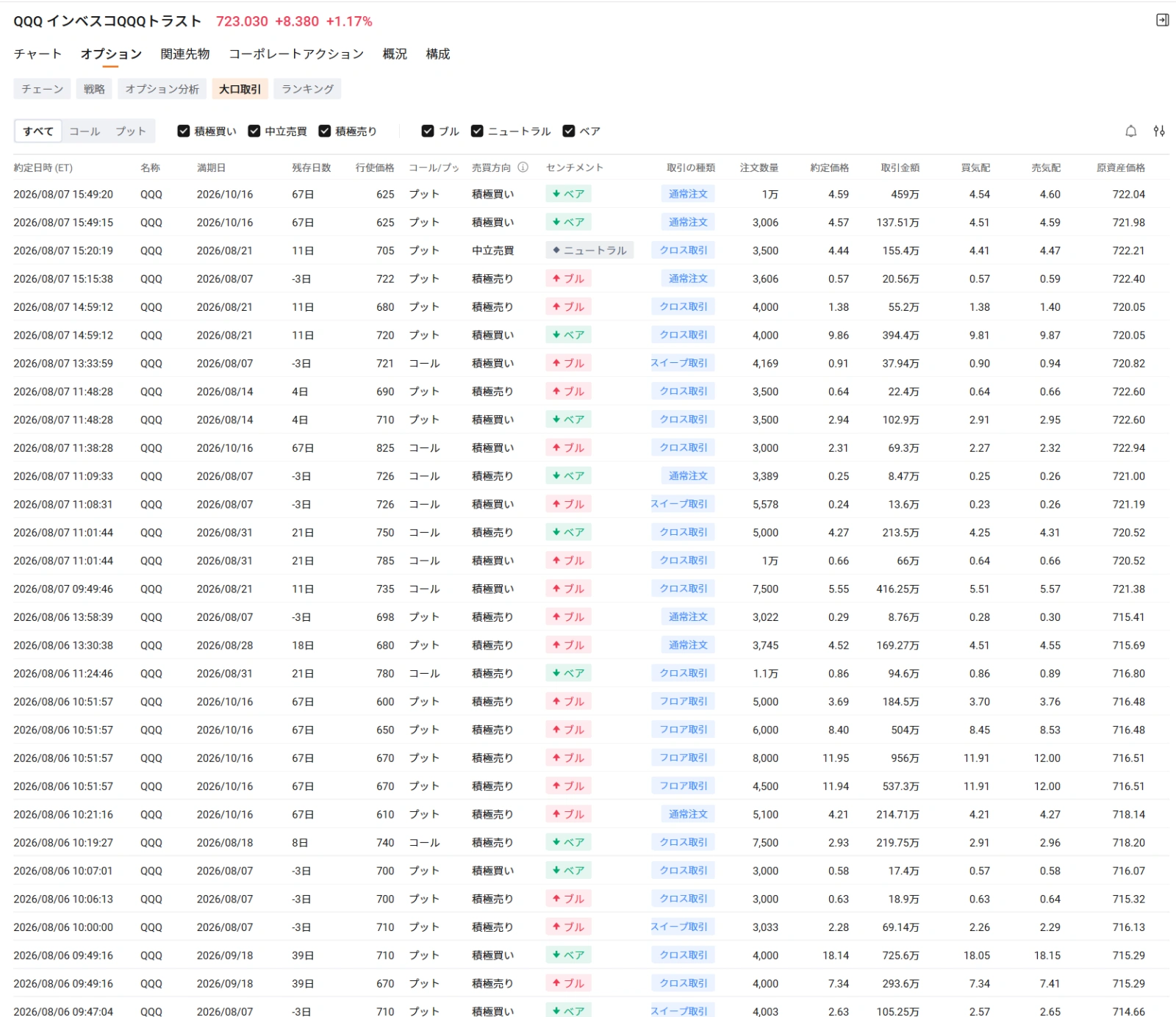
Even in block trades, put selling at lower strikes and put buying near current levels are intermingled. Rather than leaning strongly bullish or bearish in one direction, the primary activity reflects maintaining certain hedges while remaining mindful of upside potential.
With the US employment report on the 7th now behind us, market focus is shifting to the next macroeconomic catalysts. Going forward, whether QQQ's IV stabilizes in the mid-range and whether the contango structure is maintained will be key points in assessing the overall tone of the index.
★ Options Strategy
Bull Put Spread (Targeting a firm base while limiting downside risk)
The rationale is that QQQ's IV stands at 22.74%, with an IV Rank of 34 and an IV Percentile of 42%, placing it in the mid-range over the past year. While extreme caution is not priced into the broader index, demand for downside hedging via put skew persists. Rather than aiming for a sharp rally with a simple long call, a strategy designed to 'generate profits as long as the market doesn't drop significantly' is better suited to the current market environment.
Sell: QQQ 2026/08/14 700 Put
Buy: QQQ 2026/08/14 690 Put
*The objective is to capitalize on a scenario where 'QQQ does not decisively break below the $700 level.' The $700 mark sits near the lower end of the expected one-week price range (approx. ±3%) calculated based on the price as of August 7. Maximum profit is capped at the premium received, while maximum loss is limited to the spread width minus the premium received. Unlike selling naked puts, this strategy's key feature is that it proactively caps downside loss risk during market declines.
Palantir: IV drops post-earnings, call dominance becomes clear
$Palantir (PLTR.US)$ The company announced its Q2 earnings after the market close on the 3rd. Revenue rose 93% year-over-year to $1.94 billion, and adjusted EPS came in at $0.41, beating market expectations. Revenue from the US Commercial segment increased 149% year-over-year to $764 million, while the US Government segment also grew 90% to $809 million.
$Palantir (PLTR.US)$ The company announced its Q2 earnings after the market close on the 3rd. Revenue rose 93% year-over-year to $1.94 billion, and adjusted EPS came in at $0.41, beating market expectations. Revenue from the US Commercial segment increased 149% year-over-year to $764 million, while the US Government segment also grew 90% to $809 million.
The company raised its full-year revenue guidance from the previous $7.65–$7.66 billion to $8.15–$8.16 billion, with net dollar retention reaching 157%. Following the strong earnings result, the stock price surged approximately 10.3% on the 7th.
Having passed through the major event of earnings releases, the decline in implied volatility (IV) has become pronounced in the options market.
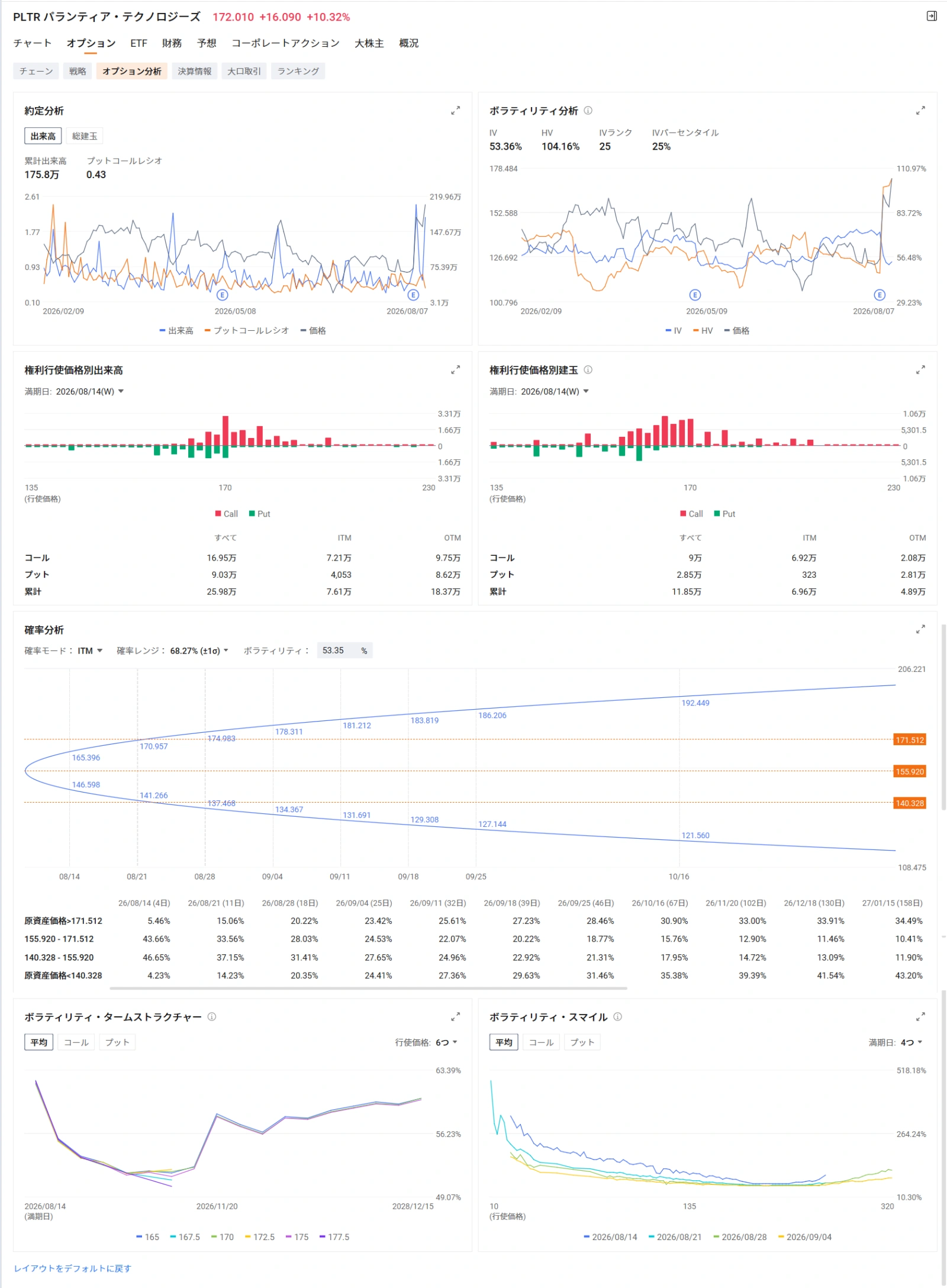
Although IV remains high at an absolute level of 53.36%, the IV Rank has dropped to 25, and the IV Percentile has also fallen to 25%. This reflects a so-called "IV crush," where the event premium dissipates after the earnings announcement.
Meanwhile, historical volatility (HV) stands at 104.16%, significantly exceeding IV. While actual stock price fluctuations remain large, the future volatility priced into the options market is declining, widening the divergence between IV and HV. The estimated expected price range for the next week, derived from IV, is approximately ±7%.
In terms of supply and demand, call options are clearly dominant. The put-call ratio based on daily trading volume across all expirations is 0.43, and even on an open interest basis for the August 14 expiration, it is around 0.32, with calls significantly outnumbering puts. This indicates that trading focused on upward price movements continues in response to the post-earnings surge.
However, a pronounced put skew is also observed, with exceptionally high IV for puts at lower strike prices. While demand for calls is strengthening, caution against the risk of a sharp decline has not completely subsided.
Looking at block trades, call buying in anticipation of post-earnings gains is prominent, while put transactions serving as downside protection are also evident. Investors appear to be adjusting their positions to hedge against pullback risks after the surge, while remaining mindful of the continuation of the uptrend.
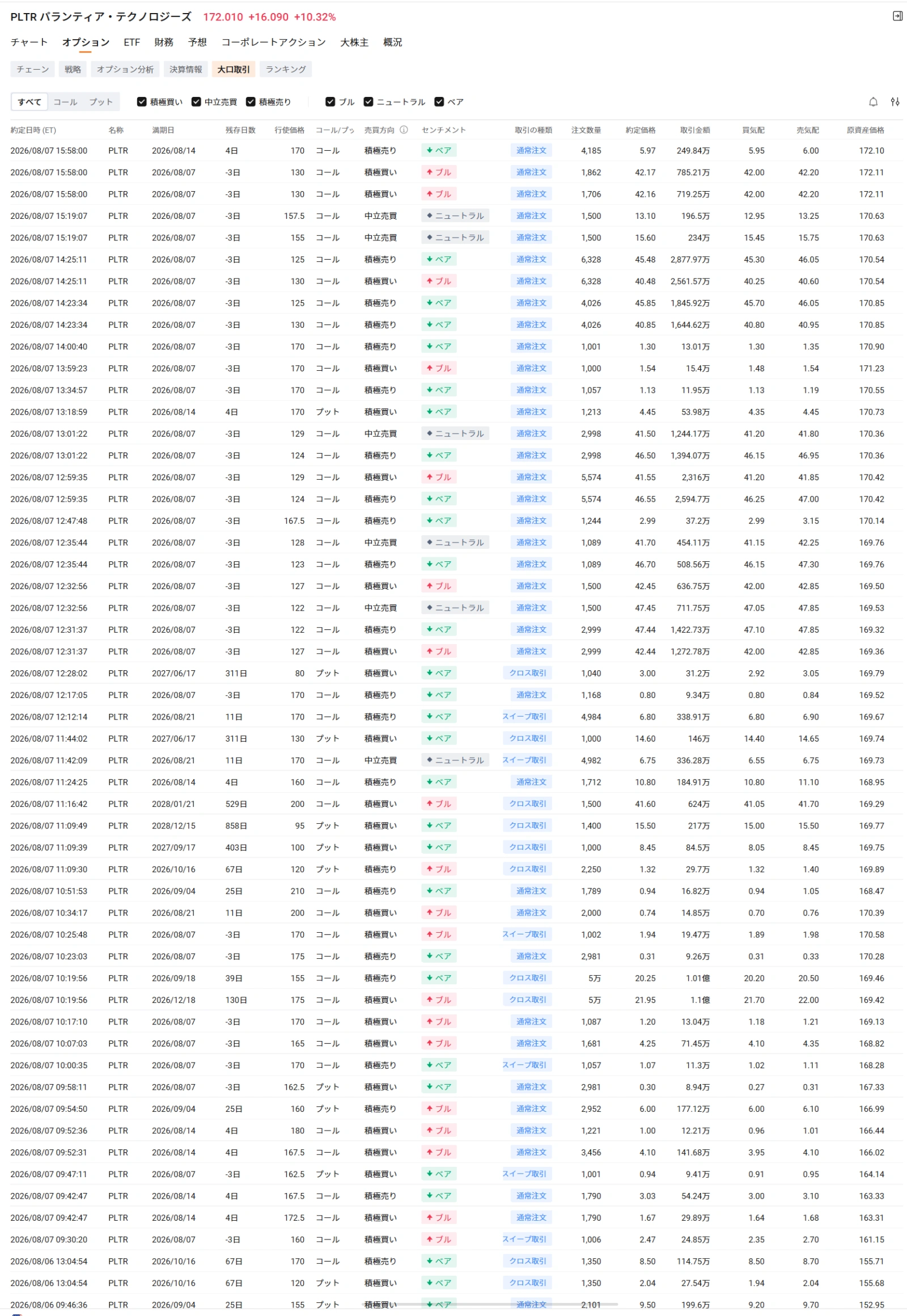
Going forward, the focus will be on whether the post-earnings surge can be sustained and how the divergence between HV and IV will narrow. Attention is on changes in the options market to see whether actual price movements will stabilize or if significant volatility will recur.
★ Options Strategy
Long Call (Aiming for a continued rally post-earnings)
The rationale is that following the earnings release, the event premium decayed and IV dropped to 53.36%, while HV remained elevated at 104.16%. This indicates that the future volatility priced in by the options market is relatively low compared to actual stock price movements.
Additionally, both volume and open interest continue to reflect call-dominated market dynamics. In scenarios where momentum persists following strong earnings, a long call is an ideal strategy, offering upside potential while capping maximum loss at the premium paid.
Buy: PLTR 2026/08/21 175C
*Note: The objective is to capitalize on a scenario where post-earnings revaluation continues, with the stock maintaining its high range and probing further upside. The 175C strike is close to the stock price level as of August 7, making it easier to secure delta compared to deep out-of-the-money (OTM) calls. While the maximum loss is limited to the premium paid, be mindful of time decay if the stock price remains flat.
NVIDIA – Call dominance, with attention on rising IV ahead of earnings
$NVIDIA (NVDA.US)$ Unlike Palantir, which has already passed its earnings report, NVIDIA is approaching its event risk.
$NVIDIA (NVDA.US)$ Unlike Palantir, which has already passed its earnings report, NVIDIA is approaching its event risk.
The company is scheduled to announce its Q2 FY2027 earnings after the market close on August 26. The company has provided revenue guidance of $89.2 billion to $92.8 billion for the quarter, while market expectations stand at approximately $86.4 billion.
In the options market, IV stands at 43.35%, with an IV Rank of 33 and an IV Percentile of 41%, indicating that it is currently at a mid-range level within its one-year historical range.
The estimated expected price movement for the next week, derived from IV, is approximately ±6%. At this stage, there is no significant pricing in of extreme event premiums ahead of the earnings announcement.
However, looking at IV by expiration, it shows a pattern of declining in the near term before rising again toward the end of August. IV is picking up in contracts close to the August 26 earnings date, suggesting that the market is gradually pricing in earnings risk.
In terms of supply and demand, call options are clearly dominant. The put/call ratio based on daily volume across all expirations is 0.51, while the ratio based on open interest for the August 14 expiration is approximately 0.44, with calls exceeding puts in both cases.
The volatility smile exhibits a call skew, where IV increases with higher strike prices, indicating strong demand for calls driven by bullish upside expectations.
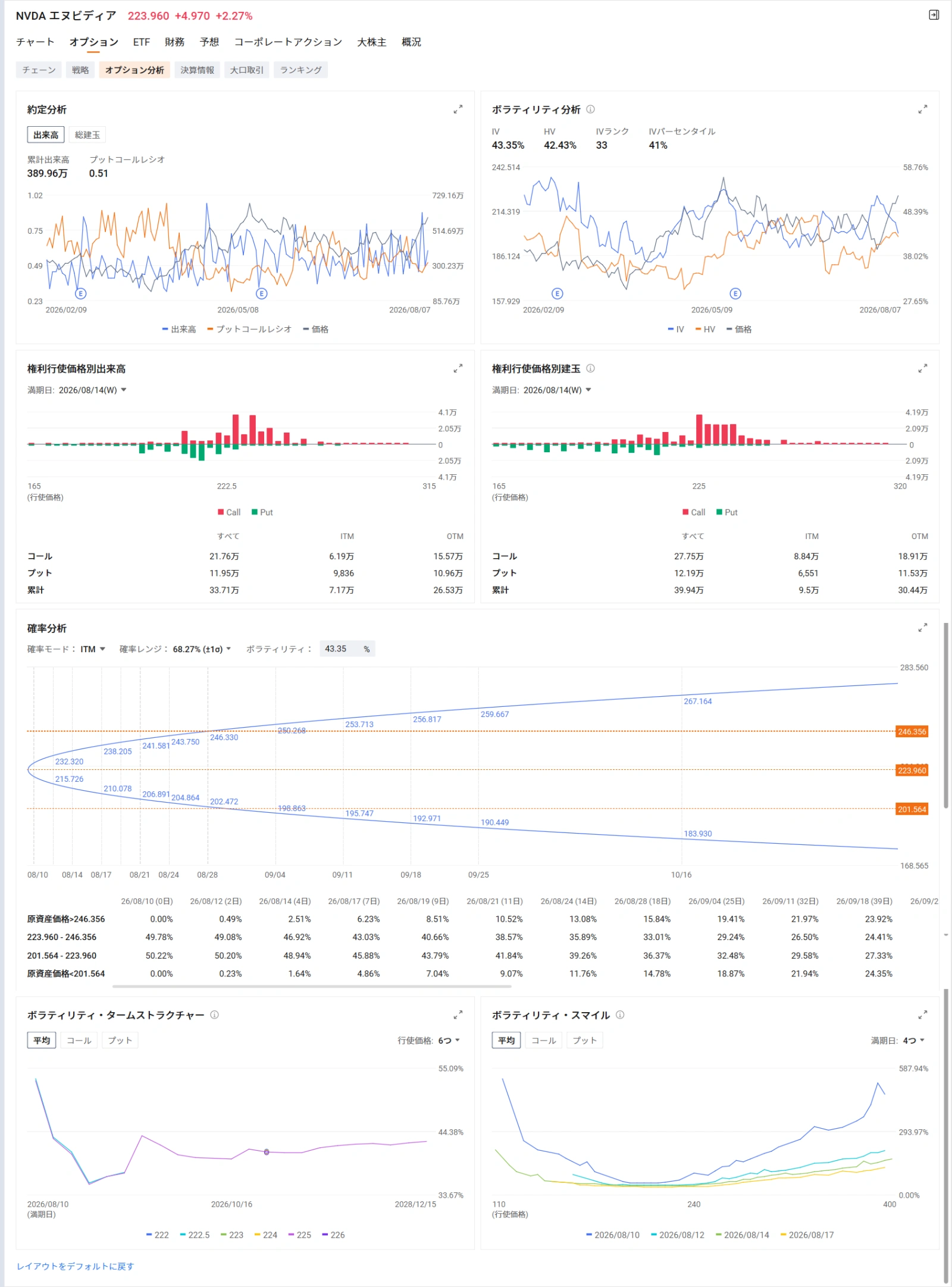
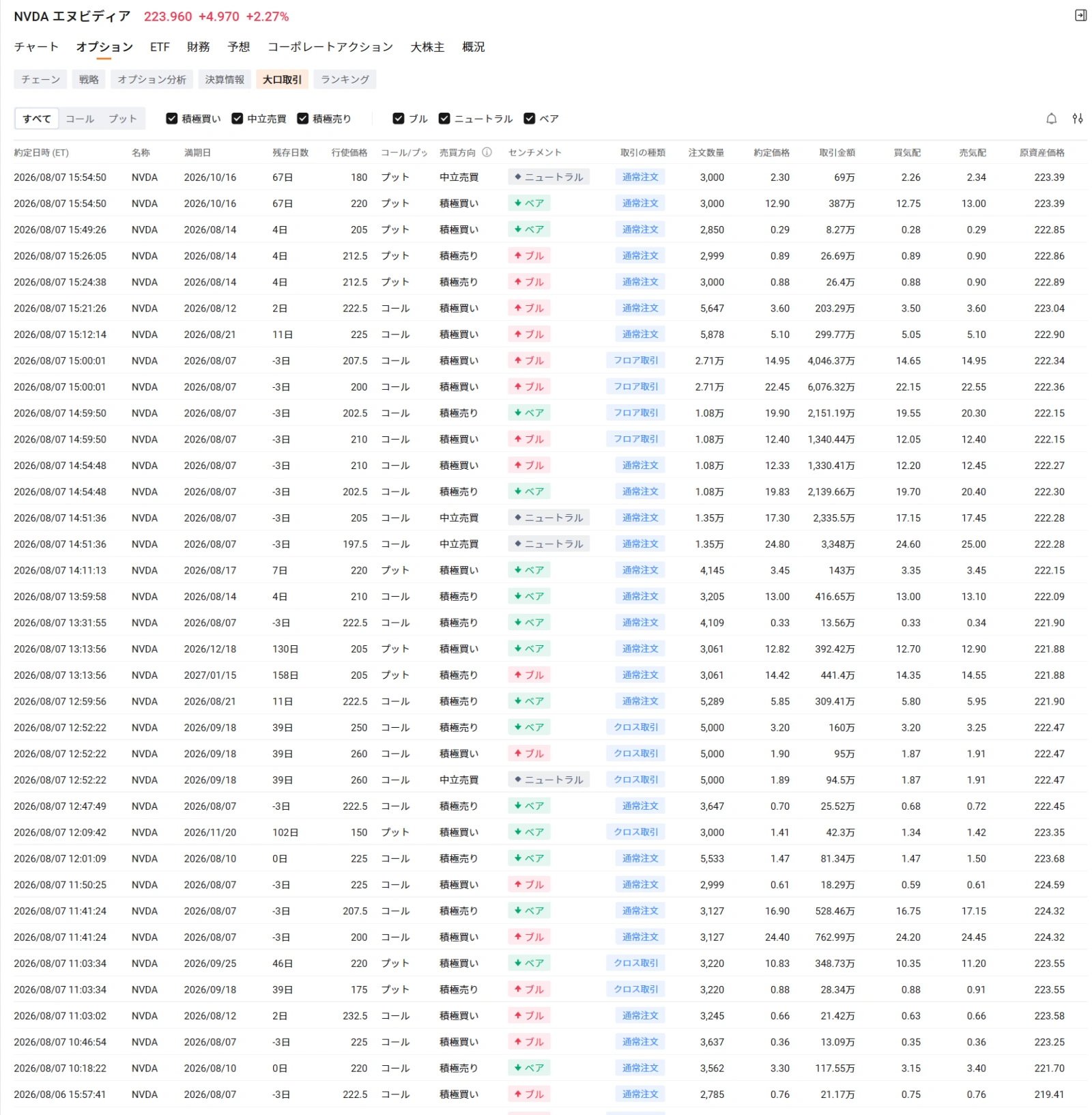
Large block trades also show prominent near-term call buying, indicating that bullish positioning is advancing ahead of the earnings release.
On the other hand, looking at recent stock price reactions on the day following earnings announcements, shares fell approximately 5.5% in February and about 1.8% in May.
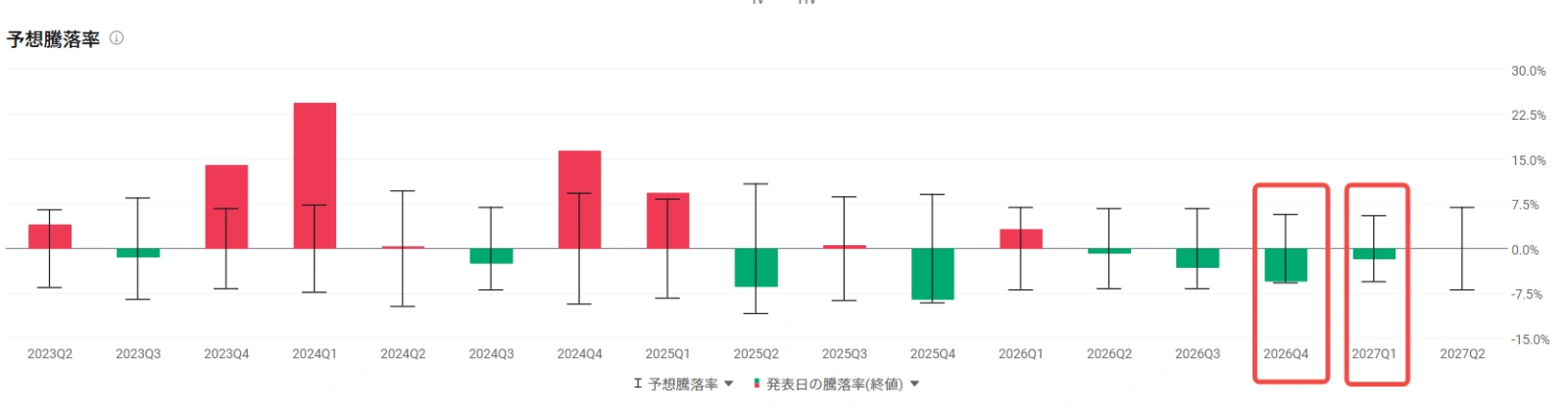
Given that there have been instances of 'sell the news' despite results beating market expectations, attention is focused on how much IV will rise leading up to the earnings report and whether the call-dominated supply/demand dynamic will be sustained.
★ Options Strategy
Long Straddle (Targeting IV rise and volatility expansion ahead of earnings)
The rationale is that although the earnings release on August 26 is approaching, IV stands at 43.35%, with an IV Rank of 33 and an IV Percentile of 41%, meaning it remains at mid-range levels relative to the past year.
Looking at the term structure, IV is beginning to rise toward the late August expiration, leaving room for event premium to increase as earnings approach. Rather than betting on a single directional move, a strategy designed to capture the pre-earnings IV rise and stock price volatility expansion is more suited to the current market environment.
Buy: NVDA 2026/08/28 225C
Buy: NVDA 2026/08/28 225P
*Note: The objective is to capitalize on a scenario where IV rises as earnings approach, or the stock makes a significant move in either direction. By selecting the $225 strike, which is near the at-the-money (ATM) level close to the stock price as of August 7, the structure is positioned to react to moves in both directions. The maximum loss is limited to the total premium paid for the two options.
It should be noted that the primary focus of this strategy is to capitalize on the IV rise leading up to the earnings, rather than holding the position through the earnings event. After the earnings are released, an IV drop (IV crush) is likely to occur, so caution is required regarding the risk that option prices may fall even if the directional outlook is correct.
From an Investor's Perspective
In summary, for recent AI-related stocks, the options market's pricing varies significantly depending on their position in the earnings calendar, rather than reflecting a simple bullish or bearish sentiment.
As an index ETF $Invesco QQQ Trust (QQQ.US)$Following the release of the US employment data, implied volatility (IV) has remained in the mid-range, with call open interest dominating in the nearest expiration. There are no signs of extreme caution across the broader index; going forward, interest rate trends and additional macroeconomic factors will drive market movements.
On the other hand, the budget has been approved.$Palantir (PLTR.US)$Meanwhile, for stocks that have already reported earnings, strong results and a sharp rally in share prices have sustained call-dominated supply and demand, while IV has dropped significantly due to the decay of event premiums. Key points to watch are whether the stock price can maintain its high levels after the surge, and how the divergence between historical volatility (HV) and IV will converge.
In contrast, $NVIDIA (NVDA.US)$Ahead of the August 26 earnings report, IV is at a median level over the past year, but an upward trend is visible in contracts expiring close to the earnings date. Call-dominated supply and demand continue, so the focus is on how much event premium and positioning will build up leading into the earnings announcement.
This week, in addition to Palantir's post-earnings price action and IV changes ahead of NVIDIA's earnings, the US CPI release on the 12th will be a new focal point. If a slowdown in inflation is confirmed, it could support high-P/E AI and tech stocks through lower interest rates. Conversely, an upside surprise would heighten caution regarding valuation adjustments driven by rising long-term interest rates.
Rather than evaluating AI-related stocks as a monolith, it appears we are entering a phase where it is crucial to gauge the varying volatility and position shifts across stocks that have already reported earnings, those about to report, and the broader indices, while simultaneously monitoring whether the interest rate environment will once again provide a tailwind.
This article uses machine translation in part
-moomoo News Kingsley
This document is prepared solely for informational purposes and does not constitute a recommendation to invest in or trade any specific financial instrument. Investors are solely responsible for their own final investment decisions and the resulting outcomes. Financial instruments carry risks including price volatility, credit risk, and liquidity risk. Principal is not guaranteed and losses may occur. The company assumes no liability whatsoever for any damages arising from the use of this document or from investment decisions made based on its content. Option trading involves the risk of losses exceeding the initial investment. Please be sure to review all key documentation—including the Contract Pre-Conclusion Document, Subscription Agreement, and other materials—covering important matters such as risks and fees, and trade only at your own discretion.
Disclaimer: Moomoo Technologies Inc. is providing this content for information and educational use only.Read more


Comments
to post a comment
13
5