
Semiconductor Equipment: The New AI Bottleneck Trade
The semiconductor equipment rally is no longer just a side trade on AI. It is becoming one of the clearest signals that investors are moving upstream from buying AI demand to buying the physical bottlenecks behind that demand.
The move has been broad. Semiconductor equipment leaders including $Applied Materials (AMAT.US)$ , $Lam Research (LRCX.US)$ , $KLA Corp (KLAC.US)$ , $ASML Holding (ASML.US)$ and $ACM Research (ACMR.US)$ all rallied sharply, while SOXX also outperformed the S&P 500 by a wide margin.

Industry Financial Snapshot
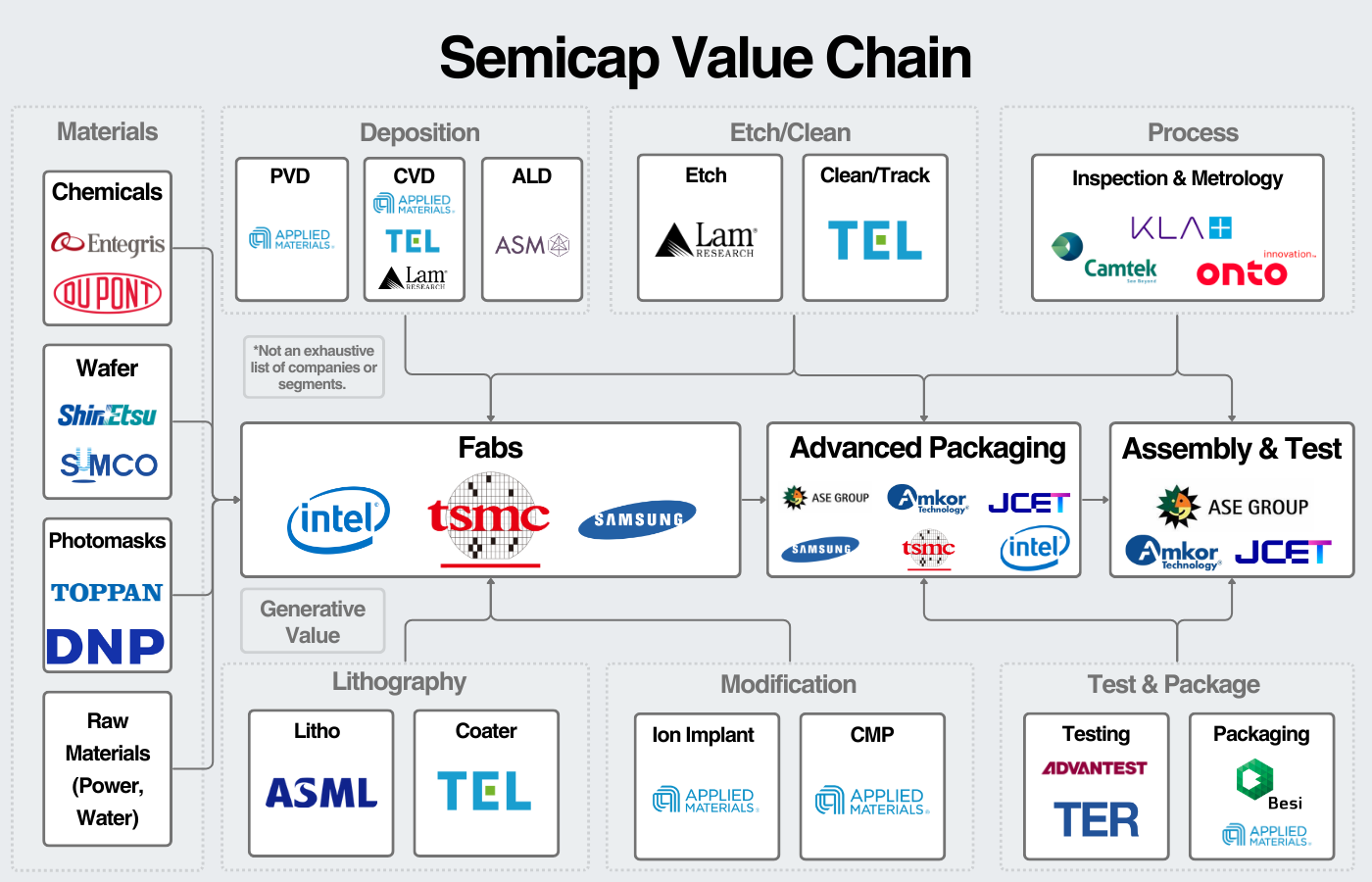
The key number behind the rally is WFE. In simple terms, WFE is the spending required to build and upgrade chip manufacturing capacity. It covers tools such as lithography, deposition, etch, process control, cleaning and related equipment. For investors, WFE is the capex layer underneath AI chips.

This cycle is being rebased. The prior WFE peak in 2022 was about $98 billion. Recent sell-side forecasts now point to roughly $140 billion to $154 billion in 2026, with 2027 expectations moving toward about $180 billion to more than $200 billion depending on the bank.
That is why the market reaction has been so strong. Investors are not only looking at 2026 earnings. They are starting to price a larger 2027 equipment cycle, where AI data centers, HBM, advanced logic, advanced packaging and memory upgrades all feed into the same capex channel.
Three Things to Watch
WFE Is Being Rebased, Not Just Revised
The most important change is not that 2026 estimates are moving higher. It is that the market is starting to accept a higher structural ceiling for equipment spending.
Past WFE cycles were usually driven by a single end market, such as smartphones, PCs, 5G or a memory upcycle. Those cycles had clearer saturation points. This cycle is different because AI infrastructure is pulling from multiple directions at the same time: leading-edge logic for accelerators, DRAM and HBM for memory bandwidth, NAND for storage, and advanced packaging for system-level performance.
If AI capex keeps rising, the constraint eventually shifts from chip demand to chip supply. Equipment makers sit directly at that bottleneck.
The Real Constraint Is Cleanroom Capacity
The strongest industry signal is that the bottleneck appears to be shifting from demand to physical capacity.
The bullish read is simple. If customers want more wafers, they need more fab space, more cleanroom capacity and more process tools. If cleanroom space is limited, orders do not disappear. They get pushed into the next installation window. That is why 2027 matters so much for the equipment group.
This also changes how investors should think about the cycle. In a normal downturn, weak end demand leads to order cancellations. In the current setup, the issue is closer to delayed supply. If new cleanroom capacity comes online through 2026 and 2027, deferred equipment demand can turn into actual shipments rather than lost demand.
Equipment Has Better Visibility Than Most AI Hardware
One reason equipment stocks are being rerated is visibility. Chip equipment is not a short-cycle consumer electronics business. Customers plan fabs years ahead, validate process tools deeply, and rarely switch vendors once a tool becomes part of the process of record.
That gives leading equipment suppliers unusual pricing power. As chip complexity rises, customers need more steps, tighter process control and higher equipment intensity per wafer. EUV adoption in DRAM, more complex etch and deposition, higher process-control intensity, and advanced packaging all push the same direction: more equipment value per unit of output.
This is why the sector can deserve a higher multiple than in older memory cycles. The market is not only paying for more tools. It is paying for more mission-critical tools, longer order visibility and a larger recurring service base.
What the Stock Moves Really Mean
The stock-level message should not be overcomplicated. ASML represents the EUV bottleneck. Applied Materials and Lam Research represent the broader process tool cycle, especially deposition, etch, DRAM, NAND and advanced packaging. KLA represents process-control intensity, where more complex chips require more inspection and metrology.

But the more important point is not which stock rose the most on one trading day. The sector move says investors are assigning more value to the equipment layer of AI infrastructure.
That matters because AI hardware trades have gone through several rotations. First, the market bought GPUs. Then it bought HBM. Then it bought power, cooling, networking and optical components. The equipment rally suggests the next layer is being repriced: the factories and tools required to produce all of that silicon.
The Main Risk: AI Capex Must Keep Expanding
The biggest risk is also easy to define. The entire thesis depends on sustained AI capex from hyperscalers and leading chipmakers. If Microsoft, Google, Amazon, Meta or Oracle begin to narrow data center spending plans, the equipment chain would feel it quickly.
The transmission path would be direct. Lower AI capex would reduce pressure on advanced logic capacity, then weaken DRAM and HBM expansion assumptions, then hit WFE orders for deposition, etch, lithography and process control. Because equipment stocks have already moved sharply, even a pause in estimate revisions could create volatility.
Export controls are the second major risk. Tighter restrictions could weigh on China revenue for global equipment vendors. The offset is that non-China capacity buildout in the U.S., Japan, Europe, Taiwan and Korea may absorb part of that pressure, especially because advanced non-China fabs tend to require higher-value equipment.
Summary
The semiconductor equipment breakout is best understood as an AI infrastructure bottleneck trade. The market is no longer only paying for chips that sell into AI data centers. It is paying for the tools required to manufacture the next wave of those chips.
The industry case is stronger than the single-stock case. WFE estimates are being lifted, cleanroom capacity is tight, order visibility is extending, and equipment intensity per wafer is rising. After the sharp move, the question is no longer whether the sector benefits from AI. The question is whether 2027 WFE numbers keep moving higher.
Disclaimer: Moomoo Technologies Inc. is providing this content for information and educational use only.Read more


Comments (4)
to post a comment
55
70