Earnings Season Portfolio Challenge | Every trade deserves to be shared


Seagate (STX): The Shop Floor Investor's Journey and Analysis
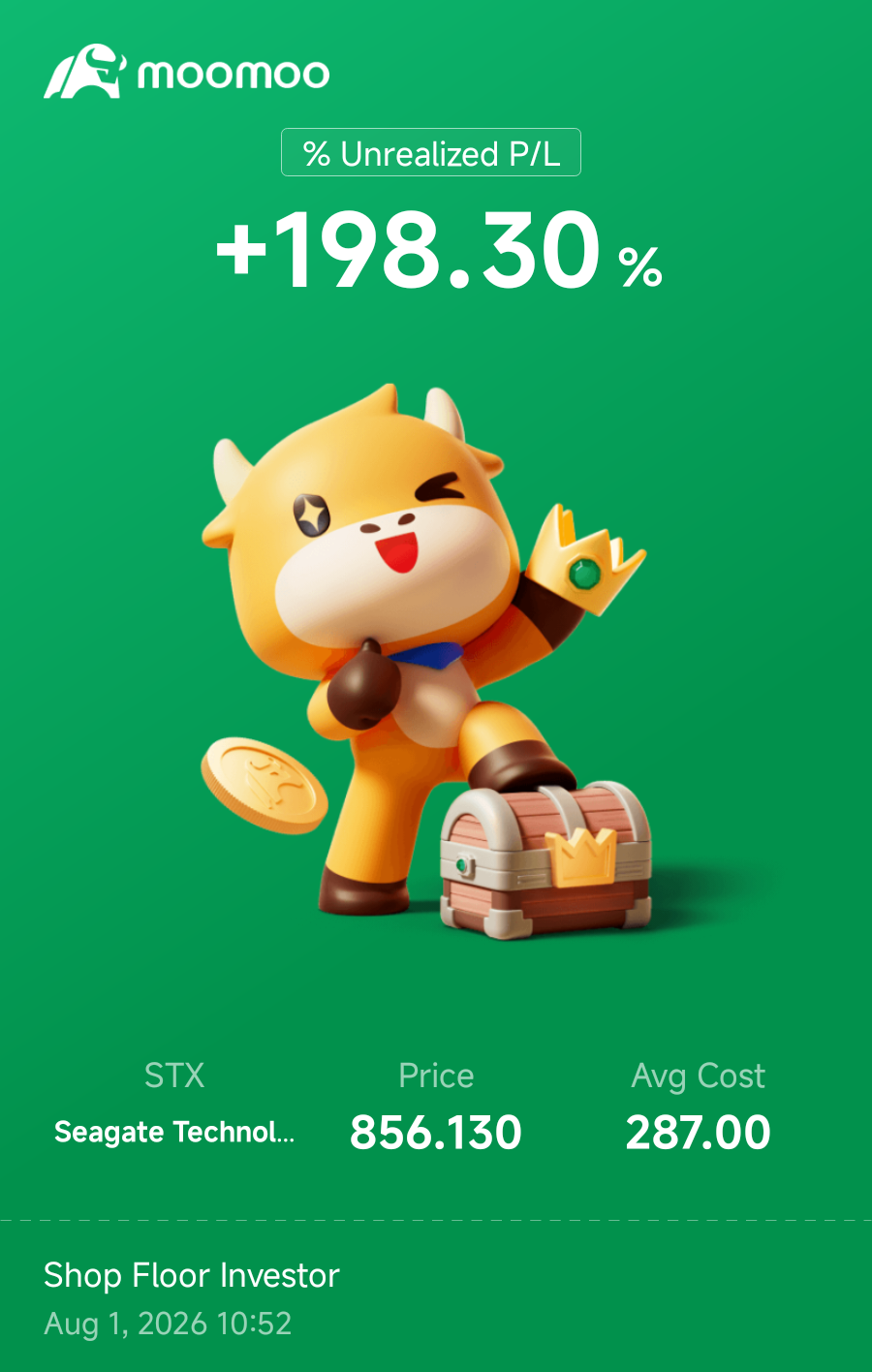
The first stock I am sharing for the Earnings Season Portfolio challenge is $Seagate Technology (STX.US)$, which boasts the current highest percentage return in my portfolio of +198.3% thus far. Average cost is at 287 with the latest closing price of 856.13.

If you look at that number and assume I called the memory/storage boom early and held with conviction the whole way, then you would be wrong. The real story is messier, and I think the messy version is more useful to you than the clean one.
This is my actual trade history of STX (not the highlight reel):
Sep 2025: Bought 13 shares @ $193.30, sold same day @ $202 | Small win, but no real thesis
Oct 2025: Bought 10 @ $257.50, sold same day @ $250.69 | Loss
Oct 2025: Bought 7 @ $229.33, sold six days later @ $211.80 | Loss
Jan 2026: Bought 8 @ $287 | This is the position that actually mattered
Apr 2026: Trimmed 4 @ $513.85 | +79% on that lot
Today, I am holding the remaining 4 shares @ $287 cost, which yields me +198.3% gains on what's left.
Unsupported feature.
Please use the mobile app.
That is three round-trips, two of them losses, before I built a position I actually held. This is the part I do not see people post, and I am sharing this to show you that big gains like +198.3% are not all roses and petals.
My reasoning in late 2025 was only one sentence: "ride the memory/storage boom." That is it. No margin analysis, no read on where Seagate sat in its own cycle, no view on execution risk in the technology roadmap it was betting on. Strange, right? As someone who will not sign off on a change management record at work without proper justification, impact/risk assessment, in-depth review, and capability data, I bought a stock on a narrative alone. Furthermore, it does not reflect the quality and depth of the analysis I strive for in my posts here. The two losing round-trips are what that gets you. I had no framework for why I owned it, so I had no framework for holding through normal volatility either.
In retrospect, here is what I should have been tracking from day one: revenue growth, margin trajectory, technology execution risk (Seagate's story rests on its HAMR roadmap actually shipping at volume, not sitting on a slide), customer concentration and durability of demand, where the industry sits in its own cycle, and direct competitor positioning. I did not do any of that until January. The fact that the position I finally built conviction around is the one still working is not a coincidence.
Seagate's fiscal Q4 2026 results were genuinely strong: revenue of $3.63B, up 48% year-over-year, non-GAAP EPS of $5.71 versus a $5.10 estimate, and non-GAAP gross margin at a record 52.7%, up from 37.9% a year earlier. Full fiscal 2026 revenue came in at $12.2B, up 34%, with record free cash flow of $3.1B. Guidance for next quarter is $4.1B revenue and $7.30 EPS, which comes in well above what analysts had modeled.
The engine is the HAMR-based Mozaic drive platform, which now represents roughly 40% of nearline exabyte shipments exiting fiscal 2026, targeting 70% by June 2027. Data center customers already account for 81% of revenue and 89% of exabyte shipments, with that segment growing 43% year-over-year. This is AI-driven hyperscaler demand for high-capacity drives, not a consumer story. Consensus rating is Strong Buy, with price targets raised into the $900–$1,250 range across Argus, TD Cowen, Wedbush, and Barclays.
Nevertheless, I want to be honest since I am holding the stock. Valuation is stretched, with P/E TTM around 61x at the time I am writing this. This is well above historical multiples for hard drive makers. The long-term SSD/QLC NAND substitution risk has not gone away. Flash storage getting cheaper per bit could erode HDD's advantage in the highest-capacity tier over time. Western Digital is the direct competitor, and the thesis partly depends on Seagate keeping its HAMR lead. This industry also has a real cyclical history. Storage went through a genuine downturn as recently as fiscal 2023, and Seagate carries more balance sheet leverage than WDC, which matters more in a downturn. Even the stock's own behavior is a tell: shares fell over 8% intraday on earnings day before recovering after hours, meaning a lot of good news is already priced in.

Even so, I will be holding for now, but with a reason, not inertia. I already trimmed half the position in April and banked a 79% gain on that lot. What is left is a small residual position sized at a level where I am comfortable being wrong. I am not adding here at these multiples. What would change my mind: the Mozaic 4 HAMR ramp slipping off schedule, gross margin dropping below 50% for a couple of quarters, or hyperscaler capex commentary turning cautious.
Storage and memory have cratered before: fiscal year 2023 was not that long ago. For anyone who has lived through a cyclical downturn in this space, semis, memory, or storage: what was the earliest real-time signal you actually saw before the cycle turned, not the one you only recognized looking back?
$S&P 500 Index (.SPX.US)$ $NASDAQ 100 Index (.NDX.US)$ $Nasdaq Composite Index (.IXIC.US)$ $Invesco QQQ Trust (QQQ.US)$ $SPDR S&P 500 ETF (SPY.US)$ $iShares Core S&P 500 ETF (IVV.US)$ $Vanguard S&P 500 ETF (VOO.US)$ $The Technology Select Sector SPDR® Fund (XLK.US)$ $Vanguard Information Technology ETF (VGT.US)$ $Roundhill Memory ETF (DRAM.US)$ $Vanguard Mid-Cap Growth ETF (VOT.US)$ $iShares MSCI USA Momentum Factor ETF (MTUM.US)$ $Vanguard Total Stock Market ETF (VTI.US)$ $iShares Core S&P Total US Stock Market ETF (ITOT.US)$
Disclaimer: Community is offered by Moomoo Technologies Inc. and is for educational purposes only.Read more


Comments (4)
to post a comment
30
2