
Burry Bets Against Semis: Is the AI Equipment Trade Too Hot?


S&B Research and the Deathly Bubble - Part 2 - The Last Innings..

The Last Innings of the Software Bear Market & The Deathly AI Infrastructure Bubble
Software is being priced like yesterday’s story just as the market is finally starting to understand how valuable the application layer will be once the AI buildout matures. Meanwhile, semiconductors and AI infrastructure are being treated like they can defy gravity forever, even as hyperscaler capex turns parabolic and revenue forecasts become more aggressive by the quarter.
The market has it backwards. Software has already taken the pain. Semiconductors have not.
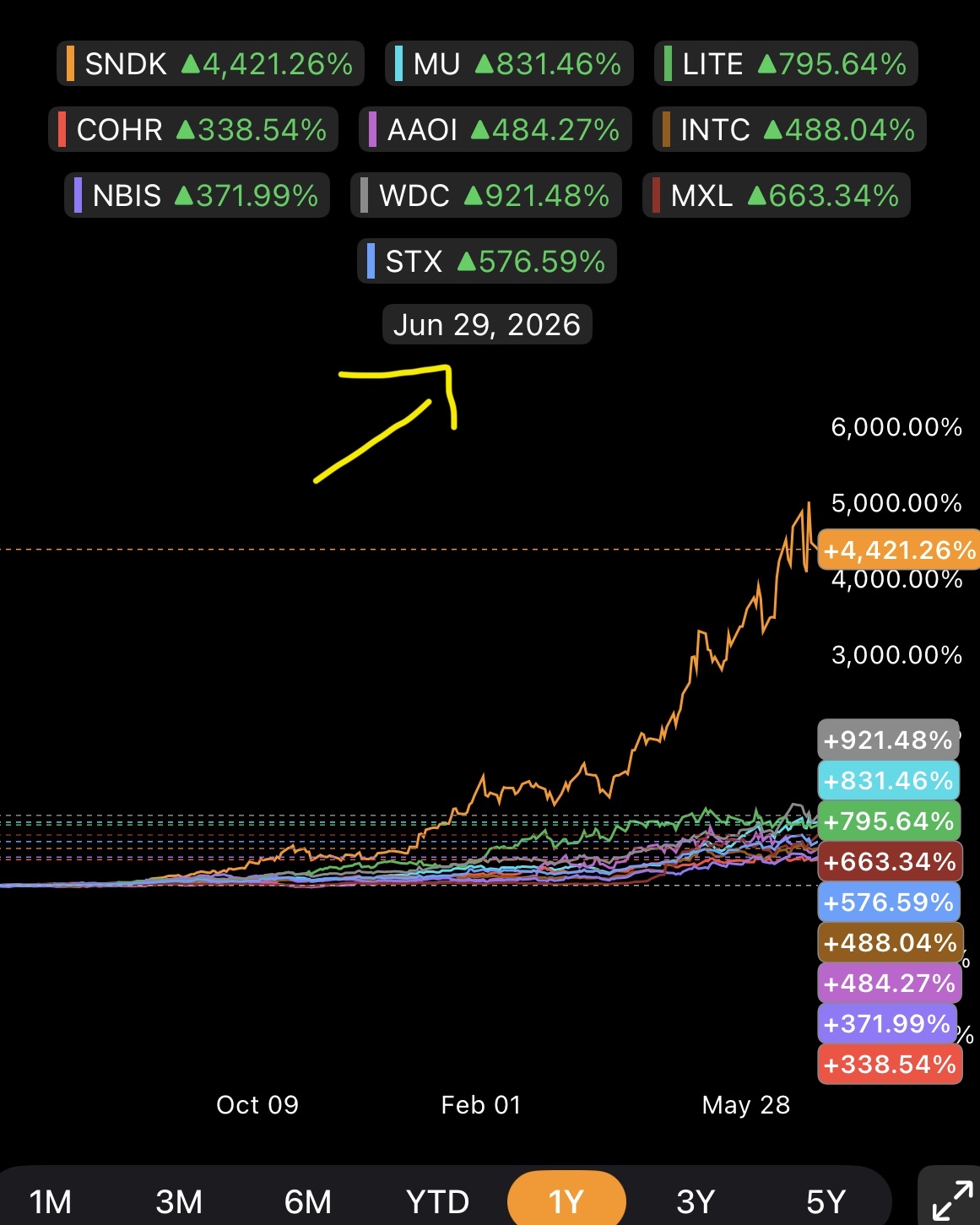
$SanDisk (SNDK.US)$ $Western Digital (WDC.US)$ $Micron Technology (MU.US)$ $Lumentum (LITE.US)$ $Coherent (COHR.US)$ $Applied Optoelectronics (AAOI.US)$ $MaxLinear (MXL.US)$ $Intel (INTC.US)$ $NEBIUS (NBIS.US)$ $Seagate Technology (STX.US)$ $Astera Labs (ALAB.US)$ $VanEck Semiconductor ETF (SMH.US)$ (1 Year chart)
Software Already Did the Bleeding
The software selloff is no longer a theory. The iShares Expanded Tech-Software Sector ETF entered bear-market territory, sitting roughly 27% below its September 2025 peak, while major software names suffered deep drawdowns as investors panicked over AI substitution risk. The repricing has been brutal enough that analysts and commentators started calling it the "SaaSpocalypse," with median SaaS multiples collapsing and distressed debt rising across the sector.
That matters because software is no longer expensive in the way it was at the top. A large part of the fantasy premium has already been destroyed. When a sector has already endured drawdowns, multiple compression, and credit stress, it is usually much closer to the end of the punishment than the beginning.
Why Software Deserves a Better Tone
The bearish case on software is loud, but it is also increasingly lazy. AI agents are absolutely attacking weak, commodity, seat-based SaaS models, especially where the product was little more than workflow overhead sold one human license at a time. But that is not the same as saying software loses. It means bad software loses.
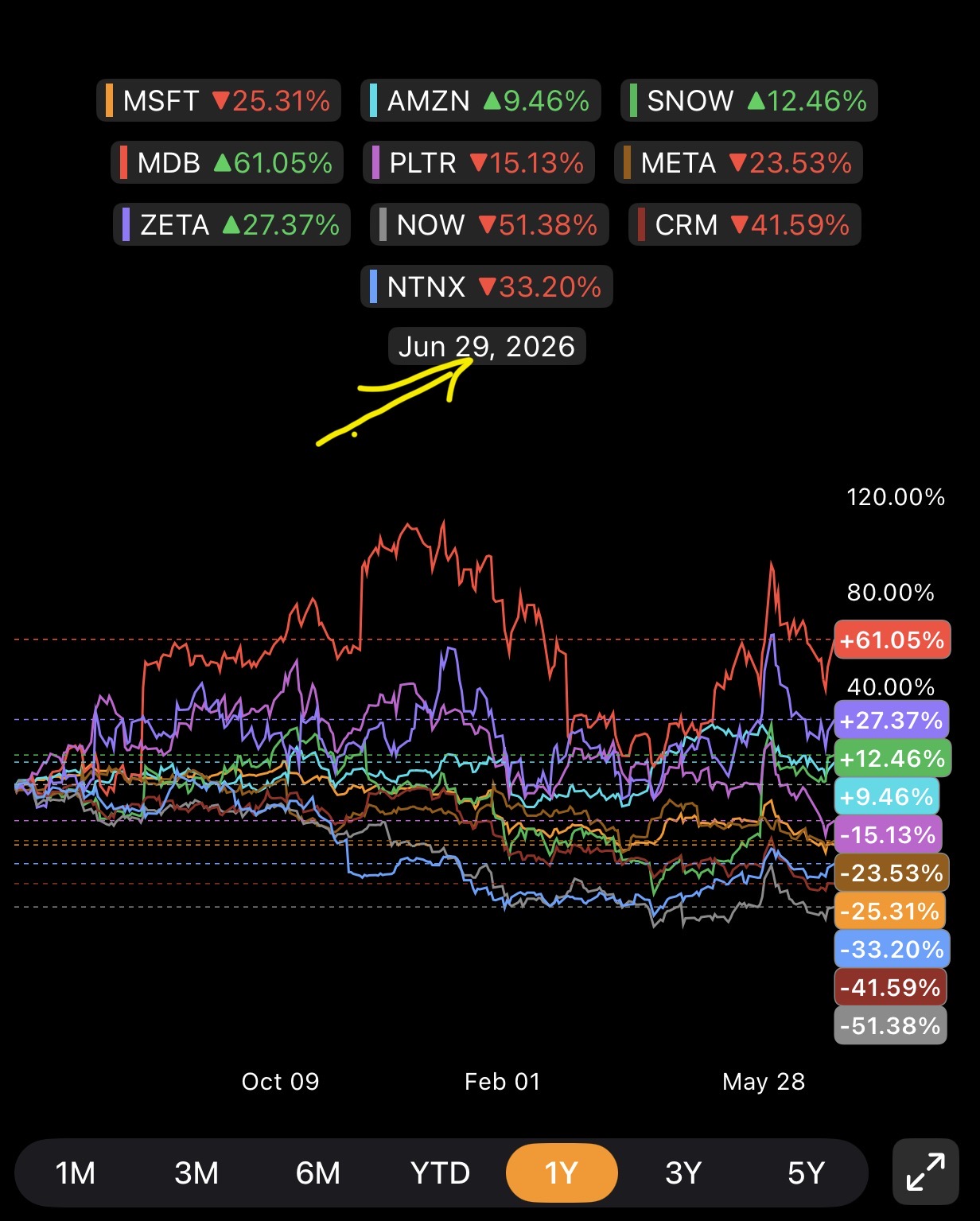
$Microsoft (MSFT.US)$ $Meta Platforms (META.US)$ $Amazon (AMZN.US)$ $MongoDB (MDB.US)$ $Snowflake (SNOW.US)$ $Zeta Global (ZETA.US)$ $ServiceNow (NOW.US)$ $Salesforce (CRM.US)$ $Nutanix (NTNX.US)$ $Palantir (PLTR.US)$ $Applovin (APP.US)$ $iShares Expanded Tech-Software Sector ETF (IGV.US)$
The winners on the other side of this washout could be better businesses than before: leaner cost structures, more usage-based pricing, stronger workflow ownership, and deeper integration with AI-driven outcomes instead of seat counts. Once the market stops treating all software like disposable middleware, capital can start separating true application-layer winners from the bloated casualties of the old SaaS era.
The Semiconductor Bubble Is the Real Problem
This is where the tone should get harsher. The semiconductor and AI infrastructure trade is starting to look less like disciplined investing and more like late-cycle worship of whatever touched the AI narrative first. Hyperscaler AI and cloud capex has surged from roughly $250 billion in 2024 to around $400 billion in 2025 and is projected to reach roughly $635 billion to $690 billion in 2026. That is not normal growth. That is a spending frenzy.
Bank of America now sees the semiconductor market surpassing $1.3 trillion in 2026 after a massive upward revision, while Deloitte and SEMI also project historic peaks in industry sales and equipment spending driven by AI demand. Those forecasts may prove directionally right over time, but the market is already acting as if every dollar of capex will earn a heroic return and every premium GPU, ASIC, network switch, and fab tool will remain scarce forever.

That kind of thinking is how bubbles talk.
Why the Bubble Looks Deathly
The most important detail is that only about 25% of hyperscaler capex goes directly to chips, while roughly 75% is going into the surrounding physical stack: data centers, power, cooling, networking, and land. In other words, this is not just a chip boom. It is a full-body infrastructure binge.
And binges end badly when expectations get stupid. Futuriom has warned that hyperscaler capex could drop 20% to 30% if spending ratios revert toward historical norms. If that happens, the market will discover very quickly that semiconductors are not magical; they are cyclical, capital-intensive, and brutally exposed when demand expectations overshoot reality.
Last Innings
Software already got punched in the face. Semiconductors are still being congratulated at the casino. That is why the better risk-reward may now be in select software names that can actually monetize AI through workflow, data, and outcomes, while the bigger valuation danger sits inside the infrastructure layer that the market still treats like a one-way trade.
The AI cycle rewarded the shovel sellers first. The next phase may reward the companies that actually turn that compute into revenue. When that rotation happens, software will stop looking like the problem and semiconductors will start looking like what they are: the deathly bubble nobody wanted to challenge at the top.

Thank you
SBR
Additinol Notes -
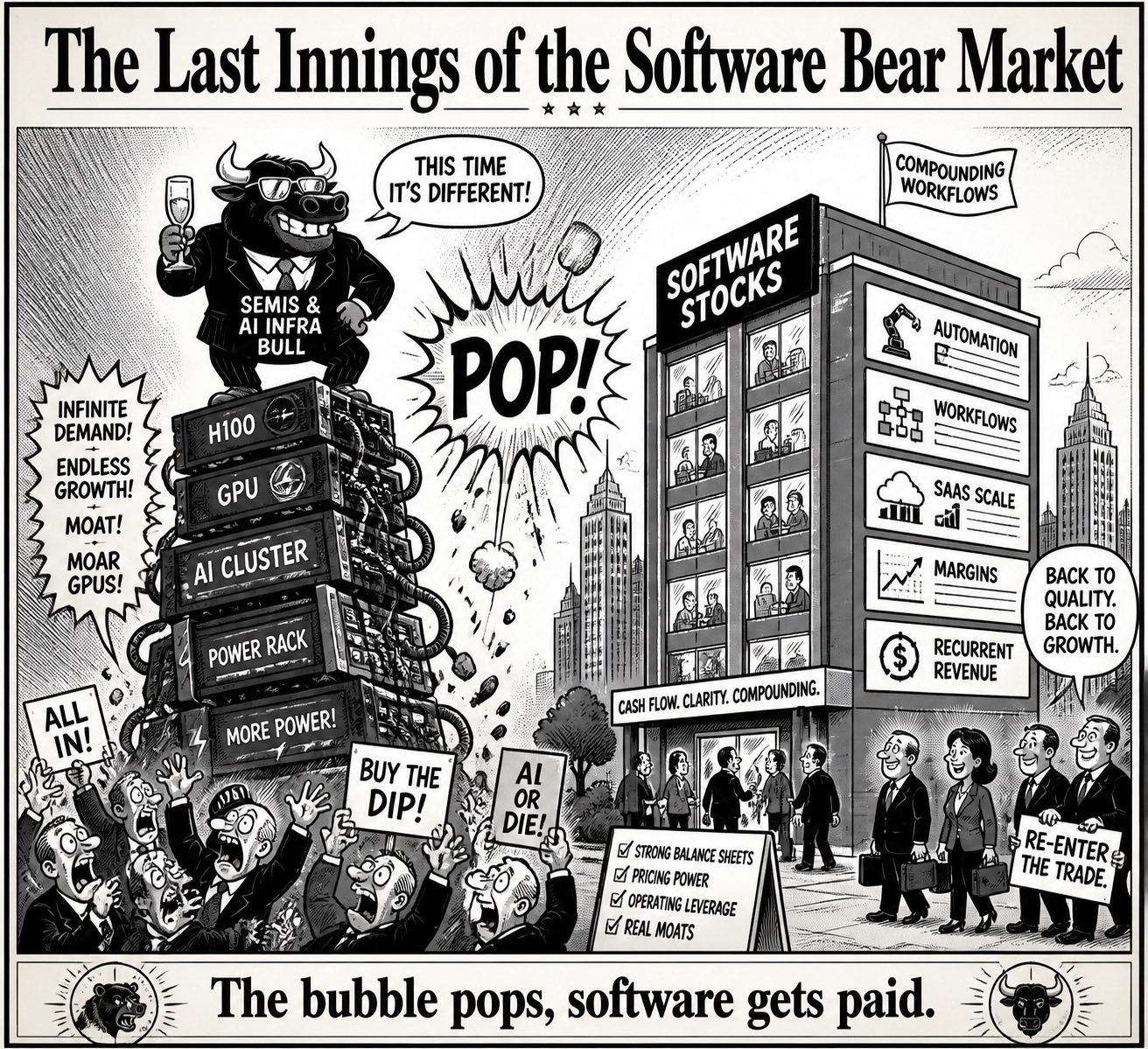
When a bubble pops, the market quickly stops rewarding hype and starts repricing assets based on fundamentals, which usually means sharp declines, tighter credit, layoffs, and a reset in confidence. For software, that can actually be a positive setup if the bubble is in semiconductors or AI infrastructure, because companies often shift from aggressive capex to efficiency, workflow automation, and tools that help them do more with less.
That is why software can benefit after a capex slowdown: it is lighter on capital, faster to deploy, and more directly tied to cost savings and operating leverage than hardware-heavy AI spending. If investors rotate away from crowded chip and infrastructure names and toward businesses with recurring revenue, stronger margins, and clearer utility, software can re-rate upward even while the old bubble deflates.
S&B Research Desk Notes
Personally, I have turned bullish on software. As we move into July 1 and the second half of the year begins, the narrative could start shifting. If investors begin rotating out of the most crowded AI infrastructure and semiconductor names, capital may flow back into software, where valuations have already been compressed and re-rating potential looks much better. Financial stocks may also fit into that same bucket as the market broadens beyond the AI trade.
We have seen a version of this before. In 2022, semiconductor demand cooled sharply after the pandemic-era surge, and the industry was left dealing with excess inventory, slower order flow, and margin pressure. That inventory buildup eventually hurt balance sheets and earnings reports across parts of the supply chain. The lesson is simple: when the cycle turns, the market often punishes the most crowded winners first, while overlooked sectors like software can quietly become the next place where money rotates and valuations recover.
I know this was long, but its was needed. Thank you for taking the time in doing so. Please know we dont do options, and follow me for more stock picks and deep dive research like this. The next quarter we will released “S&B Research and the Prisoners of Wallstreet”
Cheers 🍻
Disclaimer: Community is offered by Moomoo Technologies Inc. and is for educational purposes only.Read more


Comments (6)
to post a comment
17
8