
NVIDIA's largest-ever foreign direct investment! Google joins the fray! Anthropic secures another massive $35 billion deal! What signals are being sent by the "energyfication" of AI computing power?
In the AI semiconductor race, changes more significant than "improvements in GPU performance" are taking place.
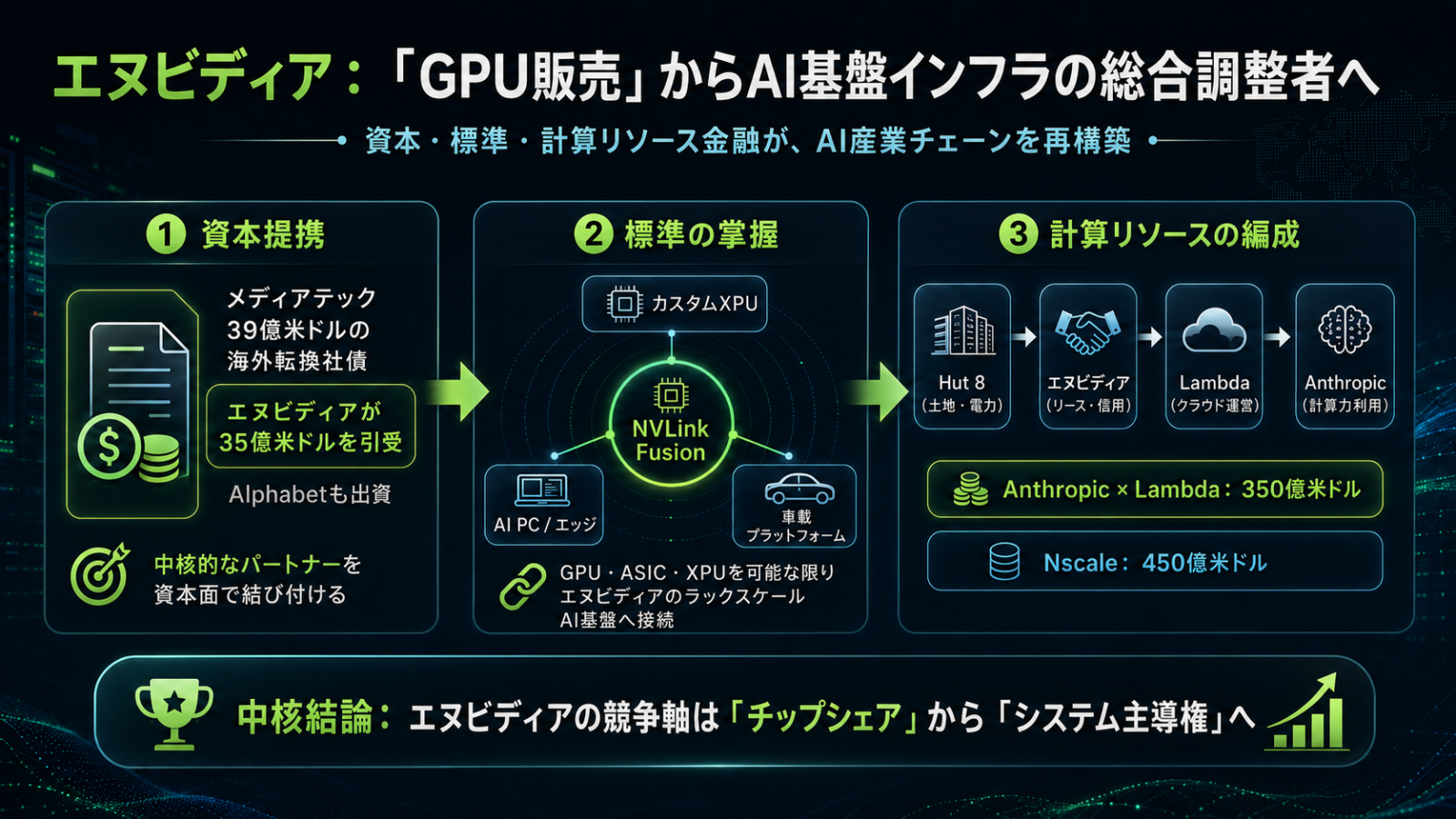
On August 31, $NVIDIA (NVDA.US)$ invested $3.5 billion to underwrite overseas convertible bonds (CBs) issued by Taiwanese semiconductor manufacturer MediaTek, $Alphabet-A (GOOGL.US)$ also quietly joined in. Around the same time, it was revealed that Anthropic$NVIDIA (NVDA.US)$ signed a cloud computing contract worth $35 billion with Lambda, which is backed by$NVIDIA (NVDA.US)$ . According to reports, the related data center lease agreements are held by
Looking at these two moves together, NVIDIA CEO Jensen Huang's strategy is becoming increasingly clear.
NVIDIA is evolving from a mere GPU supplier into a "comprehensive coordinator of AI infrastructure," linking semiconductors, interconnect standards, data centers, and capital.
The AI competition is also escalating from "whose semiconductors are faster" to a comprehensive system war combining financial engineering around capital alliances, system standards, and computing power.

 Why is NVIDIA actively supporting customers' in-house chip development? What is the rationale behind the massive $3.5 billion bet on MediaTek and Google's undercover participation?
MediaTek has completed the issuance of overseas convertible bonds (CBs) worth $3.9 billion, the largest in the company's history. Of this amount,$NVIDIA (NVDA.US)$ subscribed to $3.5 billion all at once, marking the largest direct investment in a non-U.S. company on record, according to Bloomberg News. $Alphabet-A (GOOGL.US)$ also participated, though the amount remains undisclosed. Since the investment vehicle is convertible bonds, it currently constitutes debt investment and does not involve direct ownership of MediaTek shares.

What investors should truly focus on is not the $3.5 billion figure itself, but thestrengthened partnership via "NVLink Fusion" announced alongside the investment.is.
Based on NVLink Fusion, MediaTek will support customers in designing custom XPUs and connect these semiconductors to NVIDIA's rack-scale AI infrastructure.
The scope of the partnership extends from data centers to AI-enabled PCs and automotive platforms, including collaboration on the jointly developed "GB10 Grace Blackwell" as well as integration between "Dimensity Auto" and "NVIDIA DRIVE AGX."
In other words,$NVIDIA (NVDA.US)$ is actively supporting customers in developing semiconductors that are "not its own GPUs."
While this may seem unusual at first glance, it likely represents a significant strategic shift by CEO Jensen Huang.
Google has "TPU", $Amazon (AMZN.US)$ Amazon has "Trainium", $Microsoft (MSFT.US)$ Microsoft has "Maia," $Meta Platforms (META.US)$ and each continues to develop its own accelerators. The trend of major cloud providers developing in-house ASICs to cut costs and improve inference efficiency is now irreversible.$NVIDIA (NVDA.US)$ If NVIDIA insists that "all AI computing requires GPUs," it will ultimately end up in direct conflict with its largest customers.
Instead of stubbornly defending the stance that "customers should buy our GPUs for all AI computing," CEO Jensen Huang is adopting a more realistic strategy.
While NVIDIA allows customers to develop their own semiconductors, it ultimately wants them to run on rack-scale systems defined by NVLink.
It is important to emphasize that even if third-party XPUs adopt NVLink, the use of CUDA is not mandatory. $NVIDIA (NVDA.US)$ The real battle for hegemony is over lower-level scale-up connectivity and system entry points in the era of heterogeneous mixed AI computing.
$Alphabet-A (GOOGL.US)$ This trend has become even clearer with Hut 8's participation in this fundraising round.
While Google expands its TPU capabilities, $Broadcom (AVGO.US)$ or $Marvell Technology (MRVL.US)$ it is deepening collaborations with custom semiconductor partners such as [partners], and even participated in MediaTek's fundraising this time. The future of AI infrastructure is unlikely to see 'GPUs displacing ASICs' or 'ASICs replacing GPUs'; rather, GPUs, ASICs, and XPUs are highly likely to coexist in the long term.
The real battleground lies in who controls the interfaces between these heterogeneous semiconductors, the networks, and rack-scale systems.
Is Anthropic investing $35 billion in NVIDIA? A three-way partnership involving NVIDIA, Anthropic, and LambdaIf the MediaTek deal signals NVIDIA's strategic moves regarding semiconductor architecture and interconnect standards, Anthropic's $35 billion contract highlights another front in the AI race, namely"the financialization of computing power".
According to reports, Anthropic has signed a cloud computing contract worth approximately $35 billion with Lambda. The project is located in Texas, where $Hut 8 (HUT.US)$ will be responsible for building the data center, while Lambda will operate the computing power provided by NVIDIA GPUs. Meanwhile, the lease agreement for this data center istruly held by $NVIDIA (NVDA.US)$ It has been reported that...
The most notable point here is not "how many additional GPUs Anthropic purchased," but ratherthe overall structure of the transaction.is.
・ Hut 8 is responsible for securing power and constructing data centers.
・ NVIDIA leverages its strong creditworthiness to secure long-term infrastructure.
・ Lambda operates the GPU cloud services.
・ Anthropic can commit tens of billions of dollars upfront, eliminating the need to purchase server rooms or servers directly, and convert significant capital expenditures into operating expenses through long-term cloud contracts.
$Hut 8 (HUT.US)$ To date, it has signed two lease agreements with Beacon Point, each for 352 megawatts (MW) over a 15-year term. The total value of these base contracts reaches $19.6 billion for 704 MW. The company has disclosed that it has already contracted 949 MW of IT capacity across its entire AI data center portfolio.

Anthropic's "compute capacity hoarding" does not stop here.
Previously, Anthropic reportedly entered into a compute capacity agreement worth approximately $45 billion with Nscale to deploy NVIDIA's "Vera Rubin." The combined value of the two contracts with Lambda and Nscale has already reached approximately $80 billion. At the same time, Anthropic continues to extensively utilize Google's "TPUs," adopting a multi-vendor strategy to mitigate the risk of dependence on a single technology path.
This signals a highly significant shift.
Previously, the approach was to "buy GPUs as needed," but it has now become strikingly similar to practices in the energy sector.
First, secure power supply, then acquire land, accelerate data center construction, and ultimately lock in computing capacity for several years ahead through long-term contracts and financial instruments. AI computing power has transformed from standard IT equipment into a strategic resource requiring groundwork to be laid years in advance.
Why should we pay attention to these two developments?When we look at the developments involving MediaTek and Anthropic together, $NVIDIA (NVDA.US)$ the strategy becomes very clear.
While NVIDIA's core strengths have traditionally been its GPUs and "CUDA," it is now continuing to expand further into the periphery.
At the semiconductor layer, "Blackwell" and "Vera Rubin" will continue to serve as the core providers of general-purpose AI computing power.
At the system layer, "NVLink Fusion" aims to integrate third-party ASICs and XPUs into a unified interconnect architecture.
At the infrastructure layer, NVIDIA is beginning to connect emerging cloud and data center developers, such as Lambda and Nscale, through investments, lease agreements, and credit support.
As a result, $NVIDIA (NVDA.US)$and $Broadcom (AVGO.US)$ or $Marvell Technology (MRVL.US)$ relationships such as these have also begun to shift from mere competition to "coopetition" (cooperative competition).
$Broadcom (AVGO.US)$and$Marvell Technology (MRVL.US)$ continues to benefit from the explosive adoption of in-house developed ASICs by major cloud providers.
$Advanced Micro Devices (AMD.US)$ also benefits as customers pursue multi-vendor and heterogeneous computing. However, if the proportion of these semiconductors ultimately integrated into the NVLink ecosystem increases, ASIC growth does not directly translate into $NVIDIA (NVDA.US)$ lost opportunities for .
$Advanced Micro Devices (AMD.US)$ also benefits as customers pursue multi-vendor and heterogeneous computing. However, if the proportion of these semiconductors ultimately integrated into the NVLink ecosystem increases, ASIC growth does not directly translate into $NVIDIA (NVDA.US)$ lost opportunities for .
What CEO Jensen Huang truly aims to achieve is not making all AI semiconductors NVIDIA products. Rather, it is to create a state where, regardless of whether GPUs or ASICs are installed in server rooms, they are connected via methods defined by NVIDIA.
However, this model has also sparked new controversies.
If NVIDIA, while being a semiconductor supplier, invests in customers, supports emerging cloud providers, and even engages in long-term data center lease agreements, the market will naturally"circular financing"raise concerns. The concern is that the supplier is artificially inflating demand by providing funds to customers to purchase its own products.
This risk cannot be ignored.
$Alphabet-A (GOOGL.US)$ Participation in MediaTek's fundraising, the actual compute bottlenecks faced by Anthropic, and the sustained increase in capital expenditure by hyperscalers all indicate that AI demand is not solely driven by financial engineering.
However, as investors, suppliers, lenders, and customers become increasingly intertwined within the supply chain, it implies that credit risks could be amplified in a domino effect if AI's commercial returns fall short of expectations.
Goldman Sachs: Shortage of AI compute resources expected to persist until 2028. Real opportunities are already spreading from GPUs to "peripheral areas"! Which stocks should you watch now?Eric Sheridan, Head of TMT (Technology, Media, and Telecom) at Goldman Sachs, believes that the tight supply and demand for AI computing power could last until the first half of 2028. Market focus is gradually shifting from "how large will capital expenditures ultimately be" to "when will these capital expenditures generate revenue and profits."
Against this backdrop, there remainthree realistic bottlenecks.advanced semiconductors, memory, and power/data centersis.
For US equity investors, this means investment opportunities are expanding from single GPU plays to the entire supply chain.

If "NVLink Fusion" continues to expand compatibility with third-party semiconductors,$NVIDIA (NVDA.US)$ the valuation logic for [NVIDIA] will have further opportunity to evolve from "GPU hegemon" to "AI infrastructure platform." However, investors must now closely monitor not only GPU shipment trends but also the credit risk of neocloud providers, regulatory developments, and the return on investment (ROI) of AI.
● $Broadcom (AVGO.US)$ 、 $Marvell Technology (MRVL.US)$ 、 $Advanced Micro Devices (AMD.US)$ [AVGO and MRVL] represent the custom computing sector.
$Alphabet-A (GOOGL.US)$ 、 $Amazon (AMZN.US)$ 、 $Microsoft (MSFT.US)$ 、 $Meta Platforms (META.US)$ Both companies continue their efforts to reduce reliance on single GPUs, and the long-term trend of ASIC penetration remains valid.
AVGO holds a solid advantage in custom AI semiconductors, while MRVL is expanding partnerships with clients such as Google. Meanwhile, AMD is a key beneficiary of GPU diversification.
● $Arista Networks (ANET.US)$ 、 $Credo Technology (CRDO.US)$ 、 $Astera Labs (ALAB.US)$ 、$Coherent (COHR.US)$ 、 $Lumentum (LITE.US)$ [ANET, CRDO, ALAB, COHR, and LITE] represent high-speed interconnects.
As AI servers transition from single-GPU configurations to rack-scale systems comprising dozens or even hundreds of GPUs and XPUs, the importance of data transfer speeds is rising rapidly.
ANET’s AI-focused Ethernet, CRDO’s high-speed connectivity, ALAB’s PCIe/CXL solutions, and the high-speed optical communications and CPO (Co-Packaged Optics) represented by COHR and LITE will all benefit from the scaling of AI clusters.
● $Taiwan Semiconductor (TSM.US)$ and $Micron Technology (MU.US)$ [Advanced process nodes, advanced packaging, and HBM] are foundational assets where one must "buy the pickaxes regardless of who wins the gold rush."
Ultimately, whether GPUs or ASICs see wider adoption, advanced process nodes, advanced packaging, and HBM (High Bandwidth Memory) remain indispensable.
With HBM capacity per AI semiconductor chip continuing to increase, MU remains one of the US stocks most directly benefiting from the memory cycle.
●Finally, there are higher-risk, higher-elasticity plays $Hut 8 (HUT.US)$ and the neo-cloud supply chain.
$Hut 8 (HUT.US)$ Hut 8 is transitioning from a crypto mining company to a "power + land + AI data center real estate" business, with long-term lease agreements providing cash flow visibility. While Lambda, Nscale, and Fluidstack are unlisted, they are reshaping resource allocation in the AI cloud market.$Hut 8 (HUT.US)$ For Hut 8, the biggest catalysts are data center handovers and new lease agreements, while the biggest risks are construction delays, financing costs, and the creditworthiness of end tenants.
●On the other hand, $Alphabet-A (GOOGL.US)$ 、 $Amazon (AMZN.US)$ 、 $Microsoft (MSFT.US)$ 、 $Meta Platforms (META.US)$ The logic for hyperscalers is different.
They are not only the largest buyers of AI-related capex but also the most aggressive companies in developing their own semiconductors.
If custom chips like "TPU," "Trainium," and "Maia" gradually lower the cost per token, the true long-term winners may not just be semiconductor suppliers, but hyperscalers capable of converting cheap computing power into profits from cloud services, advertising, and AI applications.
SummaryMediaTek's $3.5 billion investment and Anthropic's massive $35 billion deal with Lambda may appear to belong to different sectors at first glance, but they actually highlight a common shift within the AI industry.
Competition is escalating from a battle over semiconductor performance to a war over system ecosystems.
$NVIDIA (NVDA.US)$ While leveraging "NVLink Fusion" to integrate a broader range of third-party XPUs, it is also engaging in the expansion of AI data centers through capital expenditure, leasing agreements, and emerging cloud providers.
Therefore, at this next stage, investors should not merely ask, "Who can take GPU market share from NVDA?" They need to pose a different question.
"When GPUs, ASICs, and XPUs coexist, who will control the standards, networks, memory, power, and data centers that connect them?"
Amidst this shift, NVDA remains firmly at the core. However, custom computing, high-speed interconnects, memory manufacturing, and AI infrastructure—represented by AVGO, MRVL, AMD, ANET, CRDO, ALAB, COHR, LITE, TSM, MU, and HUT—are increasingly becoming a critical second battlefield in the current AI capex cycle.
At the same time, investors must remain wary of the debt levels of emerging cloud providers, private credit, revolving loans, and the ROI of AI commercialization. If future application revenues fail to justify the current massive capital expenditures, this highly financialized AI infrastructure ecosystem could become the primary driver of the next major valuation swing.
Source: moomoo, public market filings
-moomoo News Sherry
This article uses machine translation in part
Disclaimer: Moomoo Technologies Inc. is providing this content for information and educational use only.Read more


Comment (1)
to post a comment
28
20