Tesla Surged Ahead of Cybercab Event — What's Next?

No Steering Wheel, No Problem? How Costs, Policy, and Market Potential Will Shape Tesla's Cybercab
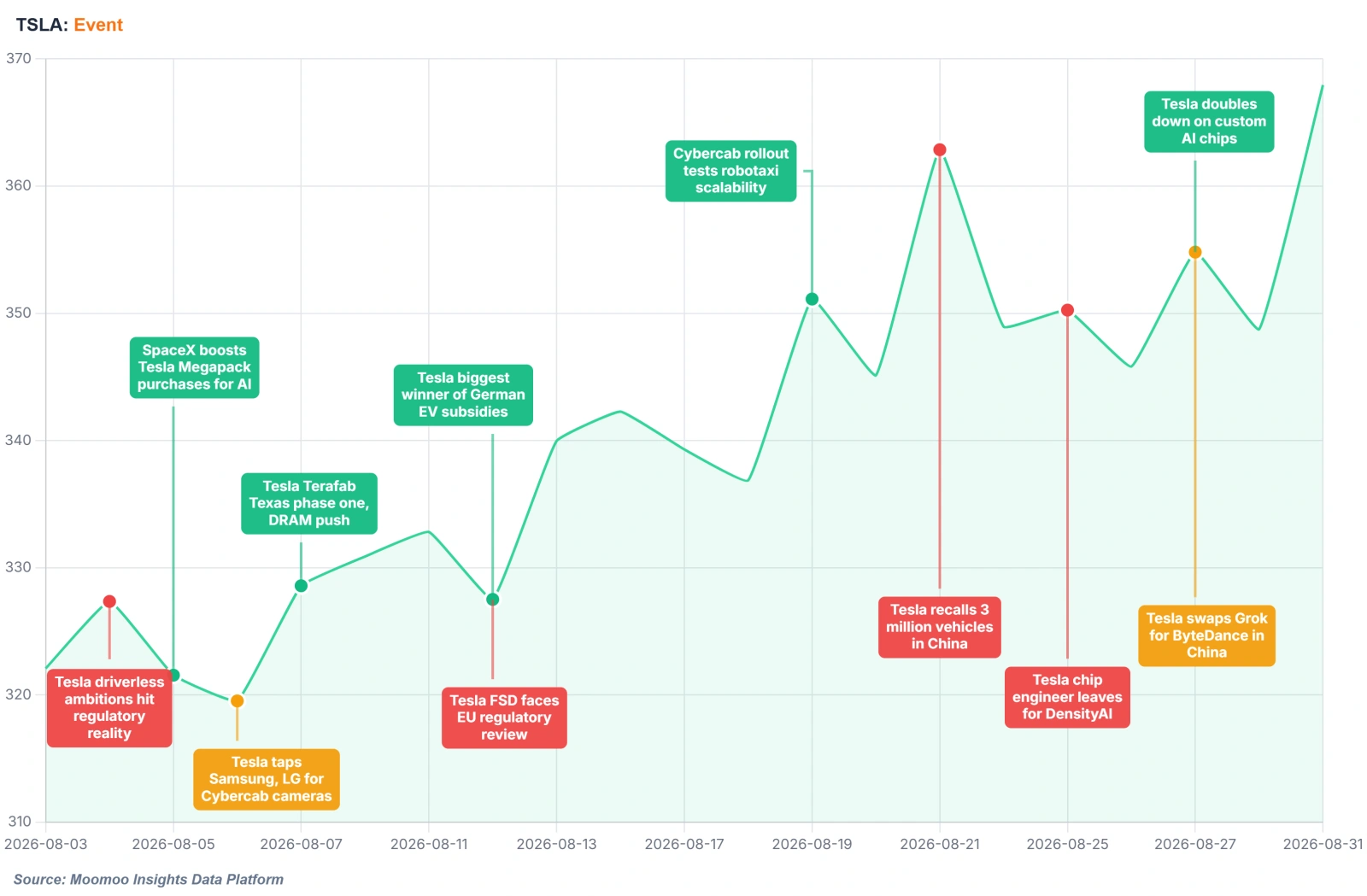
$Tesla (TSLA.US)$ ’s stock surged by more than 5% on Monday as investors eagerly anticipated the upcoming Cybercab launch event. The market's enthusiastic response underscores the immense commercial expectations surrounding Tesla's upcoming Robotaxi rollout.
This surge is not mere speculation — it is driven by converging fundamental forces that could accelerate Robotaxi deployment far beyond current timelines. Below, we examine three key drivers: structural cost reductions, evolving policy frameworks, and the vast addressable market.
Costs
The Cybercab achieves structural cost reductions by streamlining its hardware. Based on global mobility data, 90% of trips involve two or fewer passengers, and 95% of trips are under 100 km. Consequently, the Cybercab features a two-seat configuration with a 35 kWh small battery pack. Built on a new chassis that continuously accumulates data, it lacks a steering wheel and pedals, offering a range of approximately 320 km. Its AI decision-making response time is under 100 ms, roughly 60% faster than the average human reaction time of 250 ms. The manufacturing cost per vehicle is estimated at $23,000–$25,000, about 30% lower than the purchase price of mainstream US ride-hailing vehicles during the same period.
The Cybercab’s battery pack costs are expected to drop by 40%–60% compared to the Model Y. Utilizing a 35 kWh small battery design, it incorporates 4680 cells, Cell-to-Chassis (CTC) integration, and dry battery electrode technology. CTC technology alone reduces battery costs by approximately 14% compared to the Model Y. Under equivalent range conditions, this translates to savings of roughly $2,000–$5,000.
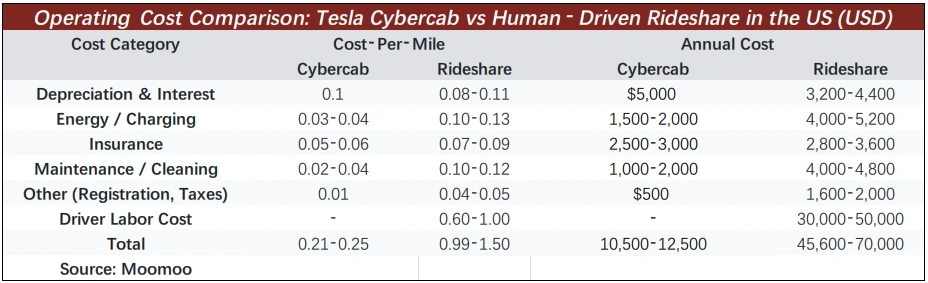
Post-mass production, the Cybercab’s operating cost is projected to be around $0.21–$0.25 per mile, demonstrating clear commercial viability. This cost advantage is driven by three structural factors:
① Fleet self-insurance model: Actuarial pricing based on driving behavior data yields insurance rates at approximately 50% of personal driving rates.
② Energy efficiency and charging: With an efficiency of 6 miles/kWh and access to a Supercharger network, electricity costs are around $0.03 per mile.
③ Reduced labor dependency: Predictive part replacement and automated cleaning lower annual maintenance and operations costs to roughly $1,000–$2,000.
Based on AAA (American Automobile Association) data and assuming an annual ride-hailing mileage of approximately 40,000 miles, the core cost assumptions break down as follows.
Depreciation and interest amount to roughly $4,334 annually, while fuel costs, calculated at an average gas price of $3.15 per gallon, equate to about $0.13 per mile. Insurance runs approximately $2,859 annually, which translates to $0.07–$0.09 per mile. For maintenance and cleaning under high-intensity usage, small sedan maintenance is estimated at $0.10 per mile and mid-size sedan maintenance at $0.12 per mile. Financing costs are $1,131 per year, and with registration and taxes at roughly $519 per year, these combined fees equate to $0.04–$0.05 per mile. Finally, driver labor, assuming 40 working weeks per year at 40–50 hours per week with major city hourly wages of $15–$20, translates to labor costs of $0.60–$1.00 per mile.
Policy
Regulations for operating vehicles are expanding, and insurance frameworks are accelerating. Tesla’s Robotaxi fleet expansion will benefit from increased caps on vehicle operations under new legislation. In April 2025, NHTSA released a new autonomous driving regulatory framework. Its core principles prioritize safety, remove unnecessary barriers, and support commercial deployment. It also introduced the AV STEP voluntary reporting framework, trading transparency for regulatory flexibility as federal policies gradually align.
Under the current Federal Motor Vehicle Safety Standards (FMVSS), the annual exemption quota for vehicles without steering wheels is limited to 2,500 units. The proposed SELF DRIVE Act of 2026 aims to raise the annual exemption limit for vehicles not meeting traditional motor vehicle requirements to 90,000 units; its pace of advancement will dictate the upper limit of Robotaxi expansion.
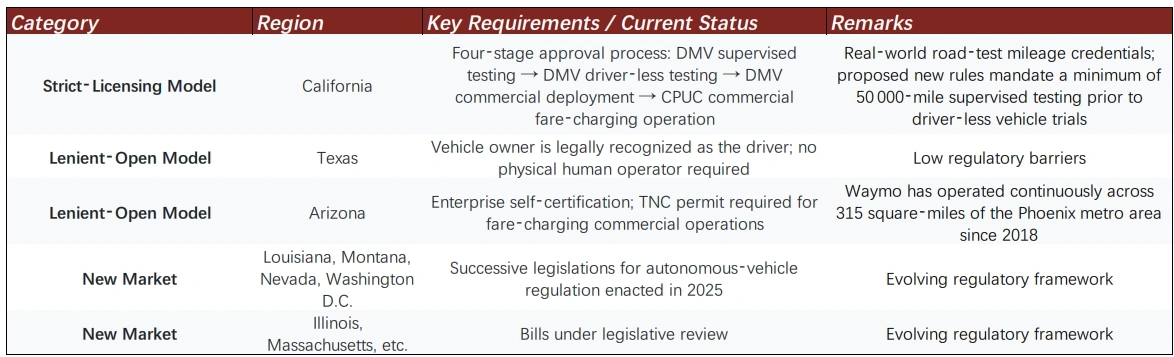
US Robotaxis are prioritizing deployment in Southern and Southwestern states, primarily due to wider roads, fewer extreme weather events, and relatively relaxed regulations. Northeastern cities like New York and extremely cold regions like Alaska serve as supplementary areas for collecting long-tail scenario data in extreme weather.
State-level regulatory classifications vary: States like California have strict licensing requirements, necessitating both a DMV autonomous driving permit and a CPUC (California Public Utilities Commission) commercial permit. Texas has relatively relaxed regulations, having already issued Transportation Network Company (TNC) operating permits that allow Robotaxis to operate statewide without a safety driver. Regulatory frameworks in other states continue to evolve alongside federal legislation.
Market: US Robotaxi Fleet to Reach ~260,000 Units by 2030
The growth potential for Robotaxis is vast, with advanced autonomous driving expected to scale rapidly. According to Frost & Sullivan, the global Robotaxi market will expand rapidly from $300 million in 2025 to approximately $352.6 billion by 2035, representing a 10-year CAGR of ~103%.
US travel demand is highly concentrated. With Robotaxis currently holding less than 0.5% market share, there is ample room for penetration. The pace of adoption depends on the speed of regulatory licensing, the reduction in per-vehicle operating costs, and user acceptance in core cities. According to US Census data, the total US population is 352 million, with urban road mileage accounting for ~69%. Private car commuting makes up ~91% of travel, while public transit accounts for ~3%–5%, leaving significant penetration space.
The US Robotaxi landscape is led by $Alphabet-A (GOOGL.US)$ 's Waymo and Tesla. Tesla aims to cover half of the US population, with state-level coverage rates directly impacting the speed of achieving this goal. Second-tier players like $Amazon (AMZN.US)$'s Zoox are accelerating their layout through ecosystem partnerships with $Uber Technologies (UBER.US)$ / $Lyft Inc (LYFT.US)$ . Uber’s proprietary $Lucid Group (LCID.US)$ vehicles are scheduled for delivery and operation by late 2026. The "Uber-Lucid-Nuro" alliance plans to deploy approximately 20,000 Robotaxis in the San Francisco Bay Area over six years.
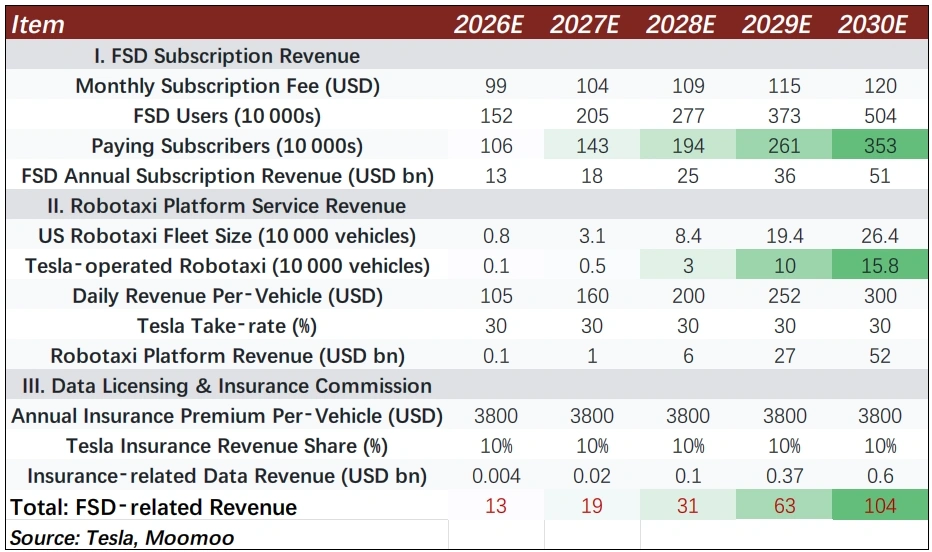
Optimistic market estimates project the US Robotaxi fleet to reach ~260,000 units by 2030. From 2026 to 2030, under a neutral scenario, it will grow from 4,000 to 220,000 units. FSD-related revenue could reach the $10 billion level by 2030, comprising: $5.1 billion in annual subscription revenue; $5.2 billion in Robotaxi platform service revenue; $60 million in Tesla insurance revenue sharing.
Disclaimer: Moomoo Technologies Inc. is providing this content for information and educational use only.Read more


Comments (5)
to post a comment
39
10