Reward | Share Your Trade Plan Today!


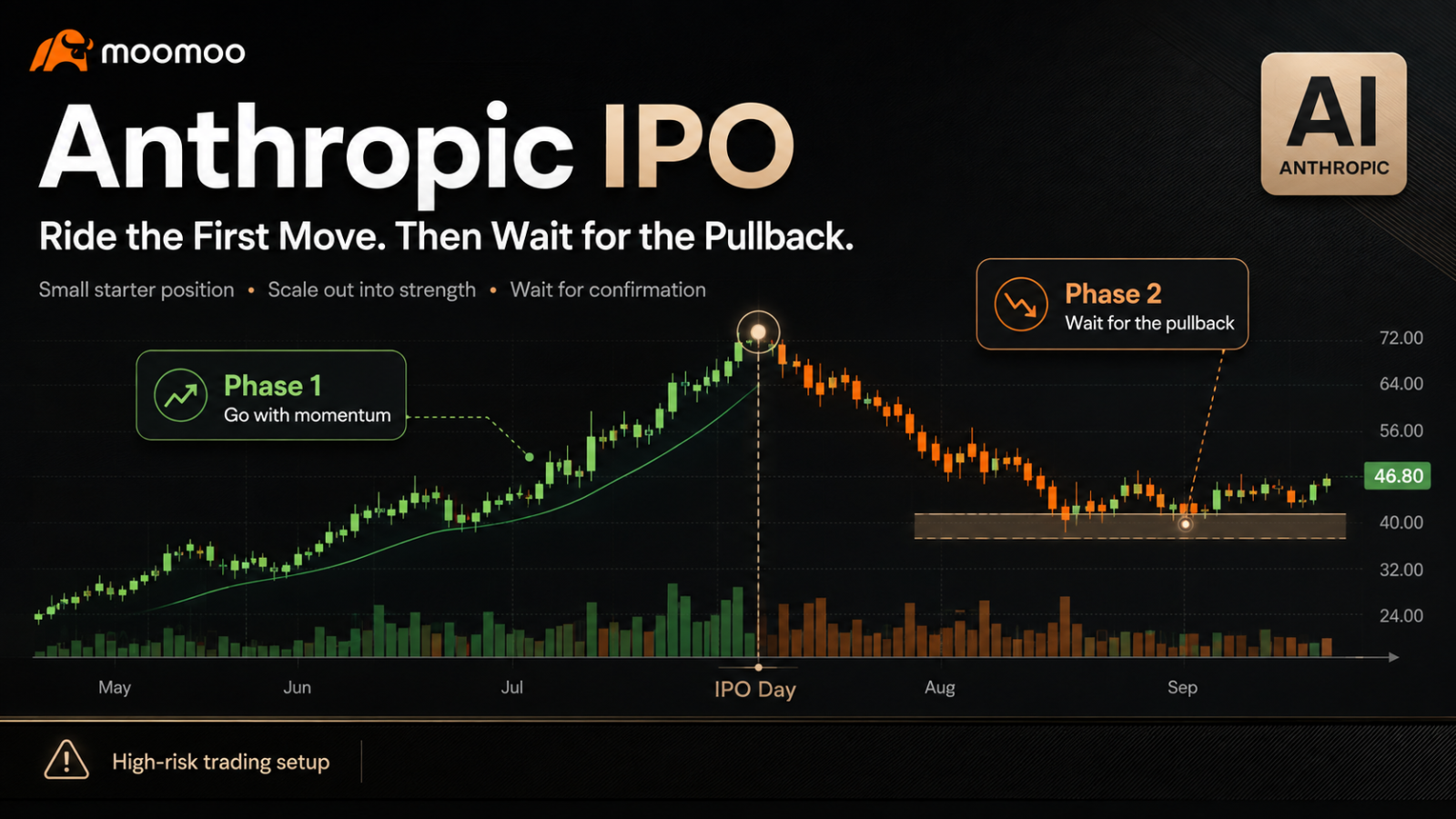
My Anthropic IPO Plan: Ride the First Move, Then Wait for the Pullback

Why I Still Want In
It’s August 26, and another eye-catching Anthropic headline has just surfaced. Reports yesterday said the company may pitch investors on a potential market worth more than $30 trillion, even larger than the $28.5 trillion opportunity SpaceX highlighted during its own IPO process. The market is also discussing a possible IPO that could raise as much as $100 billion at a valuation of around $2 trillion, with a listing potentially coming as early as September or early October. None of this is final yet. The offer price, ticker and listing date have not been officially announced. In other words, Anthropic is clearly getting closer to the public market, but the numbers circulating right now should still be treated as pre-IPO expectations rather than confirmed terms.
Why do I still want to participate when it lists? The reason is pretty simple. In the public market, Nvidia sells the picks and shovels, while Microsoft, Google and Amazon are broader technology platforms. Anthropic, however, would be one of the few listed companies offering investors direct exposure to frontier models, Claude Code and enterprise AI agents. Once it goes public, that scarcity alone could create a powerful short-term premium. A lot of investors may not immediately care whether the company is worth $1.5 trillion or $2 trillion. Their first concern will simply be whether they have a position. Anthropic’s annualized revenue run rate reportedly exceeded $65 billion in July, while the company is projecting revenue of between $190 billion and $200 billion in 2028. That kind of growth story can easily drive market excitement.
The Valuation Is Already Aggressive
That said, I personally would not place too much weight on the latest $30 trillion market-opportunity figure. It does not mean Anthropic is realistically going to generate $30 trillion in revenue. It is more of a theoretical calculation based on the assumption that AI could participate in a huge share of human work and capture 100% of the relevant markets. To me, it sounds more like an IPO narrative than a financial forecast. What really matters will be the quality of revenue, customer concentration, gross margins, compute costs, cash burn and future capital expenditure disclosed in the final prospectus. If Anthropic really lists at a $2 trillion valuation, that would be roughly 31 times its current annualized revenue run rate. Even using the midpoint of its projected 2028 revenue, the valuation would still be around 10 times revenue two years into the future. A great deal of future success would already be priced in.
How I’d Enter
So my plan is not to buy a huge position at any price. My plan is to buy a small position regardless of whether the final valuation looks expensive. Suppose I allocate 100 units of capital to this trade. On the first day, I would initially deploy only 15 to 20 units. I would not rush in during the first few seconds of trading either. I would watch the first 10 to 15 minutes, let the most chaotic opening orders clear, and then start buying gradually with limit orders. If the first pullback holds around the opening range and the stock begins strengthening again, I may add another 10 to 15 units. My total first-day position would generally stay below 35 units. If the stock opens more than 50% above the IPO price, I would probably buy only 5 to 10 units. At that point, I would not be buying the fundamentals. I would be buying into extremely crowded sentiment. I can accept paying an expensive price for a small position, but I will not go all in simply because I am afraid of missing out.
Taking Profits Before Emotion Takes Over
I would also decide my profit-taking levels before entering the trade rather than making emotional decisions after the stock starts moving. If the share price rises 20% above my average cost, I would sell 40% of the position. At a 35% gain, I would sell another 30%. For the final 30%, I would use a trailing stop roughly 10% to 12% below the highest price reached. For example, if the stock peaks at $200 and then falls back to around $176 to $180, I would close the rest of the position. I am not trying to sell at the exact top. I simply want to make sure that an unrealized gain on the screen eventually becomes real money in the account. On the downside, if the stock falls 10% to 12% from my entry, or if it opens strongly, sells off into the close and then breaks below the first day’s low on the following session, I would get out. If I entered the trade for the IPO momentum, I cannot suddenly rename it a ten-year investment just because it starts losing money.
I Wouldn’t Short It Too Early
After selling the first long position, I would not immediately flip to the other side. I would first wait for clear evidence that Anthropic was genuinely losing momentum. At a minimum, I would want to see the stock fall 12% to 15% from a recent high, attempt a rebound, fail to recover the previous level and then break below the earlier low on stronger volume. In simple terms: an initial drop, a weak rebound and then another breakdown. Buying an inverse product simply because the stock has already risen a lot would be extremely dangerous. A heavily hyped IPO can still rise another 30% or even 50% after it already looks expensive. If I turn bearish too early, the two-times leverage could wipe out the position before the real decline even begins.
The instrument I would consider for that second stage is a two-times inverse single-stock ETF tied to Anthropic, sometimes described as a -2x Daily ETF or an UltraShort ETF. Its objective would be to deliver roughly twice the inverse of Anthropic’s daily return. SEC filings already show applications for leveraged inverse products linked to Anthropic, but that does not guarantee they will begin trading on the same day as the stock. It also does not guarantee that they will immediately have enough volume, liquidity or tight enough bid-ask spreads to trade efficiently. These products target twice the inverse of the stock’s daily move, not twice its cumulative decline over a month. The longer they are held and the more volatile the stock becomes, the more the final result can differ from what people intuitively expect. In an extreme case, Anthropic could be down over a certain period while the inverse ETF still fails to produce a profit.
The Second Trade Would Be Smaller
For the second stage, I would only use money already earned from the first trade. I would not put the original principal back at risk. For example, if I made $10,000 on the long position, I would use no more than $2,000 to $3,000 for the two-times inverse ETF. I would enter with only half of the planned position first. I would add the other half only if Anthropic’s rebound failed and the stock broke down again. If the inverse ETF lost around 8%, I would cut the position. If it gained 15%, I would sell half. At a gain of roughly 25% to 30%, I would largely exit the rest. I would generally hold the position for only one to five trading days and reassess it every day. This is not the type of product I would buy and forget about. It is a short-term trading instrument.
Tesla and SpaceX Are Good Reminders
Tesla and SpaceX have already shown how both the opportunity and the risk can play out. Tesla went public in 2010 at $17 a share. It closed its first trading day at $23.89, a gain of more than 40%, but fell back below the IPO price only a few sessions later. Over the long term, Tesla obviously became an extraordinary investment. But for investors trading the first week, the initial surge and the sharp pullback were equally real.
SpaceX is an even closer comparison. It was priced at $135, gained about 19% on its first day and later traded as much as 67% above its IPO price. Once the excitement faded, however, the stock fell back below $135 and at one point dropped 43% from its post-listing closing high. That is often how truly popular IPOs behave: scarcity and excitement push the stock far above fundamentals at first, and only later does the market begin focusing again on valuation, earnings and the amount of stock available for trading. But the SpaceX example also shows how difficult it is to identify the exact top. The first decline may only be a shakeout, and the first rebound may still lead to another record high. I would rather enter the second stage a little late than buy a two-times inverse product too early just to capture a few extra percentage points.
My Bottom Line
That is essentially my approach. I intend to participate in the Anthropic IPO, but I will not abandon discipline simply because the company is Anthropic. In the first stage, I am trying to capture the scarcity premium, the rush for shares and the broader AI excitement. In the second stage, I would be looking for fading sentiment, valuation compression and profit-taking. But both stages do not have to happen. If the stock fails to show strength after listing, I will cut the position. If there is no clear reversal, I will not buy the inverse ETF. If the inverse product has poor liquidity, I will skip the second stage entirely. The market is under no obligation to follow the scenario I have written in advance. The only things I can control are position size, profit-taking and risk management.
This is a very high-risk plan involving a heavily anticipated IPO, short-term market timing and two-times inverse products. It should not be copied blindly. I am writing down my framework and trading levels in advance so that I am less likely to be controlled by emotion once trading begins. A great company, an expensive stock and an attractive short-term trade are three completely different things.
This is only my personal trading plan and does not constitute investment advice.
Disclaimer: Community is offered by Moomoo Technologies Inc. and is for educational purposes only.Read more


Comments (4)
to post a comment
38
2