Nvidia's 70% Growth Outlook May Be Too Conservative. How High Can It Go?

Mooers' Top Picks | 'Obviously Undervalued' Nvidia Takes the Crown Again
This week's AI earnings season is delivering a repricing across every layer of the stack.
Hey guys,
Three earnings reports dropped simultaneously last night — $NVIDIA (NVDA.US)$, $Salesforce (CRM.US)$, and $CrowdStrike (CRWD.US)$ — leaving barely a moment of silence in after-hours trading.
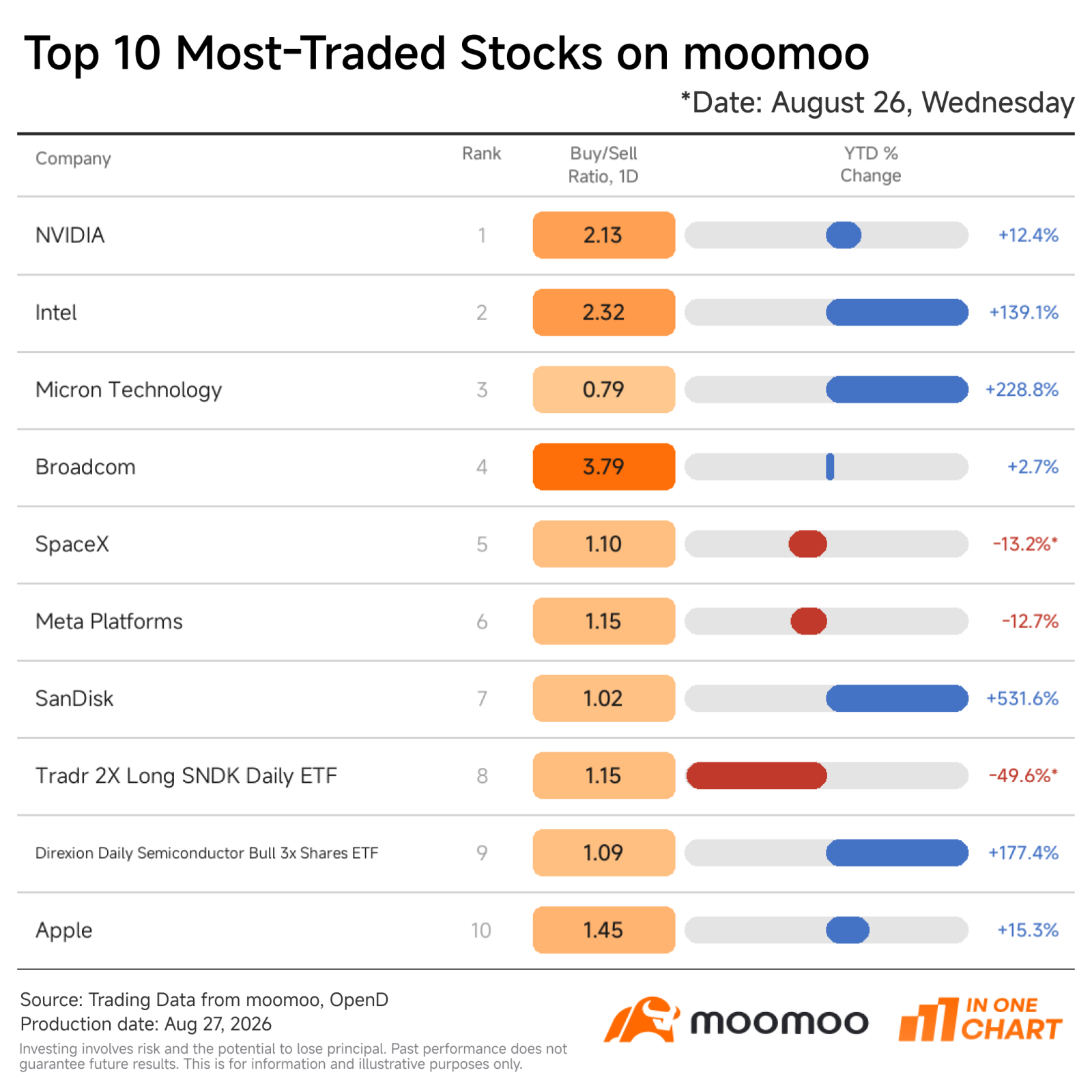
Nvidia is once again the most-traded name on moomoo, up ~6% in pre-market. The pattern of the past four quarters — beat expectations, sell off anyway — has officially been broken.

--
--
--
15 Consecutive Beats
$NVIDIA (NVDA.US)$ has now topped Wall Street's revenue and EPS estimates for 15 straight quarters. But beating expectations and seeing the stock go up are two different things — over the past four quarters, shares fell every single time after an earnings beat.
So what actually flipped the after-hours move from red to green wasn't the $96.2B in revenue or the $2.22 EPS — it was Jensen Huang's Q3 guidance: $108B, a full $3B above consensus. That's when the market exhaled: demand has not peaked.
The valuation backdrop deserves its own mention. Nvidia's forward P/E has compressed to roughly 23x — nearly in line with the S&P 500 average, and far below its own 5-year average of 72x.
Goldman Sachs has called this multiple "quite attractive," and Morningstar's fair value sits about 30% above where the stock was trading.

--
--
--
Here's the interesting part: even Nvidia's most high-profile bear doesn't dispute that the stock looks cheap. Michael Burry recently wrote that Nvidia's valuation appears "obviously undervalued" — and then shorted it anyway.
His thesis: the monopoly cycle in AI hardware will be shorter than the market expects; margins will compress as competition arrives; and much of the AI capex boom lacks real end-user demand to support it — a structure he compares to Enron.
His short positions in Nvidia, Oracle, and other tech names now exceed 21% of his portfolio.

The "SaaSmagedon" Has Been Called Off
The fear was simple: if AI can do the work of 20 people, why would anyone keep paying for 20 SaaS seats? That anxiety peaked on January 29, when the software sector shed over $1 trillion in market cap in a single week.
Last night, two earnings reports put that narrative to rest.
$Salesforce (CRM.US)$ posted Q2 Non-GAAP EPS of $5.90 versus $3.27 expected — a beat of over 80%. The driver: Agentforce, its AI agent product line, now at $1.5B in annualized revenue, up 240% YoY.
The key shift is pricing — $2 per AI-completed conversation, or $125/user/month for the enterprise tier. It's no longer "buying tools for people," it's "renting AI workers" — a fundamentally higher-margin structure.
$CrowdStrike (CRWD.US)$ told a similar story from a different angle: more AI adoption means more attack surfaces means more security spend. Net new ARR hit a record $333M (+51% YoY), shares up 12% after hours.
AI didn't bypass software companies — it became their most powerful repricing tool.

--
--
--
Tonight: Marvell Takes the Stage
$Marvell Technology (MRVL.US)$ reports Q2 after the close tonight. Street expectations: $2.71B in revenue (+35% YoY), $0.93 EPS — both largely in line with the company's own guidance. Marvell specializes in custom ASIC chips and high-speed optical interconnects. $Alphabet-C (GOOG.US)$ shifted part of its chip orders from $Broadcom (AVGO.US)$ to Marvell this year, and Nvidia announced a $2B investment in the company.
Tonight's real question isn't the current quarter — it's whether management's FY2028 outlook can break above the previous $11.5B–$16.5B target range.
Custom chip programs run on 12-to-24-month design-to-revenue cycles; once guidance signals a new contract window opening, the market's reaction tends to be nonlinear.
Disclaimer: Moomoo Technologies Inc. is providing this content for information and educational use only.Read more


Comments (9)
to post a comment
33
20