Meta Stock Slides as AI Costs Rise: When Will the Payoff Arrive?

Meta's Ad Engine Is Strong. Cloud Is the New Wild Card
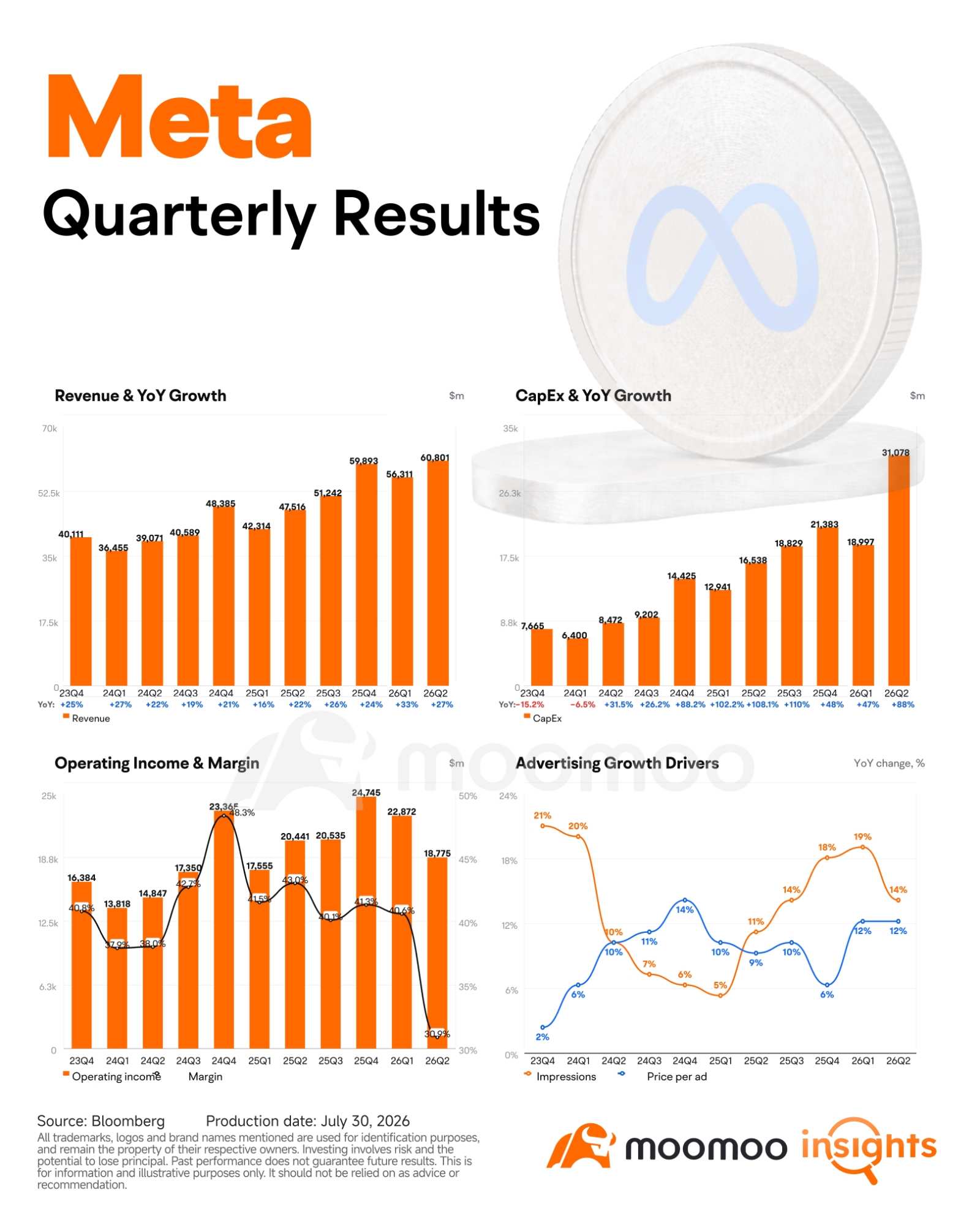
Meta shares fell roughly 6% after its second-quarter results. The problem was not advertising demand: revenue grew 28% to $60.8 billion, while ad revenue rose 27%. Instead, investors focused on surging costs, near-zero free cash flow and the lack of visibility into future AI spending.

The Ad Engine Is Still Strong
Ad impressions increased 14%, while average price per ad rose 12%, showing that Meta continues to grow through both higher volume and better monetization.
AI is already contributing to that performance. Meta said recent model improvements increased Facebook ad clicks by 8.3% and conversions by 15.7%. Advantage+ reached an annual revenue run rate of more than $75 billion, while over 9 million small businesses now use at least one of Meta’s generative AI advertising tools.
Headline profitability looked considerably weaker. Operating income fell 8% to $18.8 billion, and operating margin declined from 43% to 31%. However, the quarter included $2.4 billion of legal charges and $1.18 billion of severance expenses. CFO Susan Li said operating income would have increased 9% without these items.
The core advertising business therefore remains healthy. The larger issue is that infrastructure, AI talent, depreciation and third-party cloud expenses are increasing much faster than revenue.
Free Cash Flow Is Paying the AI Bill
Operating cash flow rose to $31.9 billion, but CapEx reached $31.1 billion. Free cash flow consequently collapsed 91% year over year, from $8.55 billion to only $784 million. Meta also issued nearly $25 billion of long-term debt and conducted no share repurchases during the quarter.

Meta narrowed its 2026 CapEx outlook to $130 billion–$145 billion, raising the lower end by $5 billion. Full-year expense guidance was also increased to $165 billion–$169 billion, while Q3 revenue is expected to reach $61 billion–$64 billion.
The CFO’s defense of this spending was important. Meta believes the AI industry has historically underbuilt infrastructure, making available capacity unusually valuable. The company is therefore prioritizing the maximization of its 2026 and 2027 compute capacity rather than near-term free cash flow.
Management also argues that the investment retains flexibility. Data centers and network infrastructure provide a foundation for future server deployments, while internal custom silicon could improve supply-chain leverage and long-term returns. Partnerships such as the new BlackRock-backed 1GW data center may also supplement Meta’s own cash flow and balance sheet.
The logic is defensible, but the market still lacks a specific 2027 CapEx figure. Until that becomes clearer, investors may continue to discount Meta’s future cash generation.
AI Cloud Becomes the Key Variable
Meta’s emerging cloud strategy is broader than simply renting out spare GPUs.
The company has launched a public model API, is expanding Meta Business Agents and is developing coding and productivity tools for enterprise customers. More than 1 million businesses already use its agents every week across WhatsApp and Messenger. Zuckerberg also said Meta has received offers for compute capacity at a significant premium to what it paid.
CFO Susan Li outlined three potential enterprise offerings: agentic tools, model APIs and direct compute monetization. These could help fund the infrastructure buildout and provide multiple paths to generate returns on invested capital.
This is not yet an AWS-style general-purpose cloud business. Meta has not disclosed cloud revenue, customer commitments or margin targets. For now, it should be viewed as a potentially valuable option rather than proven justification for the entire CapEx program.
But it changes the investment debate. If Meta can combine its computing infrastructure with models, messaging distribution and existing business relationships, AI cloud could become a meaningful new growth engine. If monetization remains limited, Meta risks becoming a much more capital-intensive advertising company with structurally weaker free cash flow.
Investment View
The quarter did not reveal a breakdown in Meta’s core business. Advertising growth remains strong, AI is already improving conversion, and much of the reported profit decline came from unusual charges.
However, the market is no longer willing to reward revenue growth without demanding evidence of returns on AI spending. Meta’s valuation recovery will increasingly depend on two proof points: greater clarity on 2027 CapEx and measurable revenue from APIs, business agents and compute services.
Disclaimer: Moomoo Technologies Inc. is providing this content for information and educational use only.Read more


Comments (2)
to post a comment
26
8