Korea stocks defy odds: Can memory chip momentum persist?


Memory Sector: A Volatile Week, With Price Hikes Continuing
Korea’s Memory “Twin Titans” Whipsawed This Week
South Korea’s market took a two-day hit and then staged a sharp relief rally. In the same rout, Samsung Electronics fell ~11.7% and SK Hynix ~9.6%.
This was primarily a macro + positioning shock, not a collapse in DRAM/NAND fundamentals:
-Geopolitics → oil shock → inflation fear → risk-off / de-leveraging
Escalating Middle East conflict pushed oil higher and revived inflation anxiety, which tends to hit high-beta, crowded “AI complex” equities first—including the memory heavyweights.
-FX stress amplified the equity unwind
The won’s sharp weakness adds a second channel of forced risk reduction (especially for foreign investors managing currency risk), which often means selling the most liquid index bellwethers—Samsung and SK Hynix.
-Crowded trade dynamics
Korea had been a standout performer earlier, and the rout looked like an “air pocket” where leveraged/profit-taking flows overwhelm fundamentals in the short run.
Memory May Extand the Supercycle
Notably, the latest reports suggest Samsung Electronics has ultimately settled 1Q DRAM price increases at above 100%, roughly 30 percentage points higher than the ~70% level discussed in negotiations a month ago.
According to Korean media, some overseas customers have already completed payments, and the supply-negotiation cycle has compressed from annual to quarterly—or even monthly—cadence. This round of increases is being attributed to the AI investment boom, where HBM capacity crowd-out is tightening supply for conventional DRAM while demand remains strong. SK hynix and $Micron Technology (MU.US)$ are reportedly following with similar magnitude increases, signaling an industry-wide pricing regime shift among the top three suppliers, with momentum expected to extend into 2Q.
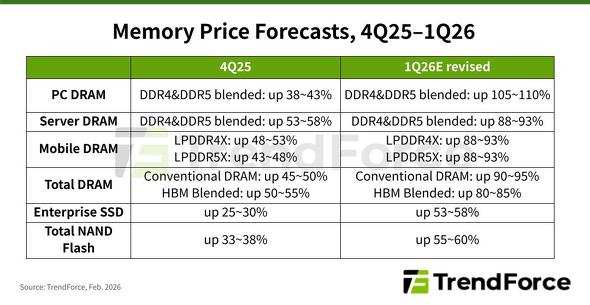
TrendForce’s latest memory industry survey indicates that sustained AI and data-center demand in 1Q26 will further exacerbate the global memory supply–demand imbalance, strengthening suppliers’ pricing power. As a result, TrendForce has materially raised its 1Q26 pricing forecasts:

– Conventional DRAM contract prices: QoQ increase revised up from +55%–60% to +90%–95%.
– NAND flash contract prices: QoQ increase revised up from +33%–38% to +55%–60%.
– Enterprise SSD (eSSD): QoQ increase projected at +53%–58%, setting a new record for quarterly price gains.
Will SRAM affect HBM?
Morgan Stanley analyst Shawn Kim wrote in the latest report that the memory market for AI inference is moving toward a hybrid model as chips become more specialised.
While HBM continues to dominate, “SRAM is carving a niche for workloads where latency matters more than throughput density,” Morgan Stanley stated.
The firm expects that Nvidia will introduce a new inference chip at its upcoming GPU Technology Conference, using a Language Processing Unit architecture built around large amounts of on-chip SRAM.
According to Kim, the debate is not SRAM versus HBM but how both will “remain hierarchical, combining SRAM for hot-path execution with HBM for scalable memory capacity.”
Despite uncertainty over how the AI memory market eventually fragments, the firm maintained Samsung Electronics as its top pick, citing HBM4 qualification, SRAM capabilities, foundry flexibility and the broader commodity upcycle.

Appendix: A valuation table showing Q1 2026 net profit based on guidance provided by the memory/storage-related listed companies themselves or Bloomberg consensus estimates, and the corresponding annualized forward P/E:
Join as a member or upgrade for more access.
Unlock V1
Disclaimer: Moomoo Technologies Inc. is providing this content for information and educational use only.Read more


Comments (6)
to post a comment
32
21