
Malaysia’s Next Semiconductor Boom: The Money Is Finally Coming
The interesting part of Malaysia’s semiconductor story may no longer be whether the industry is growing.
It is.
The bigger question now is:
Who is going to fund the Malaysian companies that need to scale with it?
Over the last couple of months, there has been increasing attention on Penang from VCs, PEs, banks, Bursa, the Securities Commission and other capital-market players.
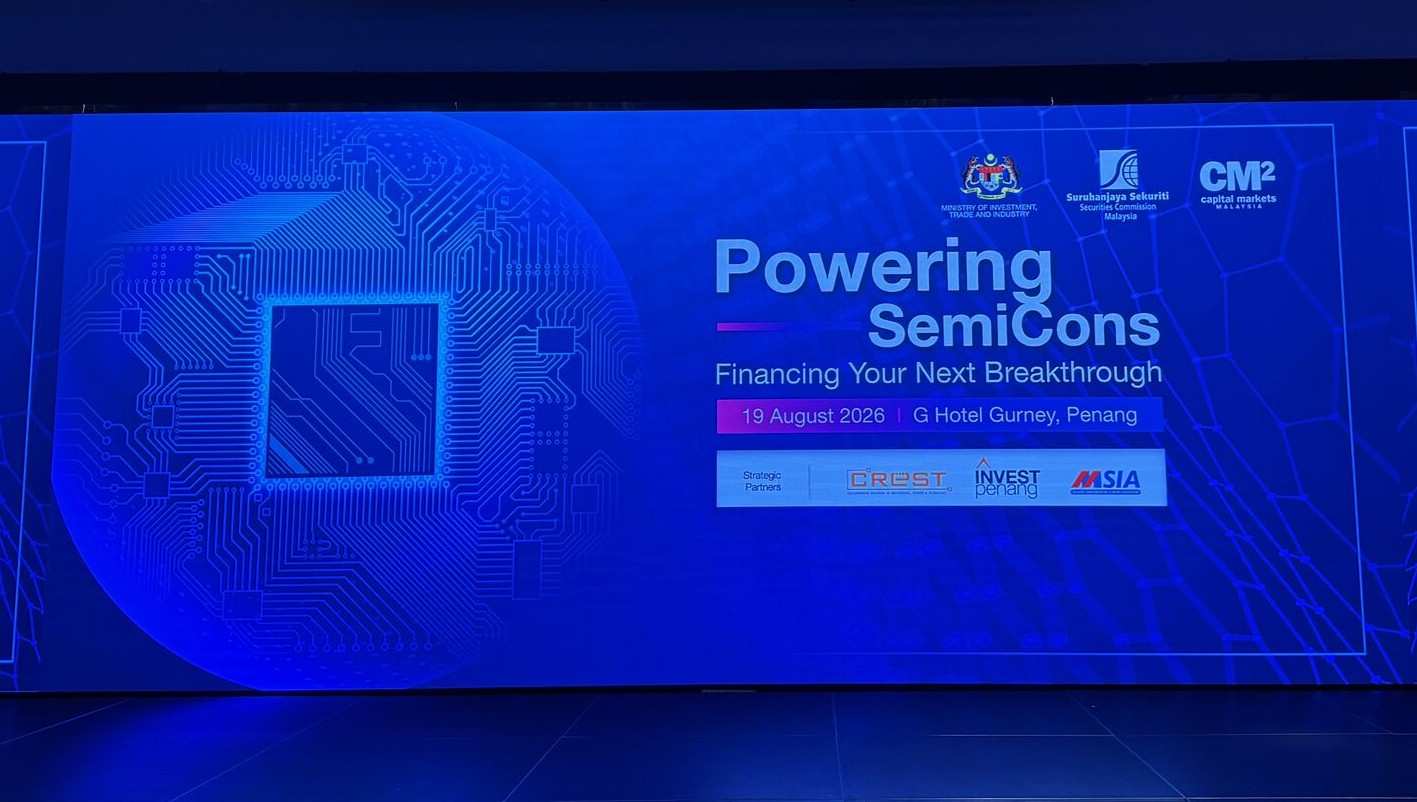
And SC's recent “Powering SemiCons: Financing Your Next Breakthrough” forum in Penang made the message quite clear: Malaysia's semiconductor companies need more than bank loans. They need access to the full capital-market ecosystem — ECF, P2P, VC, PE, private debt and eventually the public market.
Meanwhile, the global semiconductor number has gone absolutely crazy.
Two years ago, the industry was still talking about reaching US$1 trillion around 2030.
Now we are talking about US$1.5 trillion in 2026.
That is a completely different growth trajectory.
Malaysia is already sitting inside this wave.
E&E exports were around RM601 billion in 2024, climbed above RM711 billion in 2025, and reached RM563.6 billion in just the first seven months of 2026, up 43.9% YoY.
That's roughly 48% of Malaysia's total exports.
And then there is Penang.
More than RM350 billion of E&E exports in 1H26.
Do the math and Penang was responsible for roughly 75% of Malaysia's E&E exports in the first half of the year.
This is no longer a small supporting ecosystem.
This is one of Malaysia's biggest economic engines.
And here is where things get interesting for Bursa investors.
Malaysia already has a long list of semiconductor and semiconductor-related companies listed on Bursa.
SkyeChip is particularly interesting because it only made its Main Market debut in May 2026.
At wafer fabrication, there is $DNEX (4456.MY)$ through its 60%-owned SilTerra semiconductor business.
Then the OSAT side:
Then semiconductor equipment, automation and test:
And the wider semiconductor infrastructure and precision-engineering ecosystem includes:
This is the part I think the market may underestimate.
Malaysia doesn't need to build the semiconductor ecosystem from zero.
The ecosystem is already here.
The companies are already here.
The customers are already here.
The export base is already here.
Now the capital is starting to move in behind them.
CoSIF is one example.
The semiconductor scheme provides a 2:1 government-to-private co-investment structure, designed to help mobilise private capital into eligible semiconductor companies.
Then you have ECF.
P2P.
VC.
PE.
Private debt.
Bonds.
Sukuk.
And eventually LEAP, ACE or Main Market for companies that mature enough.
So perhaps the next phase of Malaysia's semiconductor story is not simply:
“Foreign semiconductor giants are investing in Malaysia.”
It is:
“Can Malaysian semiconductor companies raise enough capital to become much bigger players?”
Because building capacity requires money.
Buying equipment requires money.
R&D requires money.
Hiring engineers requires money.
Moving up the value chain requires money.
And if the global semiconductor market really is entering a US$1.5T+ era, the companies with technology, customers, capacity and access to capital could have a very different runway.
The race is no longer just about chips.
It is about capital.
Malaysia has spent years building the semiconductor ecosystem.
Now comes the interesting part:
Who gets funded to scale it?
Not investment advice. Just watching where the capital is starting to flow.


Disclaimer: Community is offered by Moomoo Technologies Inc. and is for educational purposes only.Read more


Comment (1)
to post a comment
13