Share Your Profit/Loss

Investing Essentials | Gold's 30% Slide: Panic or Opportunity?
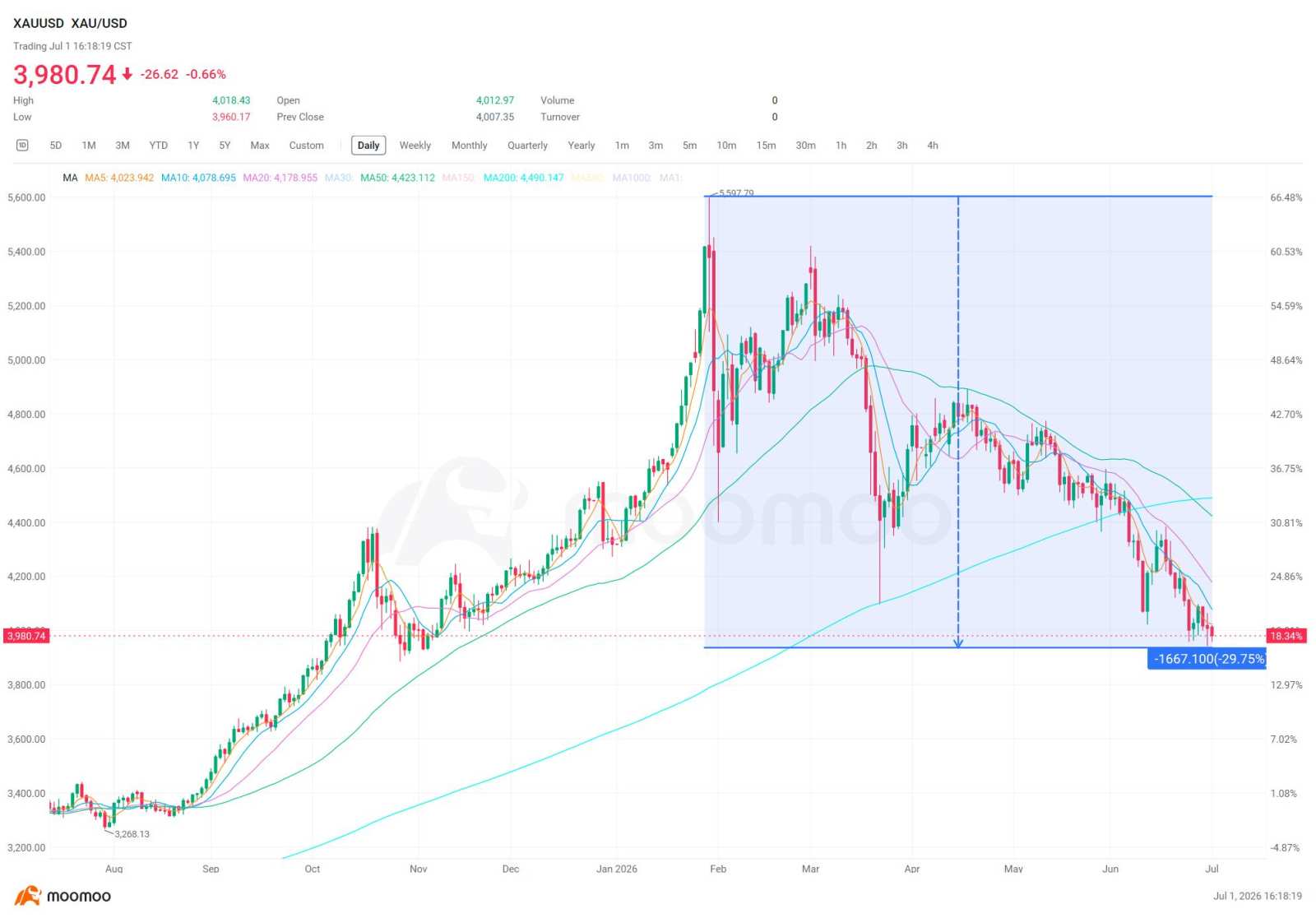
After the Record High: Gold's Sharp Pullback
Gold $XAU/USD (XAUUSD.CFD)$ hit an all-time high of $5,599 per ounce on January 28, 2026 — capping a rally that saw prices climb more than 40% through 2025. Since then, the metal has pulled back roughly 30% to around $3,980/oz as of July 1.

Three forces drove the retreat:
• Fed turned hawkish. Goldman Sachs removed all remaining 2026 rate cuts from its base case in June, pushing easing to mid-2027. Higher-for-longer rates raise the opportunity cost of holding non-yielding gold.
• ETF demand cooled. Asian gold ETFs recorded their first monthly net outflow since August 2025, signalling that the momentum-driven buying that amplified gold's run has stepped back.
• Central bank buying slowed — at least temporarily. Q1 2026 net central bank purchases fell to just 16 tonnes, against a quarterly average of ~225 tonnes from 2021 to 2025. Türkiye alone sold 60 tonnes in March.
The medium-to-long-term case, however, remains structurally intact. Major institutions maintain bullish year-end targets: Goldman Sachs at $4,900/oz, Morgan Stanley at $5,200, JPMorgan at up to $6,300, and Wells Fargo at $6,100–$6,300 — all representing meaningful upside from current levels. The structural pillars underpinning those calls haven't shifted:
• Central banks are projected to buy approximately 800 tonnes of gold in 2026. A World Gold Council survey found a record 45% of central banks plan to increase gold holdings over the coming year.
• De-dollarisation is accelerating. China's top insurance companies have received regulatory approval to allocate up to 1% of combined AUM — roughly 200 tonnes — into physical gold.
• Elevated fiscal deficits, rising sovereign debt, and persistent inflation uncertainty continue to support gold's role as a debasement hedge.
The medium-to-long-term structure is intact — but when the recovery materialises is a different question entirely.
The Problem With "Timing" Gold
If the long-term bull case holds, why not simply wait for the bottom and buy in bulk?
Because gold is exceptionally hard to time. In 2022, prices fell over 20% before reversing sharply — investors waiting for a "clear signal" to re-enter often missed the bulk of the recovery. The same dynamic has played out repeatedly across gold's cycles.
Calling a short-term bottom means simultaneously getting the Fed, the dollar, geopolitical risk, and ETF flows right — all at once. Most professional investors don't consistently manage that. For retail investors, the bar is even higher.
DCA: Less Drama, Same Exposure
Dollar-cost averaging (DCA) cuts through the timing problem by keeping things simple: invest a fixed amount at regular intervals, regardless of price. When prices dip, you automatically buy more units; when prices are elevated, you buy fewer — no forecasting required.
The numbers tell the story. A hypothetical investor who put $500/month into $SPDR Gold ETF (GLD.US)$ from January 2021 would have:
• Invested a total of $33,000 across 66 monthly purchases
• Built a position with an average cost of approximately $208.56/share
• Held a portfolio worth roughly $58,300 as of July 1, 2026 — a gain of approximately +77%
This is despite gold having pulled back ~30% from its January peak. The average cost cushion — accumulated through years of buying into weakness — provides a meaningful buffer that a lump-sum investor at the top would not have.

Set it and forget it. Put your investments on autopilot with moomoo. Calculate your potential earnings with recurring calculator before you start. Simple, smart, and disciplined investing
Silver: The Higher-Beta Sibling
$Silver Futures (DEC6) (SImain.US)$ tends to move with gold — but with more force. When gold rallies, silver often outperforms; when gold corrects, silver typically falls harder. The added influence of industrial demand (solar panels, electronics, EVs) means silver carries both a monetary and a cyclical component.
For investors who share the middle-to-long term gold thesis but want more upside exposure — and can absorb more volatility — silver may be worth considering as a complement, not a replacement.
Disclaimer: Moomoo Technologies Inc. is providing this content for information and educational use only.Read more


Comments (3)
to post a comment
43
60