
Intel Options Traders Brace for Volatility as 62% Rally Meets Resistance: Options Chatter
$Intel (INTC.US)$ options are flashing their most extreme risk signals in months as the chipmaker’s 62% rally since the end of March collides with technical resistance and a pending earnings report, positioning traders for a decisive move.
The rally was ignited by Intel’s April 1 announcement that it would spend $14.2 billion to repurchase Apollo Global Management’s 49% stake in its Fab 34 facility in Ireland, a deal management said reflects a stronger balance sheet and improved financial discipline. Shares jumped 8.8% that day and are now up about 81% so far this year.

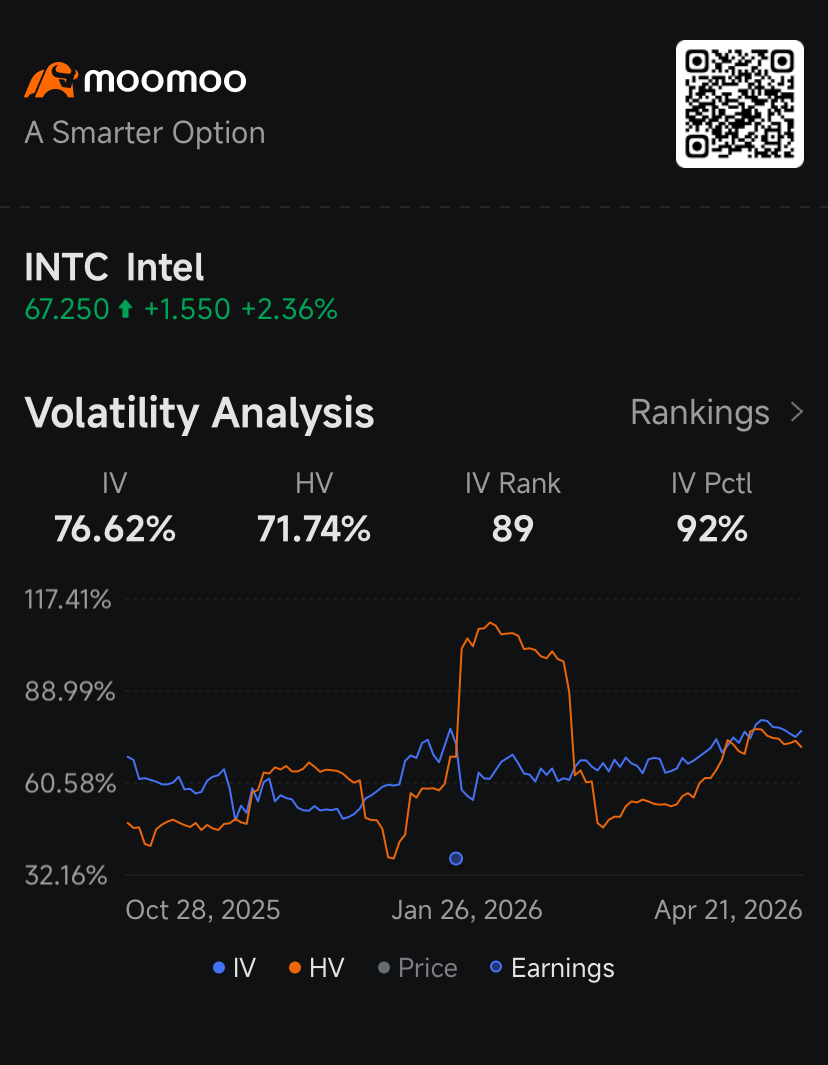
Implied volatility, which measures the market’s expectations for a stock’s price changes using variables including option premiums, stood at 76.7% Tuesday, with the IV rank at 89 and IV percentile at 92%, indicating options are pricier than they’ve been in 92% of the trading sessions over the past year.
Intel's stock has seen a string of good news that fueled the rally since the start of the month. That includes $Tesla (TSLA.US)$ CEO Elon Musk's reposting on x.com Intel CEO Lip-Bu Tan's post announcing the partnership between the two companies for the development of AI chips under the join Terafab project of the electric vehicle giant and Musk's other companies SpaceX and xAI.
That was followed by an announcement of a multi-year collaboration with $Alphabet-A (GOOGL.US)$'s Google that includes expanding their co-development of custom application-specific integrated circuit (ASIC)-based infrastructure processing unit (IPU) for AI systems.
Intel's volatility term structure is sharply inverted, with contracts expiring April 24 approaching 132% IV, collapsing to about 62% by January 2028. Traders are paying a steep premium for short-dated protection and speculation ahead of Intel’s first-quarter results due April 23.

The heightened volatility comes just days before the legacy chipmaker that has joined the AI race is due to report its first quarter financial results. While analysts, on average, expect the company to post a 2.3% decline in revenue to $12.37 billion, many are counting on the company to give clues on the progress of its turnaround.
"The focus will be on whether 1Q proves to be the shipments and margins trough and if 18A yield and throughput gains are advancing at a pace to support a firmer 2H," Bloomberg Intelligence industry analysts Kunjan Sobhani and Oscar Hernandez Tejada wrote in a note last week, referring to Intel's most advanced semiconductor process node.
Analysts, on average, expect net income margin to shrink to 0.6% in the first quarter before rebounding to 3.7% in the three months ending June 30, estimates compiled by Bloomberg show.

After the stock's run-up from just $18.83 a year ago, 94.79% of the positions in Intel are now profitable. At $66.715, Intel's share price is now just over $1 away from $68.20 resistance, the average cost of the remaining 5.21% of the Intel positions that are still unprofitable.
A climb to that resistance level could trigger some selling from holders seeking to get out once they breakeven. For now, some are no longer waiting for the stock to hit that resistance level before exiting.
Outflows outpaced inflows by $39.66 million as of 11:21 a.m. in New York, with block sell orders coming in from all sizes including large, usually from institutional investors and large speculators, and small and medium orders, including those from retail investors.

Please share your thoughts on Intel in the comments section. Do you expect Intel to sustain the share price rally through the rest of the year? Let your voice be heard by voting below. And if you want to read more options column like this one on Tesla, or this one on Meta, or this one on Broadcom, follow me here, where you can also find my column that tracks short sellers' trading volume and other interesting stories on some of the biggest stocks.
Disclaimer: Options trading entails significant risk and is not appropriate for all customers. It is important that investors read the Characteristics and Risks of Standardized Options before engaging in any options trading strategies. Opening new options positions close to or on their expiration date comes with substantial risk of losses for reasons that include potential volatility of the underlying security and limited time to expiration. Options transactions are often complex and may involve the potential of losing the entire investment in a relatively short period. Certain complex option strategies carry additional risk, including potential losses that may exceed the original investment amount. If applicable, supporting documentation for any claims will be furnished upon request.
Disclaimer: Community is offered by Moomoo Technologies Inc. and is for educational purposes only.Read more


Comments (5)
to post a comment
19
7