Fed Raises Rates by 25bps as Inflation Stays Hot. What’s Next for Markets?

FOMC Preview: Yields Touched 5%, Oil Tops $100—What to Watch, How to Position
Stocks are slipping. $Crude Oil Futures (DEC6) (CLmain.US)$ is above $100. And the Fed may be about to turn a rate-cutting cycle into a rate hike.
The decision lands Wednesday at 2:00 p.m. ET, followed by Chair Warsh’s press conference at 2:30 p.m. Markets are already feeling the strain: $SPDR S&P 500 ETF (SPY.US)$ has fallen in five of the past six sessions, while $Invesco QQQ Trust (QQQ.US)$ sank as much as 1.7% on Monday before closing down 0.8%.
The pressure goes beyond equities. The $U.S. 10-Year Treasury Notes Yield (US10Y.BD)$ touched 5.00%. The ECB has delivered its second hike of the cycle, and the Bank of Japan is expected to move again.
With Treasury yields testing 5% and oil above $100, can Warsh ease the pressure—or will this week’s Fed and BOJ decisions give markets another reason to sell?
From 'Hold' to 'Locked and Loaded': What Changed
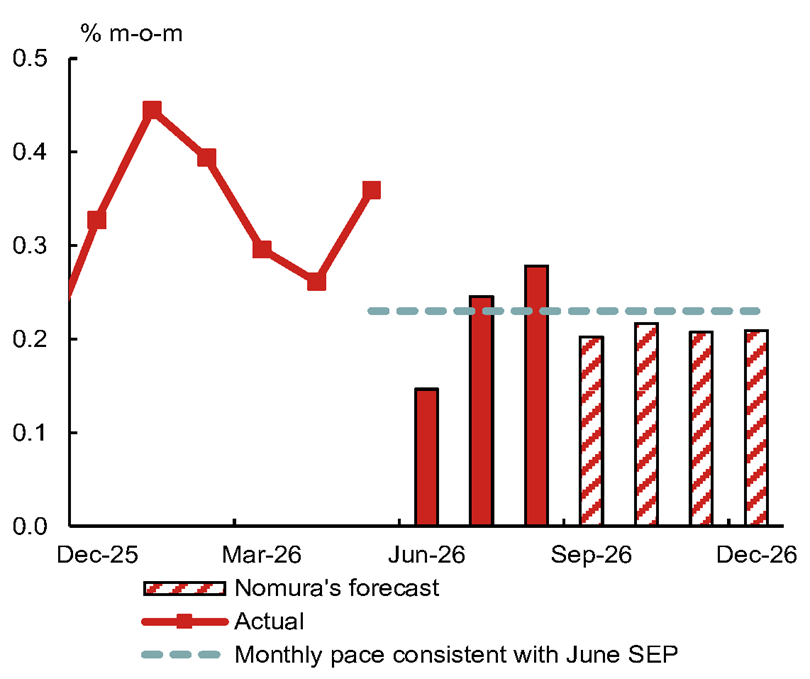
The turn began at Jackson Hole. Warsh stressed that the speed of disinflation was inadequate, played down the softer June-July prints, and repeated that "inflation is a choice" and there is "work to do" - stripping out nearly all of his prior dovish language. Then August core CPI printed +0.29% m/m (the year-on-year rate fell to a five-year low of 2.4%, but the monthly momentum is sticky), and core PCE tracking firmed to 0.26-0.28%. Renewed Middle East hostilities drove oil higher; PPI showed hospital and airfare prices accelerating - the pass-through pipes are widening. Add the ECB's hike, a federal deficit nearing $2 trillion, and a long-end selloff pricing "debt-spiral" risk, and the market's hike odds ratcheted from one-in-three to nine-in-ten.

Wall Street's Verdict: The Debate Isn't 'If,' It's 'How Many'
- Citi: one hike to 3.75-4.00%, framed as a "calibration," not a cycle; up to two dovish dissents possible; no return to cuts until June 2027.
- Nomura / Morgan Stanley: hikes in September and December, terminal 4.0-4.25%. Morgan Stanley's line says it all - "when the Fed goes into action, it rarely moves once."
- Deutsche Bank: more hawkish - 75bp total (September, December, next March) to "unwind" last year's risk-management cuts.
- BofA: against consensus for 75bp this year, headlined "Will Warsh stay home alone?" - warning that if the Fed doesn't hike, long-end yields could jump another leg on credibility fears.
Note the irony in the dissent: the likely objectors (Waller, Bowman, or July's Hammack/Kashkari/Logan) would be dovish dissents preferring a hold - squaring off against a hawkish Chair.
The Real Trade: The Dot Plot and Warsh's Tone
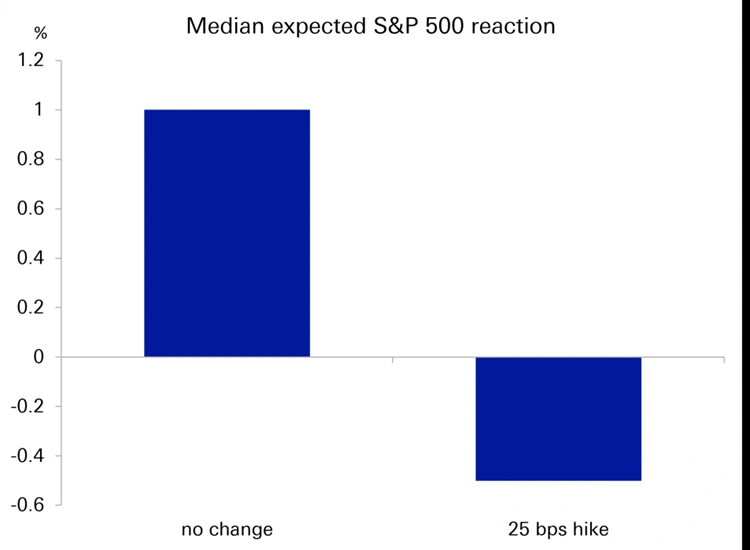
With the hike itself ~90% priced, the incremental information lives in the dot plot and the press-conference tone - a classic "buy the rumor, sell the fact." Deutsche Bank's pre-FOMC investor survey quantifies the asymmetry: on a hike, the S&P 500 is seen falling 0.5% on the day; on a surprise hold, the S&P rises 1.0% - yet long-end yields rise more, because a hold reads as capitulating to inflation.
Three Scenarios - and Where the Asymmetry Sits
A “dovish” surprise — scenario weight ~10%. A hold, or a hike paired with guidance that further tightening is unlikely. With a hike roughly 90% priced in, either could spark a relief rally. Deutsche Bank’s survey points to a 1.0% same-day $S&P 500 Index (.SPX.US)$ gain on a hold.
What to watch: that relief could fade quickly. With inflation sticky, a hold may look like the Fed backing down—and the same survey shows long-end yields rising more on a hold than on a hike. Watch the 10-year yield, not just the initial stock rally. If yields climb, treat any $SPDR S&P 500 ETF (SPY.US)$/ $Invesco QQQ Trust (QQQ.US)$ upside as a tactical opportunity rather than a durable recovery.
Hawkish base case — scenario weight ~65%. A 25bp hike, a 4.125% median dot, and Warsh describing the move as a “calibration.” Much of this is already expected; Deutsche Bank’s survey points to an S&P decline of around 0.5% on a hike.
What to watch: whether Warsh’s guidance changes the outlook for further hikes. If it adds little, stocks could swing without finding a clear direction—making the first move risky to chase. AI hardware ($VanEck Semiconductor ETF (SMH.US)$) and small caps ($iShares Russell 2000 ETF (IWM.US)$) remain exposed to higher rates. Watch energy ($Energy Select Sector SPDR Fund (XLE.US)$) for oil support, while gold ($SPDR Gold ETF (GLD.US)$) will also depend on real yields and the dollar.
Super-hawkish tail — scenario weight ~25%. A median dot of 4.375% or higher, or language pointing to a sustained hiking cycle. That could force investors to price in more tightening, pushing the dollar higher and sending stocks and bonds lower together.
What to watch: a simultaneous rise in Treasury yields and the dollar. Recent FOMC selloffs have exceeded the moves options priced in, so a modest implied move could leave investors exposed to another downside surprise. $Invesco QQQ Trust (QQQ.US)$ and $iShares Russell 2000 ETF (IWM.US)$ are key areas to watch, with downside protection worth assessing against its premium and potential payout.
The Base Rate: Five Straight Red Closes
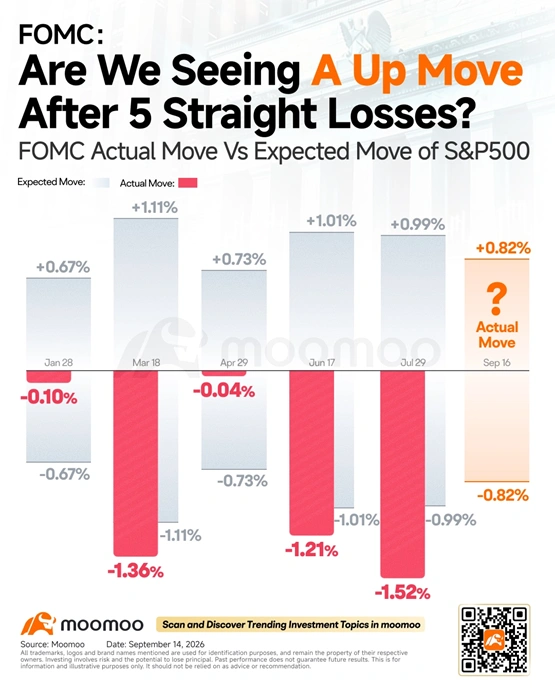
History raises the stakes. The $S&P 500 Index (.SPX.US)$ has closed lower on each of the last five FOMC decision days - and the drops have been getting bigger, not smaller: -1.21% in June and -1.52% in July, both well beyond the ~+/-1.0% the options market had priced. For September 16, options imply only a +/-0.82% move - calmer than the last three meetings actually delivered.
The takeaway isn't a formula; it's a skew. A hawkish, negatively-charged catalyst, a five-meeting losing streak, and an expected move that sits below what recently landed all point the same way: the risk into this print leans lower, and the market may be under-charging it - which is what makes protection against a further drop screen inexpensive here while implied volatility is low. For the contrarian, the streak-breaking green day (the chart's open question) is the low-probability, high-payoff surprise.
What to Watch: Yields, Oil—and the Next Central Bank
Watch whether the $U.S. 10-Year Treasury Notes Yield (US10Y.BD)$ holds above 5% after Warsh speaks. Persistent yield pressure would keep $SPDR S&P 500 ETF (SPY.US)$ and $Invesco QQQ Trust (QQQ.US)$ vulnerable, making index ETF options a focus for both event trading and portfolio protection.
Then comes the BOJ decision, where guidance could move the yen and spill into global equities. Meanwhile, $Crude Oil Futures (DEC6) (CLmain.US)$ above $100 keeps inflation pressure in play: watch $United States Oil Fund LP (USO.US)$ and $Energy Select Sector SPDR Fund (XLE.US)$ for oil-related moves. The key question is whether this week’s central-bank signals ease the pressure—or compound it.
Disclaimer: Moomoo Technologies Inc. is providing this content for information and educational use only.Read more


Comments (10)
to post a comment
92
29