
[Broadcom Earnings Outlook] FY2026 Q2 results due on June 3 — Despite 50% revenue growth, concerns linger over TPU market share; what’s the “next move” investors are looking for?
Broadcom, the global leader in AI-focused ASICs (application-specific integrated circuits), $Broadcom (AVGO.US)$ is scheduled to report its fiscal second-quarter (FY2026 Q2) earnings after U.S. market close on June 3.
Market expectations are optimistic. During its previous earnings call, the company guided for Q2 revenue of approximately $22 billion, up 47% year-over-year. Analyst consensus estimates align closely at around $22.1 billion, implying nearly 50% revenue growth (per Bloomberg).
However, the focus this time isn’t merely whether Broadcom can deliver another strong quarter. Investors are assessing whether its AI ASIC-driven growth story remains sustainable over the longer term.
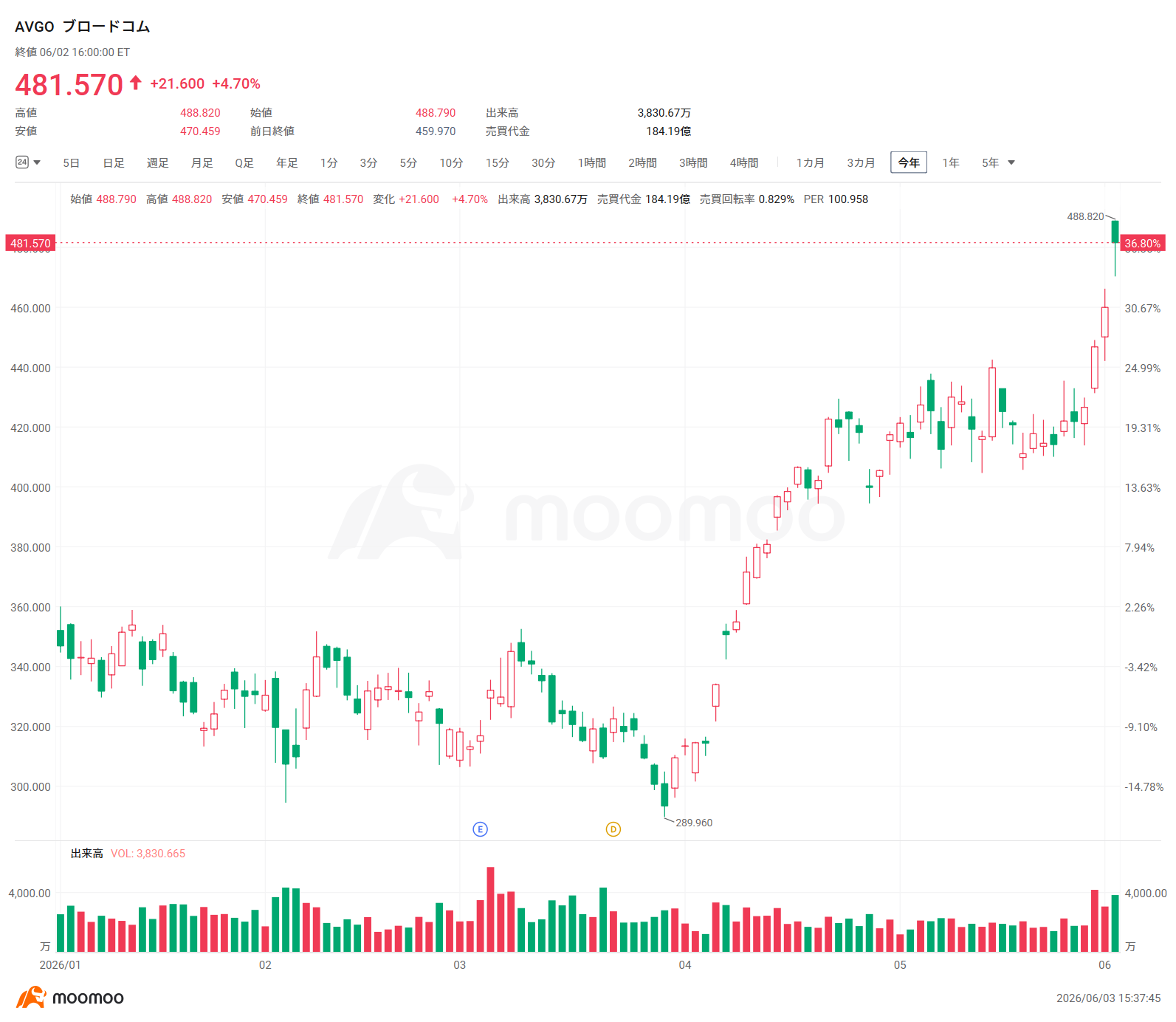
The stock has risen nearly 40% year-to-date, reaching an all-time high range, indicating that the market has already priced in a significant degree of strong growth. Therefore, what matters this time is not Q2 results per se, but rather management’s commentary on Q3 guidance, visibility into orders beyond 2027, and their views on share dynamics surrounding Google TPUs and the competitive landscape for AI networking business.

In other words, the market is testing whether Broadcom will remain just a semiconductor manufacturer or continue to be revalued as an AI infrastructure company.
Revenue and earnings keep rising, but signs of margin pressure emerge
The company's financial fundamentals remain solid. According to analyst estimates, second-quarter fiscal 2026 revenue is expected to reach $22.1 billion, with Non-GAAP net income projected at approximately $11.8 billion. Net income is forecast to rise 75% year-over-year and 16% quarter-over-quarter, driven by surging AI demand and strong operating leverage boosting profit growth.


However, early signs of change are appearing in profitability metrics. Non-GAAP gross margin is expected to come in at 76.8%, down from 79.4% in the same period last year. Despite rapid expansion in AI-related sales, gross margin has shown a gradual decline over the past few quarters.
This isn’t necessarily a negative signal. AI ASICs, AI networking products, legacy semiconductor businesses, and software operations centered around VMware each have different profitability structures, so shifts in revenue mix naturally cause fluctuations in overall gross margin.
Rather, the key metric to watch is operating margin stability. Non-GAAP operating margin is expected to reach 66.5%, surpassing 65.3% in the year-ago period. The ability to maintain operating margins despite declining gross margins indicates that economies of scale and cost discipline are working effectively.
For now, the market is likely to tolerate modest gross margin compression. However, if AI-related growth begins to slow simultaneously with further margin erosion, investor sentiment could start to shift.
AI ASIC growth underpins earnings performance
The most important theme in this earnings report is undoubtedly the AI ASIC business. Broadcom reported AI-related revenue of $8.4 billion last quarter, a 106% year-over-year increase. Furthermore, the company has projected AI semiconductor revenue of $10.7 billion for Q2.

According to analyst estimates, AI semiconductor revenue this quarter will be approximately $10.7 billion, accounting for about 72% of total semiconductor segment revenue.
This represents a transformation that would have been unimaginable for Broadcom just a few years ago. The company was previously known as a leading provider of semiconductors for networking, storage, broadband, and wireless communications. Today, however, the market increasingly views it as an 'AI ASIC platform company serving hyperscalers.'
In this context, the first key point to verify in this earnings report is whether AI semiconductor revenue reaches around $10.7 billion.
However, what matters even more lies ahead. Investors aren’t primarily interested in this quarter’s results per se—they want to know whether guidance indicates continued growth in AI revenue and whether there’s room for further upward revisions to the 2027 earnings outlook.
In today’s AI ASIC market, $Alphabet-C (GOOG.US)$ 、 $Meta Platforms (META.US)$ demand for custom chips from large customers—including Meta, Anthropic, and OpenAI-related projects—is expanding rapidly. To justify the current stock valuation, Broadcom must demonstrate to the market that this customer base will continue to grow over the medium to long term.
The controversy surrounding Google's TPU also warrants close attention
Another major topic to watch during this earnings call is the discussion around Google’s TPU.
Over the past few months, the market has speculated that Google is working with MediaTek and $Marvell Technology (MRVL.US)$ A series of reports have emerged indicating that it is advancing collaborations with others. In response, some market participants have raised concerns that 'Broadcom might lose the TPU contract.'
Indeed, it is highly likely that Google is diversifying its supply chain. As AI chips become strategic assets, it is only natural for Google to seek reduced reliance on any single supplier to enhance its pricing leverage and supply stability.
However, it would be premature to immediately conclude that this equates to 'Broadcom losing market share.' In fact, the company announced a long-term agreement with $Alphabet-C (GOOG.US)$ in April 2026. Under this agreement, the two companies will continue co-developing and supplying next-generation custom AI chips and AI rack-related components through 2031.
Furthermore, Broadcom also revealed plans to provide Google-based AI computing resources at a scale of approximately 3.5 GW to Anthropic starting in 2027. In other words, even if Google adds more suppliers, it does not necessarily mean the immediate exclusion of $Broadcom (AVGO.US)$ . Rather, given the rapid overall growth of the AI market, multiple companies could simultaneously benefit.
For investors, what matters most is assessing how much non-Google customers are growing and whether Broadcom will remain central to major AI deals going forward.
AI networking business as a second pillar
On the other hand, $Broadcom (AVGO.US)$ Broadcom’s AI story isn’t just about ASICs. Recently, network performance—as well as computational power—has increasingly become a bottleneck in AI data centers. Efficient operation of massive AI clusters requires high-speed switches, high-bandwidth data interconnects, optical networking, and scalable, scale-out network architectures.
On the other hand, $Broadcom (AVGO.US)$ Broadcom’s AI story isn’t just about ASICs. Recently, network performance—as well as computational power—has increasingly become a bottleneck in AI data centers. Efficient operation of massive AI clusters requires high-speed switches, high-bandwidth data interconnects, optical networking, and scalable, scale-out network architectures.
This is precisely the area where Broadcom and $NVIDIA (NVDA.US)$ is a critical battleground. NVIDIA is building a vertically integrated ecosystem that includes GPUs, NVLink, InfiniBand, and Spectrum-X, while Broadcom is leveraging an open Ethernet architecture centered around its Tomahawk switches.
Investors are watching closely to see how much market share Broadcom’s open Ethernet approach can gain as AI clusters continue to scale up.
If its AI networking business continues to expand steadily, Broadcom could be positioned not merely as an ASIC supplier but as an infrastructure provider supporting entire AI data centers. Conversely, if growth in its networking segment slows, the market may place even greater emphasis on NVIDIA’s ecosystem advantage.
VMware remains an important player
While attention focuses on AI semiconductors, VMware remains an important player. Infrastructure software revenue last quarter was $6.8 billion, representing just 1% year-over-year growth. However, the company expects Q2 revenue to reach approximately $7.2 billion, with growth improving to 9%.
Although VMware won’t deliver the flashy growth seen in AI semiconductors, it generates high profit margins and stable cash flows—a significant strength that provides a solid revenue foundation even amid the current surge in AI investment.
That said, challenges remain. Customer pushback against price adjustments and changes to licensing models persists, and its growth rate still lags behind that of AI-related businesses.
As a result, VMware is viewed less as a catalyst for significant stock revaluation and more as a stabilizing asset underpinning AI-driven growth.
Options Strategy
$Broadcom (AVGO.US)$ will announce its Q2 FY2026 earnings after market close on June 3. The stock has risen to around $481, strongly reflecting expectations for AI ASIC demand, projects related to Google TPUs, and growth in AI networking.
$Broadcom (AVGO.US)$ will announce its Q2 FY2026 earnings after market close on June 3. The stock has risen to around $481, strongly reflecting expectations for AI ASIC demand, projects related to Google TPUs, and growth in AI networking.
In the options market, the implied volatility (IV) for the June 5 expiration stands at 65.10%, while historical volatility (HV) is at 41.55%. The IV Rank is 87 and the IV Percentile is 97%, indicating elevated levels. Based on the current price of $481.57, the market anticipates significant post-earnings price movement. Open interest shows approximately 61,000 calls and 10,000 puts, yielding a put-call ratio of 0.51, reflecting bullish sentiment.
The focus isn't so much on Q2's strong results per se, but rather on AI semiconductor sales exceeding $10 billion, the continuity of the Google TPU deal, and order visibility beyond 2027. However, in a high-IV environment, buying short-dated calls is highly susceptible to IV crush. Realistic choices include using put spreads for downside protection on existing holdings or purchasing longer-dated in-the-money calls to participate in potential upside.

Example Options Strategy: Protective Put Spread (for AVGO shareholders)
While Broadcom’s medium- to long-term growth prospects remain attractive amid expanding AI ASIC demand, high expectations are already priced in ahead of earnings. If concerned about the risk that even solid results could be perceived as falling short of lofty expectations after the announcement, a put spread offers a viable downside hedge.
Buy: AVGO Jun 18, 2026 $460.00 Put
Sell: AVGO Jun 18, 2026 $430.00 Put
*Requires holding the underlying stock. This strategy moderately mitigates the risk of a sharp post-earnings drop while preserving upside profit potential. Hedge effectiveness becomes limited below $430.
Example Options Strategy: Buying In-the-Money Calls (to Participate in an Uptrend)
For investors who remain optimistic about upside surprises in AI ASIC demand and post-2027 order forecasts—but are cautious about initiating new positions in the stock near all-time highs—buying longer-dated in-the-money calls presents a viable alternative.
Buy: AVGO July 17, 2026 $450.00 Call
Alternatively
Buy: AVGO August 21, 2026 $430.00 Call
*Maximum loss is limited to the premium paid. This position aims to benefit from potential upside driven by post-earnings AI-related demand growth and upward revisions to order forecasts, though time decay (theta) requires attention.
Example option strategy: Put Credit Spread (buying on dips while leveraging premium)
While we believe Broadcom’s AI growth narrative remains intact, if limited price movement is expected following earnings, a put credit spread can be used to take advantage of elevated implied volatility.
Sell: AVGO June 18, 2026 $420.00 Put
Buy: AVGO June 18, 2026 $380.00 Put
*Premium income is earned if the stock stays above $420. Even in the event of a significant decline, losses are capped at the spread width. Caution is warranted if AI order guidance or comments related to Google TPUs fall short of market expectations.
Investor Perspective
Strong results in this earnings report may not be particularly surprising. Revenue is expected to increase nearly 50%, AI semiconductor sales are projected to exceed $10 billion, and operating margins remain at a high level.
The real question lies ahead: How far will Google progress in diversifying its supply chain? Will AI ASIC demand continue expanding beyond 2027? Can Broadcom’s AI networking business sustain growth while competing with NVIDIA? And will VMware continue serving as a stable profit base?
What the market is looking for is not just a strong Q2 earnings result per se, but whether Broadcom can demonstrate its ability to chart the next growth trajectory as the infrastructure company emblematic of the AI era. That answer is the most critical theme of this earnings report.
Earnings information on moomoo helps you get ahead of investment timing! Check the 'Market' > 'Stock Markets such as Japanese and US stocks' > 'Deviation rate from earnings forecasts' within the moomoo app.

Source: moomoo, Bloomberg, Reuters, public data
-moomoo News Kingsley
*Figures as of June 3, 2026 (based on our research).
*This content is provided for informational purposes only and does not constitute a recommendation to buy or sell any specific securities or investment products, nor is it intended as an offer or solicitation for investment. The views expressed herein are solely those of the individual author. Investing involves risks, including the potential loss of principal. For details regarding risks and fees, please refer to our company website.
Disclaimer: Moomoo Technologies Inc. is providing this content for information and educational use only.Read more


Comments (2)
to post a comment
17
6