

Bloom Energy Joins the S&P 500: From Hydrogen Stock to AI Power Infrastructure Winner

A company once viewed mainly as a hydrogen-energy play is becoming one of the hottest power-infrastructure names in the AI boom.
On September 4, S&P Dow Jones Indices announced that $Bloom Energy (BE.US)$ will join the S&P 500, effective before the market opens on September 21.
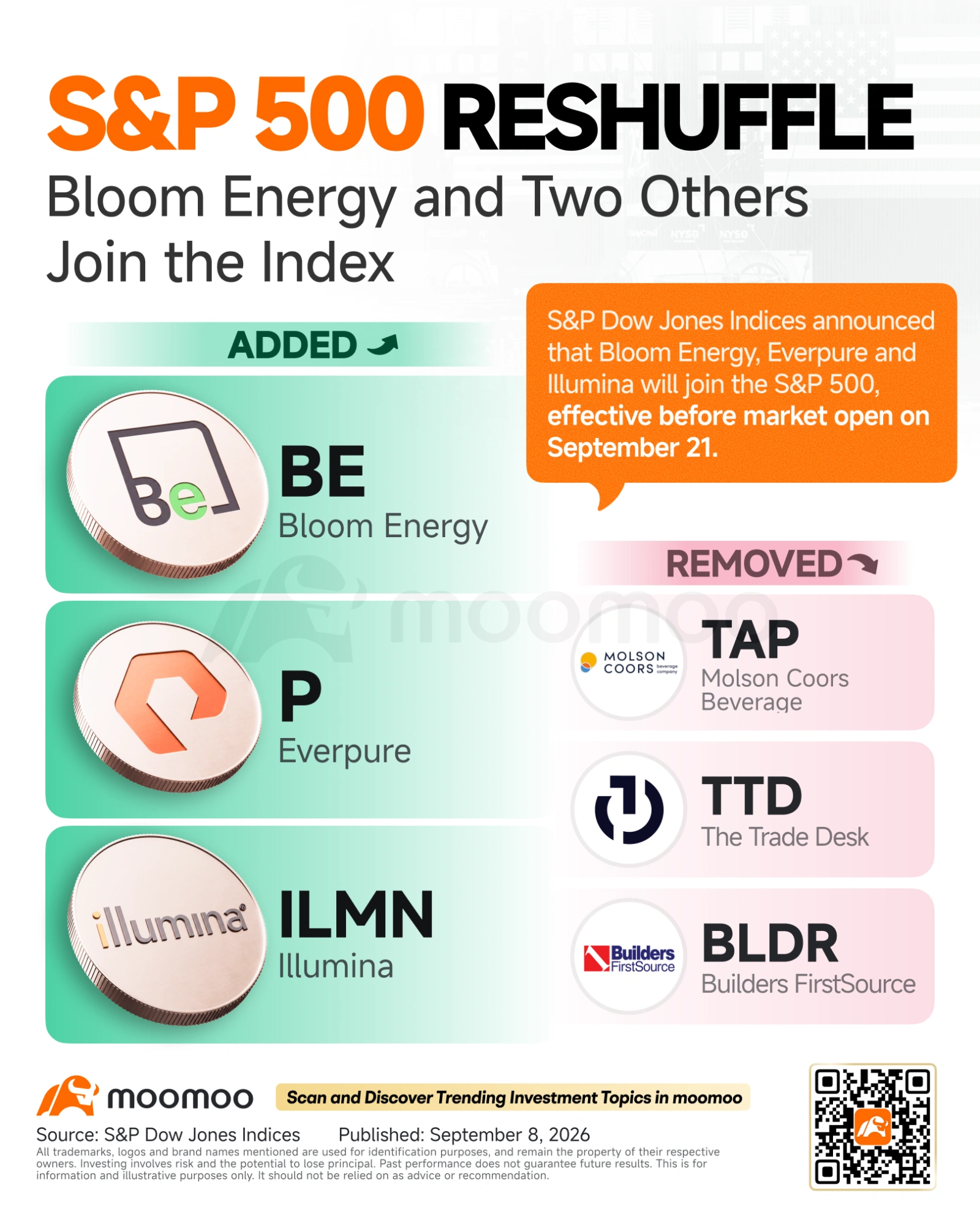
Following the announcement, Bloom Energy rose nearly 4% in premarket trading. The longer-term move is even more striking: since September 2024, Bloom Energy has risen more than 2,300%, making it roughly a 20-bagger in two years.
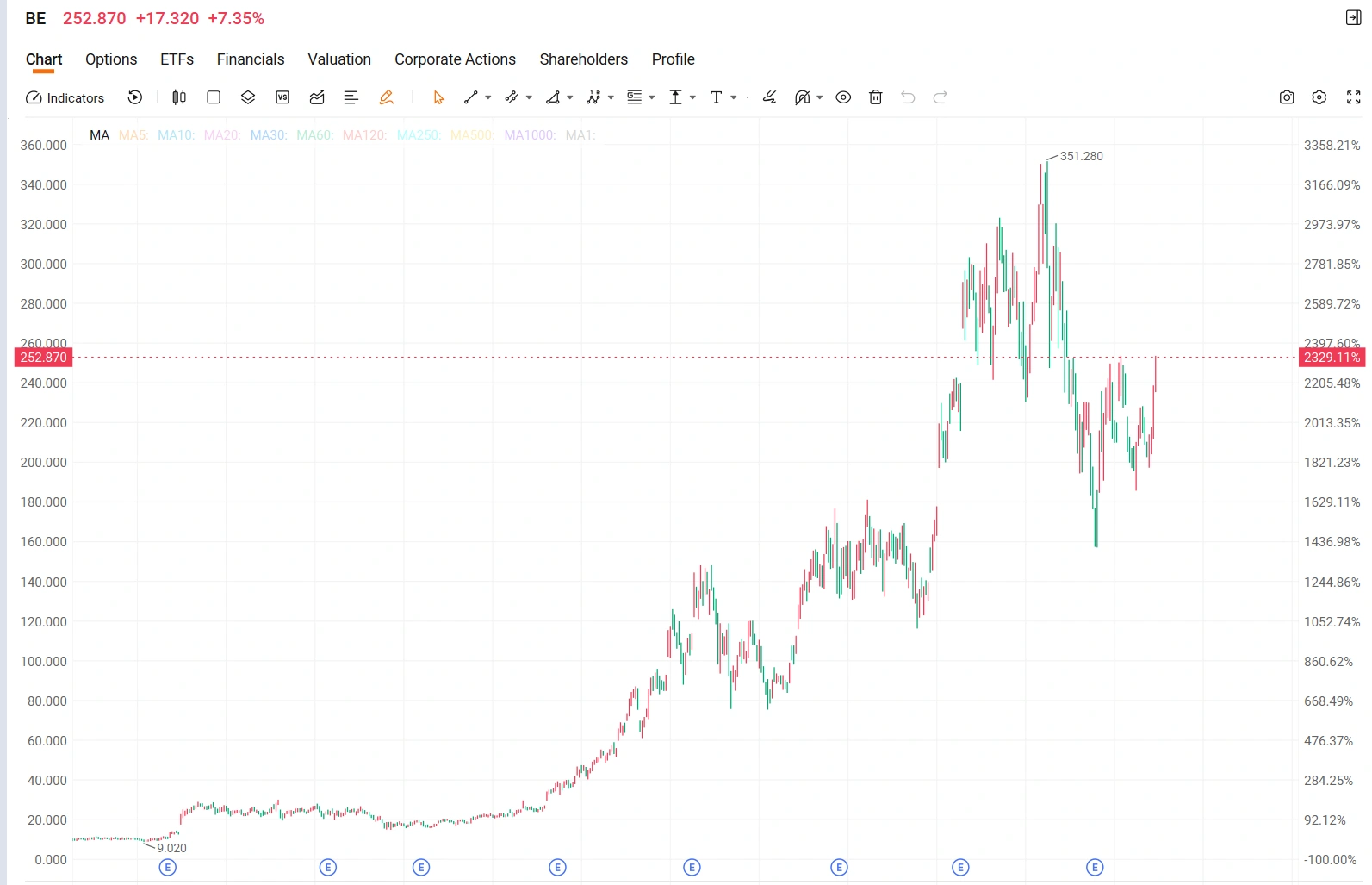
So what has turned Bloom Energy into one of the biggest winners of the AI power trade?
The Moat: AI Data Centers Cannot Wait Years for the Grid
Bloom Energy's core product is its solid oxide fuel cell, or SOFC.
Think of the traditional grid as a highway. A data center may be ready, but if transmission lines and substations have not reached the site, the GPUs simply have to wait.
Bloom offers a different solution: effectively placing a modular power plant next to the data center.
Its systems can generate electricity on-site using natural gas, biogas or hydrogen through an electrochemical process, without waiting for large power plants, transmission lines and substations to be completed.
Bloom says its systems can deliver power in as little as about 90 days, with reliability of up to 99.999%.
For an AI data center that may cost billions of dollars to build—and where GPUs are depreciating every day—speed to power has real economic value.
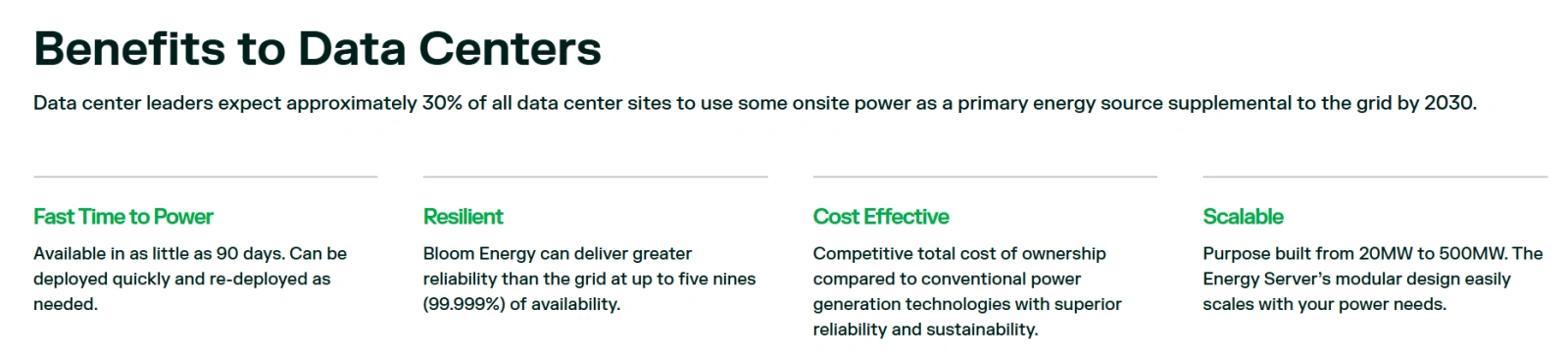
That is increasingly Bloom's core competitive advantage: rapid deployment, proven hyperscale customers, gigawatt-scale manufacturing capacity and access to project financing.
All four are scaling at the same time.
In April, $Oracle (ORCL.US)$ expanded its partnership with Bloom under a framework covering up to 2.8 GW of fuel-cell capacity, with the first 1.2 GW already contracted and under deployment.
Bloom also has an agreement with American Electric Power for up to 1 GW, while its deployments with data-center operator Equinix have surpassed 100 MW.
Financing is becoming another important part of the story.
At the end of June, Brookfield expanded its framework with Bloom for financing and developing AI power infrastructure from $5 billion to $25 billion.
That matters because large data-center power projects do not just require equipment—they require billions of dollars of capital to get built.
Bloom is increasingly offering both.
In August, the company also introduced Power Connect, moving more electrical assembly work from the construction site into the factory. Bloom says the system can reduce on-site installation time by more than 40%.
The market is therefore no longer valuing Bloom simply as a fuel-cell manufacturer.
It is increasingly being valued as an AI data-center distributed power infrastructure provider.
Fundamentals Are Catching Up With the Story
A compelling narrative alone does not produce a 20-fold stock gain.
The bigger change at Bloom is that revenue, margins, profits and cash flow are improving at the same time.
Second-quarter 2026 revenue topped $1 billion for the first time, reaching $1.065 billion, up 165.5% year over year. Product revenue surged 215% to $935 million.
That was nearly $240 million above the market's roughly $826 million expectation.
Adjusted EPS reached $0.78, almost twice consensus expectations of around $0.39–$0.41.
More importantly, margins expanded sharply.
Non-GAAP gross margin rose from 28.2% a year earlier to 34.3%, while non-GAAP operating margin jumped from 7.1% to 22.5%.
Operating cash flow also swung from a $213 million outflow a year earlier to a $226 million inflow.
Bloom is beginning to show classic operating leverage:
Higher revenue → better factory utilization → stronger gross margins → lower operating expenses as a percentage of sales → profit growth far faster than revenue growth.
Management consequently raised full-year revenue guidance again to $3.9 billion–$4.2 billion.
Compared with 2025 revenue of $2.02 billion, that implies growth of roughly 93%–108%.
The Problem: The Valuation Already Prices In a Lot
The biggest risk now is also obvious: Bloom is no longer cheap.
Its trailing price-to-sales ratio has risen to roughly 23.9x, above about 94% of its own five-year historical range and well above typical industry valuations.
Its trailing P/E is even more extreme at around 328x, although its forward P/E has fallen to about 77x as earnings expectations rise.
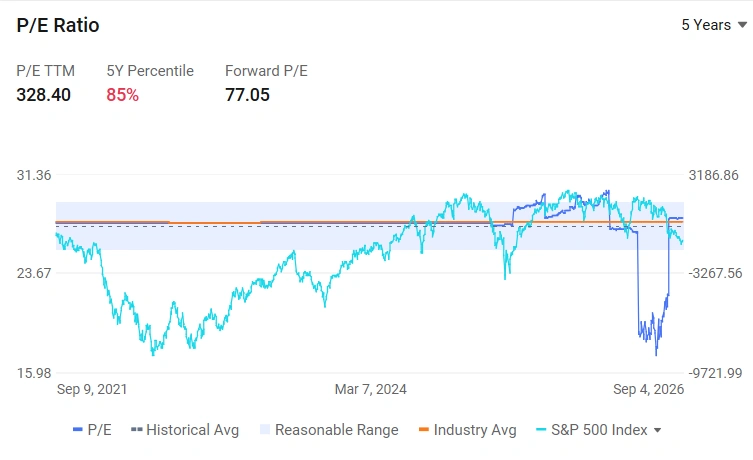
In other words, the market is no longer asking whether Bloom can become profitable.
It is asking whether large-scale projects with Oracle, AEP, Brookfield and other customers can convert into 2027–2028 revenue on schedule.
That raises the execution bar considerably.
At nearly 24x sales and more than 300x trailing earnings, expectations are already high. If data-center projects are delayed, revenue growth disappoints or margin expansion slows, the stock could face both earnings downgrades and multiple compression.
Bloom has therefore moved from an earnings-turnaround trade into a much tougher high-growth execution trade.
From here, further upside depends less on whether investors believe in AI power shortages—and more on whether Bloom can grow earnings fast enough to justify the valuation.
Why Is Bloom Only Joining the S&P 500 Now?
The S&P 500 is not simply a list of the 500 largest U.S. companies by market capitalization.
In addition to size, liquidity and listing requirements, the index committee also considers profitability and retains discretion over additions.
For years, profitability was one of Bloom Energy's biggest weaknesses.
But after several quarters of rapid revenue growth, improving profits and stronger cash flow, the company now combines large-cap scale with stronger financial fundamentals.
As of September 4, Bloom Energy's market capitalization was around $74.5 billion, well above the size thresholds typically discussed for S&P 500 eligibility.
Its inclusion therefore marks another major change in identity.
In 2024, Bloom was still viewed as a sub-$10 billion fuel-cell company.
By 2026, it has become a $70 billion-plus S&P 500 large-cap stock tied closely to the AI infrastructure boom.
Index inclusion also creates a new technical catalyst: funds and ETFs tracking the S&P 500 will need to purchase Bloom shares to match the benchmark.
How Much Further Can the Bull Case Run?
The investment thesis is relatively simple.
AI computing demand is growing much faster than the U.S. power grid can expand. As data centers race to secure electricity, solutions that can provide reliable power quickly are becoming increasingly scarce.
The first phase of the AI trade was straightforward:
More GPUs → more demand for Nvidia.
The next phase goes one level deeper:
More GPUs → larger power shortages → more value for companies that can get data centers online faster.
That is where Bloom Energy stands out.
Its biggest advantage is not simply fuel-cell technology. It is time to power.
But after the stock's huge rally, the risks are also rising.
The next phase will depend on whether Bloom can convert large orders into revenue, continue expanding margins and defend its speed advantage as gas turbines, nuclear power and energy storage compete for the same AI infrastructure spending.
Bloom Energy has already gone through a remarkable transformation:
Hydrogen stock → AI power infrastructure play → S&P 500 constituent.
The next rerating will be harder.
From here, investors will care less about the story—and much more about execution.
Disclaimer: Moomoo Technologies Inc. is providing this content for information and educational use only.Read more


Comments
to post a comment
41
38