All Eyes on Nvidia Earnings as the AI Trade Seeks Fresh Momentum

Beyond Nvidia's Earnings, Who Wins Most From Every Additional GPU Shipment?
$NVIDIA (NVDA.US)$ is set to announce its second-quarter fiscal year 2027 (FY2027) earnings after the U.S. market closes on August 26. In the previous quarter, the company generated $81.6 billion in revenue, and the midpoint of its revenue guidance for the current quarter has climbed further to $91 billion. The market will be closely watching how much order upside Nvidia's continued growth will release to its supply chain.
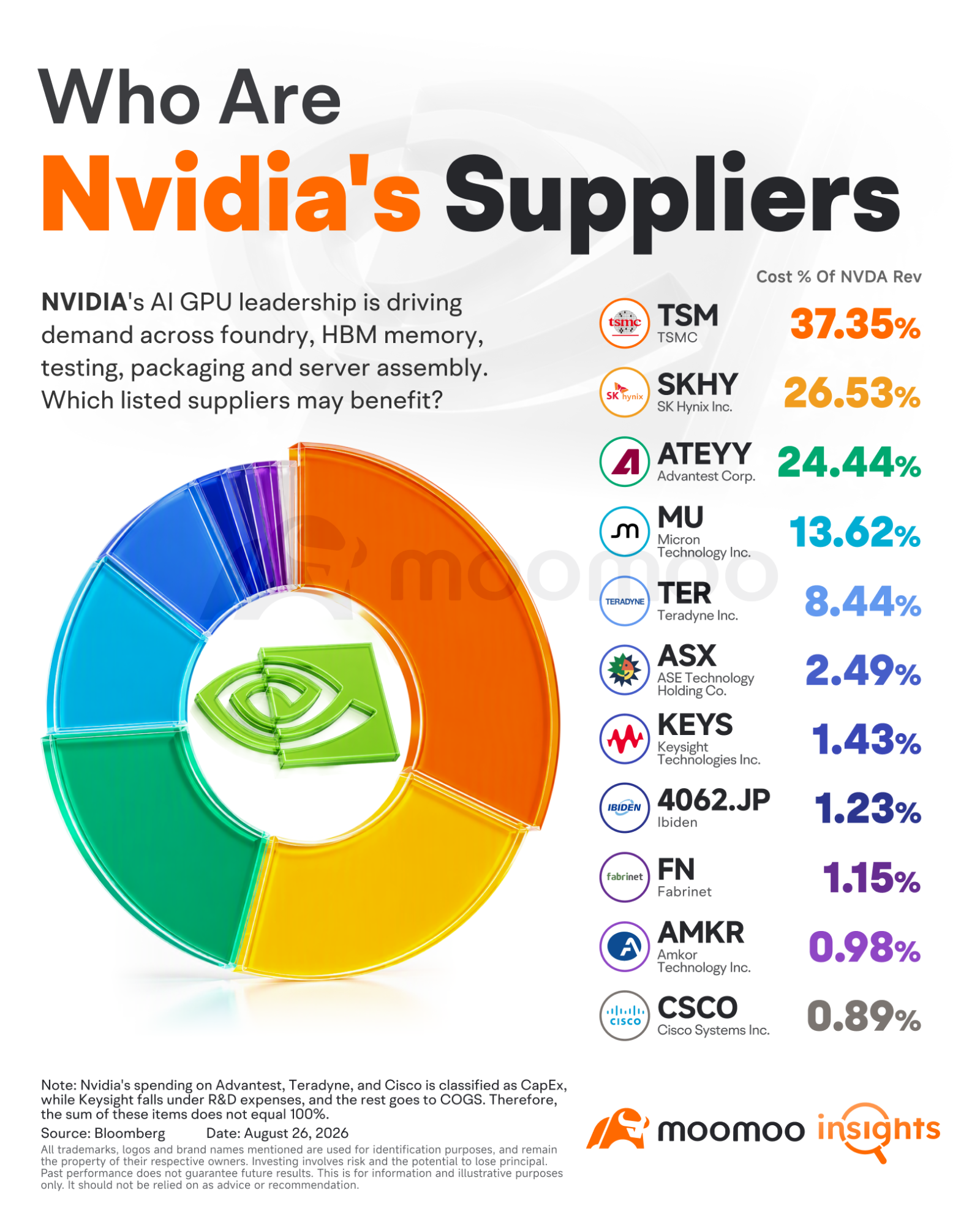
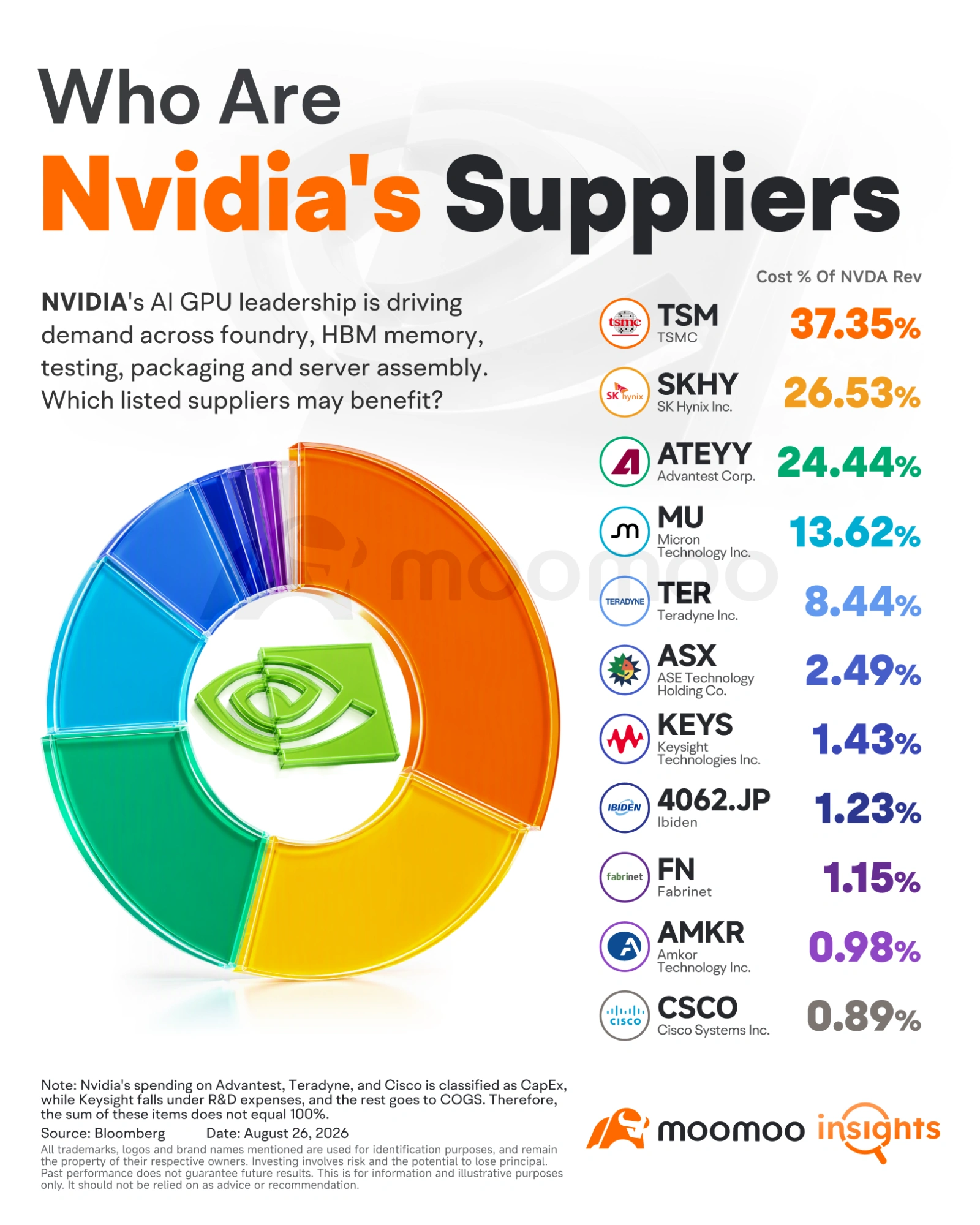
Based on supply chain data, Nvidia's highest cost-exposure suppliers are primarily concentrated in four areas: wafer manufacturing, HBM (High Bandwidth Memory), testing equipment, and AI server manufacturing. It should be noted that the "NVDA Cost Exposure" in the chart does not represent a strict BOM (Bill of Materials) breakdown; rather, it is best used to gauge the sensitivity of various suppliers to Nvidia's business momentum.
--
--
--
TSMC (The Core Manufacturing Hub)
$Taiwan Semiconductor (TSM.US)$ accounts for 37.35% of Nvidia's cost exposure, ranking first in the supply chain. Both the Blackwell and the subsequent Rubin platforms rely heavily on advanced process nodes, and AI GPUs are increasingly dependent on advanced packaging capabilities like CoWoS. Therefore, the continued growth in Nvidia's GPU shipments most directly translates into demand for TSMC's advanced manufacturing and packaging. Compared to other suppliers, TSMC acts more like an infrastructure tollbooth for the entire AI computing supply chain.
HBM
$SK hynix (SKHY.US)$ and $Micron Technology (MU.US)$ account for 26.53% and 13.62% of Nvidia's cost exposure, respectively. As AI GPUs transition from the Blackwell to the Rubin era, performance upgrades increasingly rely on higher-bandwidth memory. HBM therefore benefits not only from the growing number of AI servers but also from capacity expansion and product specification upgrades per unit. In this earnings report, Nvidia's statements regarding Rubin's progress, HBM supply, and future GPU shipment pacing will directly impact the expectations of memory manufacturers like SK Hynix and Micron.
Testing Equipment
$Advantest (ADR) (ATEYY.US)$ and $Teradyne (TER.US)$ account for 24.44% and 8.44% of its CapEx, respectively. The more complex AI GPUs become, the higher the requirements for testing precision, testing time, and yield management. Especially in the era of high-value GPUs and advanced packaging, the cost of a single chip failure increases significantly, driving up the value of the testing segment. Compared to mature manufacturing, testing equipment also has a "capacity expansion lead-time" attribute. If Nvidia continues to raise its medium to long-term demand expectations, equipment manufacturers like Advantest may see higher earnings elasticity.
As for $Keysight Technologies (KEYS.US)$ , the company is neither an OSAT packaging service provider nor a supplier of high‑volume production‑grade ATE testers for chips. Within NVIDIA’s supply chain, it functions as a vendor of high‑speed interconnect and system‑level measurement instruments for the R&D phase, supporting NVIDIA’s internal engineering labs instead of mass‑manufacturing workflows on chip production lines.
NVIDIA purchases Keysight's bit‑error‑rate testers and optical‑signal test systems primarily to validate signal integrity for interconnections within complete compute clusters.
Advanced Packaging
$ASE Technology (ASX.US)$ and $Amkor Technology (AMKR.US)$ are NVIDIA's two core OSAT (Outsourced Semiconductor Assembly and Test) partners, providing back‑end advanced packaging, HBM stacking and final chip testing services. They absorb overflow capacity from TSMC’s CoWoS lines and act as a direct constraint on GPU shipment volumes.
As the world’s largest OSAT, ASE works closely with TSMC. Leveraging its VIPack advanced‑packaging platform, it handles high‑volume 2.5D packaging, HBM stacking and full‑range testing for NVIDIA HPC chips. Mass production is mainly carried out across its Asian fabs, making it one of NVIDIA’s most critical packaging suppliers.
Amkor, the world’s second‑ranked OSAT, differentiates itself with large‑scale domestic advanced‑packaging capacity in the United States. NVIDIA has signed a multi‑year high‑value agreement to secure capacity at Amkor’s Arizona facility. Serving as a flexible supply backup for the upcoming Rubin platform, Amkor undertakes portions of GPU packaging, HBM stacking and burn‑in testing while addressing North American supply‑chain localization requirements.
AI Servers
We did not list the Taiwanese AI server assembly plant in the chart because the relevant companies are not listed on the US market. Still, Wistron, Foxconn, and Pegatron account for approximately 16.58%, 4.90%, and 2.05% of Nvidia's cost, respectively. Following Blackwell, Nvidia is increasingly selling complete systems like the GB200 NVL72 rather than individual GPUs. Consequently, industry value is gradually diffusing from chips to servers, racks, networking, power supplies, and cooling systems. As long as hyperscalers' AI capital expenditures continue to grow, ODM manufacturers stand to benefit from both increased server shipments and higher value per unit.
What Should the Supply Chain Focus on in This Earnings Report?
Last quarter, Nvidia already delivered $81.6 billion in revenue and issued a revenue guidance midpoint of roughly $91 billion for the current quarter. Hitting that midpoint would equate to an 11.5% sequential growth for the single quarter. What will truly dictate supply chain market movements in this earnings report might be the following three questions:
1. Can next quarter's revenue guidance continue to show significant growth? Given current valuations and market expectations, merely meeting consensus may not be enough. After AMD's earnings in early August, its stock dropped in after-hours trading despite issuing revenue guidance above market expectations.
2. Will Rubin's chips gradually increase production as planned? Nvidia has unveiled the Vera Rubin platform, positioning it as the core driver for next-generation data center growth. If Rubin progresses as planned, the beneficiaries will likely follow the same sequence: TSMC's advanced manufacturing and packaging, HBM4, testing, PCBs, and ODM servers.
3. Can AI CapEx sustain its momentum? Microsoft's latest quarterly Azure revenue grew by 43%, and it expects Q1 CapEx for its new fiscal year to reach $50 billion, signaling that top cloud providers are still increasing their AI infrastructure investments. Meanwhile, Nvidia recently partnered with Apollo, BlackRock, Blackstone, Brookfield, Goldman Sachs, and KKR to mobilize over $500 billion in third-party capital for AI infrastructure. This effectively expands AI computing from a tech company's CapEx into a new asset class of infrastructure.
When a company's quarterly revenue approaches the $100 billion mark, it essentially becomes the demand switch for the entire AI hardware industry. If Nvidia confirms on August 26 that AI computing demand remains strong, and Rubin is ramping up on schedule, the real opportunity lies in identifying who profits the most for every additional GPU Nvidia sells. Based on the current supply chain landscape, the answer remains concentrated in four areas: advanced manufacturing, HBM, testing equipment, and AI servers.
Disclaimer: Moomoo Technologies Inc. is providing this content for information and educational use only.Read more


Comments (5)
to post a comment
39
35