Reward | Share Your Trade Plan Today!

Before trading options around CPI, watch these three things
CPI days can create some of the biggest moves in financial markets, but they can also create some of the biggest mistakes for options traders.
The problem is that many traders focus on just one question: Will inflation be higher or lower than expected?
That matters, but it is only the starting point.
Before trading options around CPI, I focus on three things: direction, implied move and volatility.
The good news is that moomoo provides several tools that can help traders put all three into context before the number is released.
1. Direction: what is the market expecting?
The first question is not simply whether CPI will be good or bad.
It is: what has already been priced into the market?
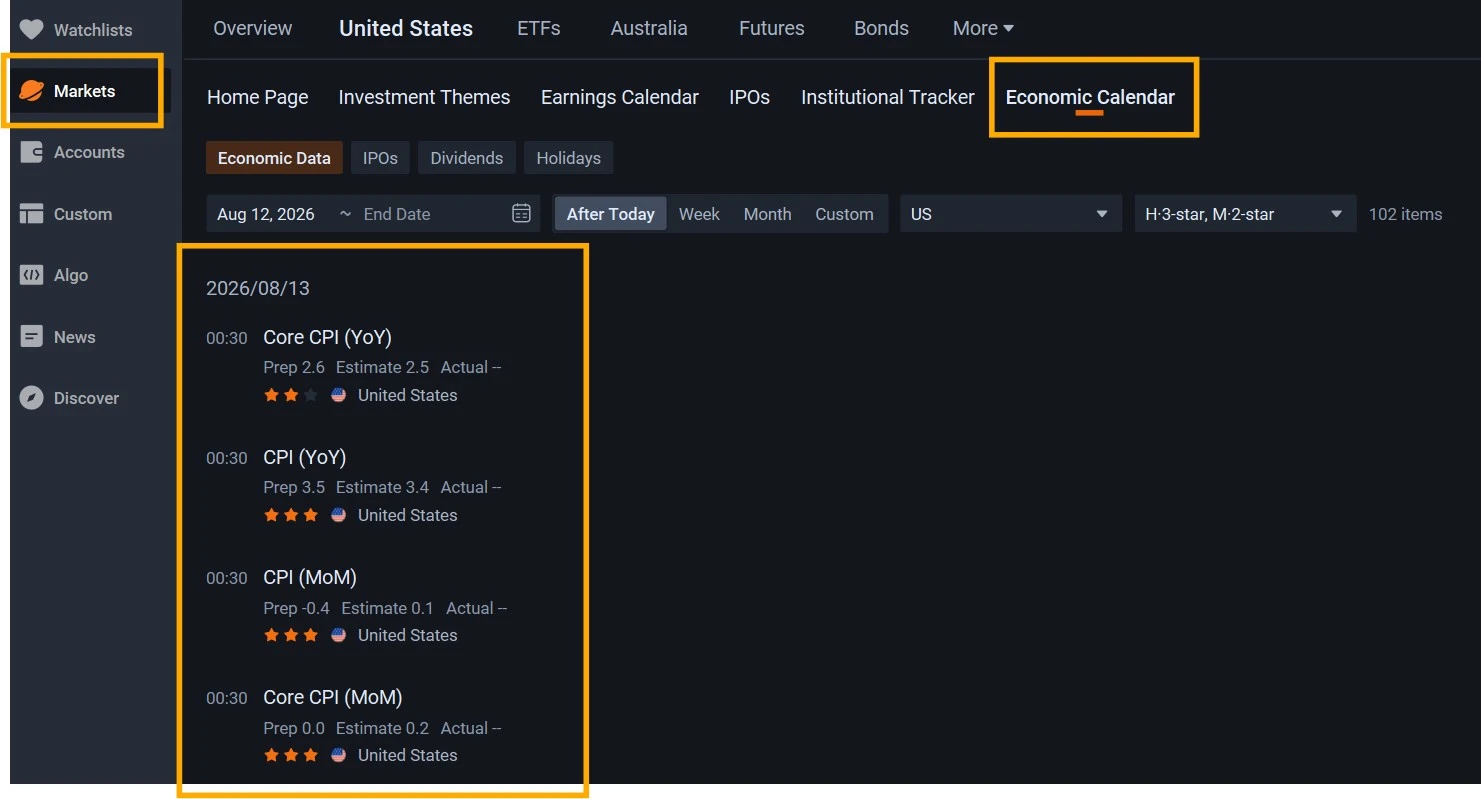
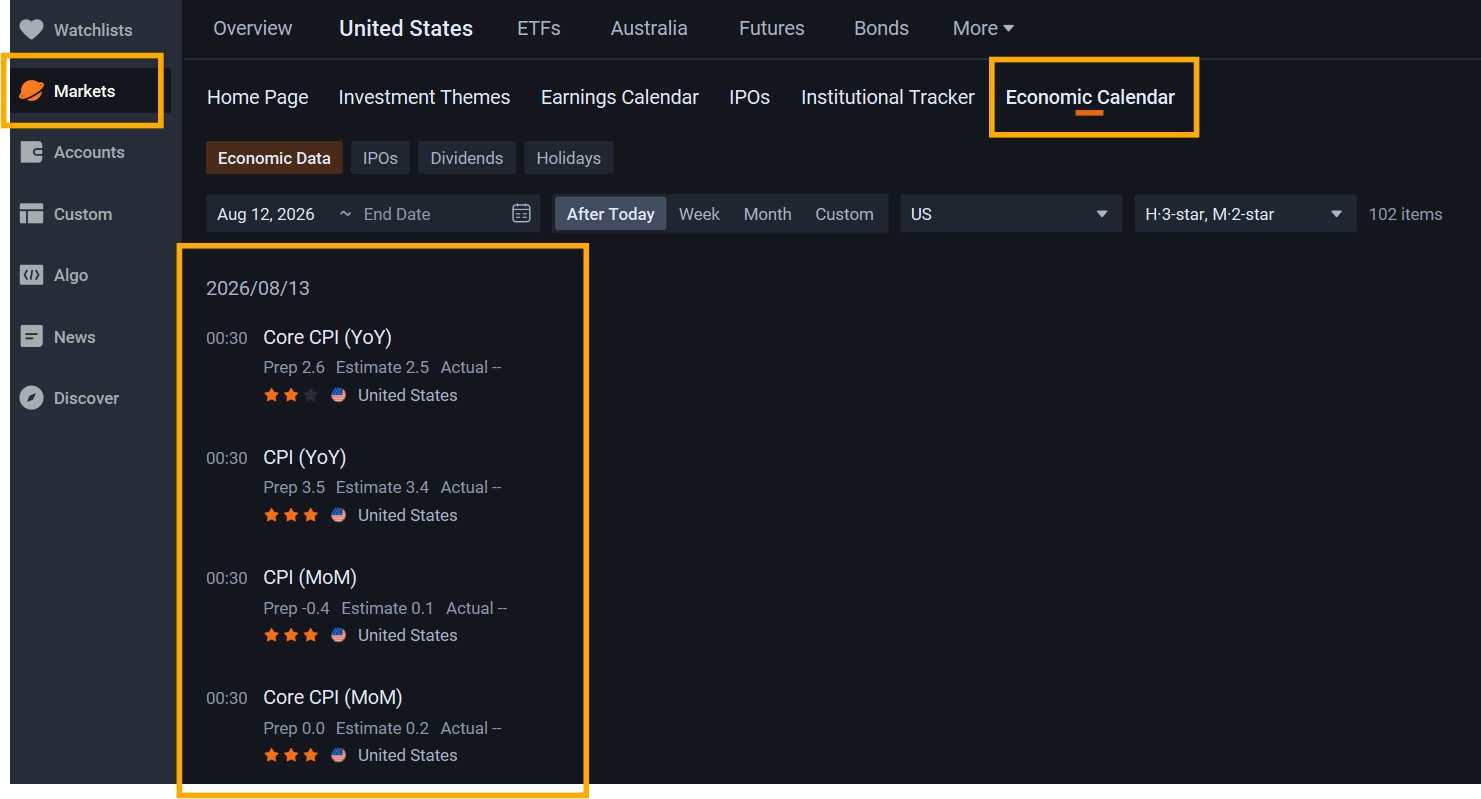
The moomoo Economic Calendar is a good place to start. It shows the upcoming economic release, the previous number and the market estimate.
For CPI, I would look at both headline and core inflation, but I would also consider what the Federal Reserve is likely to do with the information.
A hotter-than-expected CPI could push Treasury yields higher and reduce expectations for future rate cuts. That can put pressure on technology and growth stocks.
A softer CPI can have the opposite effect, particularly if it reinforces expectations of easier monetary policy.
But here is the important point: the market trades the surprise, not the number in isolation.
A CPI reading of 0.2% may initially look positive. But if economists expected 0.1%, the market may react negatively.
Likewise, a 0.3% reading could produce a positive reaction if expectations were even higher.
So before trading, establish the consensus, understand what is already priced in and think about the potential reaction function.
2. Implied move: how much does the options market expect?
This is where the moomoo options chain becomes particularly useful.
The options market effectively gives us a forecast of how much movement traders are pricing around an event.
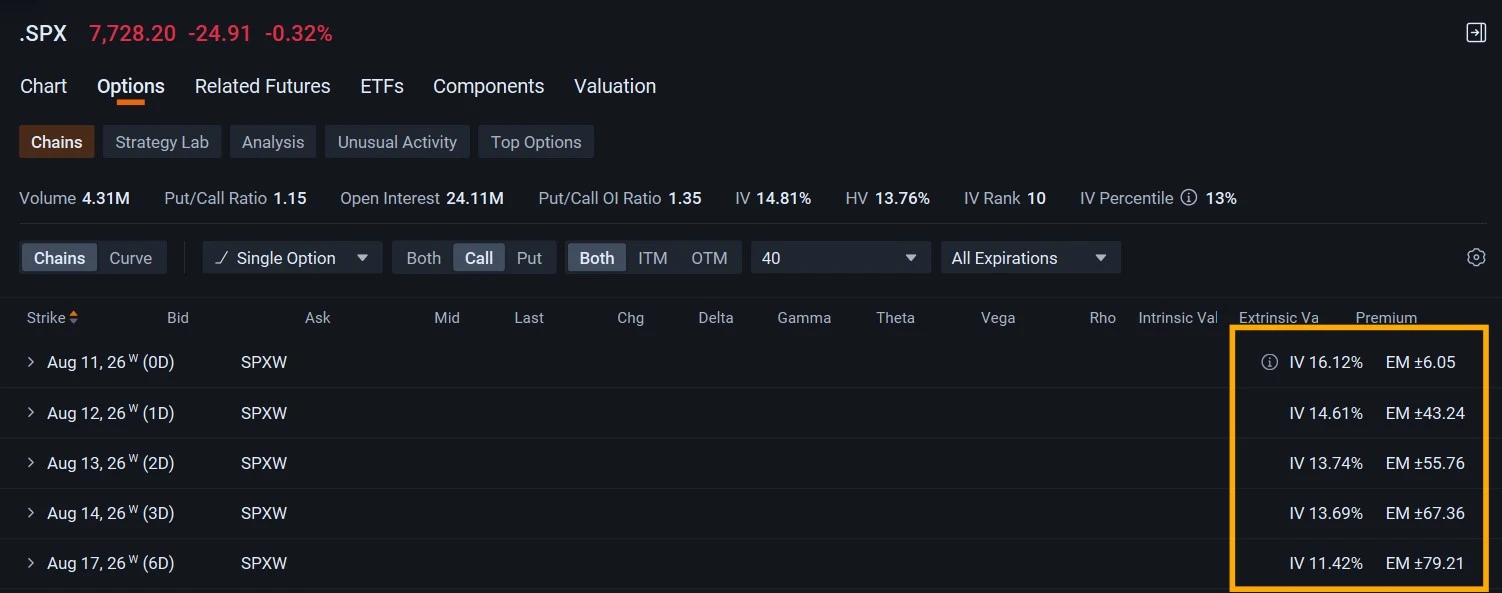
For the S&P 500, the current options screen shows an expected move of approximately ±43 points for one day, rising to around ±56 over two days and ±67 over three days.
With the S&P 500 around 7,728, the one-day implied range is roughly 7,685 to 7,771.
That is a useful reference point.
It doesn't mean the index will stay inside that range. Markets can and do move beyond the implied move.
But it gives options traders a benchmark.
If the S&P 500 moves 35 points after CPI, is that a big move?
Not necessarily. The options market was already pricing roughly 43 points.
If it moves 80 points, that is a different story. The market has delivered a move significantly larger than what was implied.
This is one of the biggest advantages of looking at the expected move before entering an options trade.
3. Volatility: don't ignore what you are paying for options
The third factor is volatility.
Ahead of major economic releases, implied volatility can increase because traders are prepared to pay more for protection against a large move.
After the announcement, that uncertainty disappears.
This can create volatility crush.
For example, buying an option immediately before CPI may give you the right direction but still produce a disappointing result if implied volatility collapses after the announcement.
That is why I don't look at option premiums in isolation.
I want to know the IV, IV Rank, expected move and Greeks before deciding whether the option is expensive or cheap relative to the event.
What does Gamma Exposure tell us?
The moomoo Gamma Exposure dashboard adds another layer to the analysis.
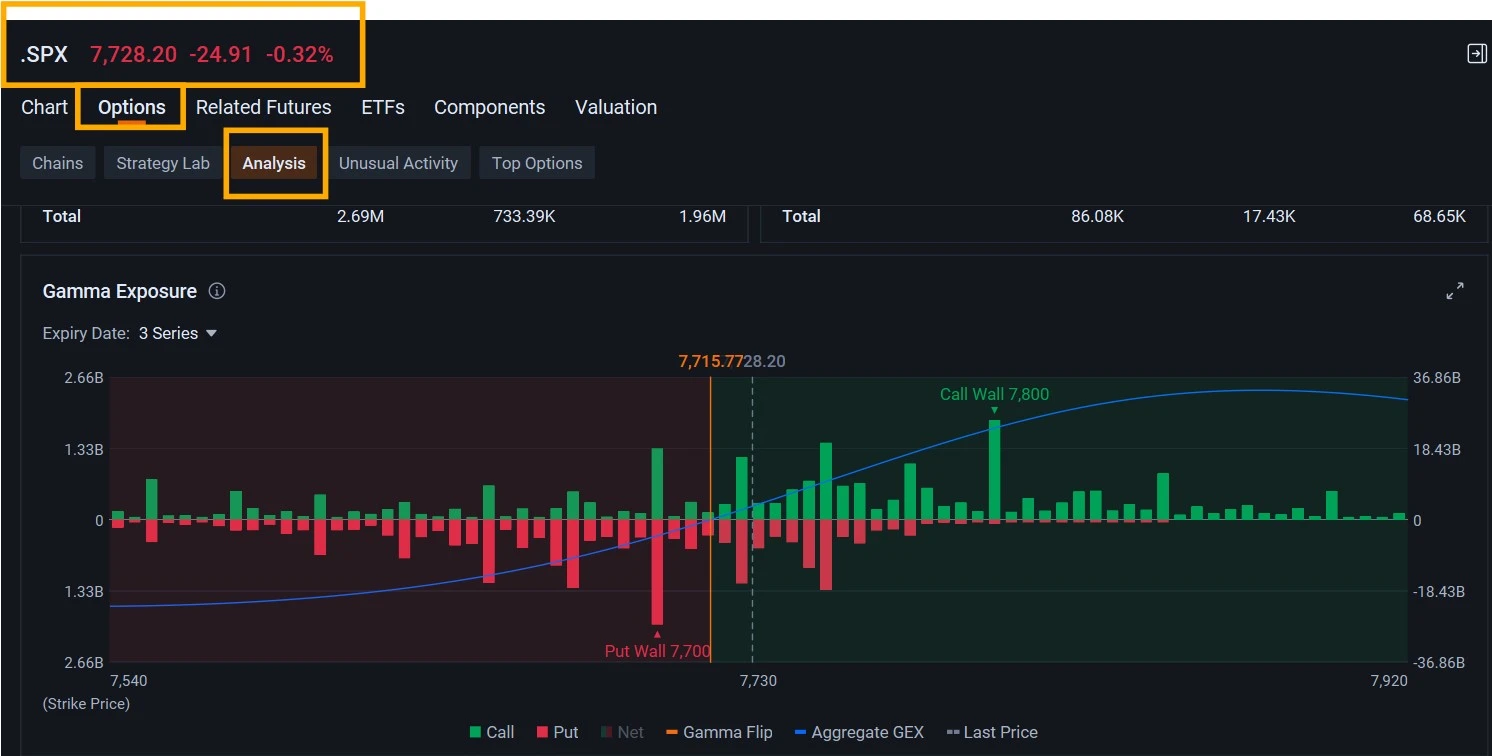
The current S&P 500 chart shows a gamma flip around 7,715, with a significant put wall around 7,700 and a call wall around 7,800.
These levels are worth watching because they can provide potential areas of support and resistance as the market moves.
If the index remains in a positive gamma environment, dealer positioning can sometimes help dampen market movements.
But if the market moves through important gamma levels, that dynamic can change quickly.
For an options trader, these levels can therefore help identify where a move could potentially accelerate or where the market may encounter resistance.
So how can you manage the CPI risk?
There are several approaches.
If you have a bullish view but want defined downside, a bull call spread can limit the amount of premium at risk.
If you already own shares and are concerned about a sharp CPI-driven sell-off, buying a protective put can provide downside protection.
A collar, combining a protective put with a covered call, can reduce the cost of that protection.
And if your view is that the market will remain within the implied range, defined-risk strategies such as iron condors or credit spreads can potentially take advantage of elevated option premiums.
But CPI is a binary event. The closer you get to the release, the more important position sizing and defined risk become.
My CPI checklist
Before placing an options trade around CPI, I would ask:
1. Direction: What does consensus expect, and what would constitute a genuine surprise?
2. Implied move: How much movement is the options market already pricing?
3. Volatility: Am I paying a premium for event risk that could disappear immediately after the announcement?
Then I would look at Gamma Exposure, key option levels, open interest and the options chain.
The objective isn't to predict the CPI number perfectly.
It is to understand what the market expects, what it is pricing and where the risks are.
Because on CPI day, knowing the number is only half the job.
Knowing what the options market has already priced in is the other half.
This article is for educational purposes only and does not constitute financial advice.
Please follow me - Greg Boland - on the moomoo community.
Disclaimer: Moomoo Technologies Inc. is providing this content for information and educational use only.Read more


Comments (392)
to post a comment
436
46