CPI Gives No Surprise, 10Y Yield Nears 5%. What's Next?

August CPI Preview: The Fed's Last Look Before a Do-or-Die Meeting
August CPI lands Friday, September 11 at 8:30 a.m. ET — the last inflation print Kevin Warsh's Fed sees before the September 15–16 FOMC, and it arrives with the long end of the Treasury curve in open revolt. $U.S. 10-Year Treasury Notes Yield (US10Y.BD)$ and $U.S. 30-Year Treasury Bonds Yield (US30Y.BD)$ sit at multi-year highs; Treasury's upsized long-end buybacks — effective the day before this release — have failed to pull them down; and with a ~$2tn deficit still running, the market is doing something it has not in years: pricing the next move as a hike, not a cut. This report decides whether the Fed's credibility gets defended or spent.
Is the $SPDR S&P 500 ETF (SPY.US)$ and $Invesco QQQ Trust (QQQ.US)$ pricing 57bps and 81bps correct for the event?

The Lead-In: A Hot Headline Wrapped Around a Cooling Core
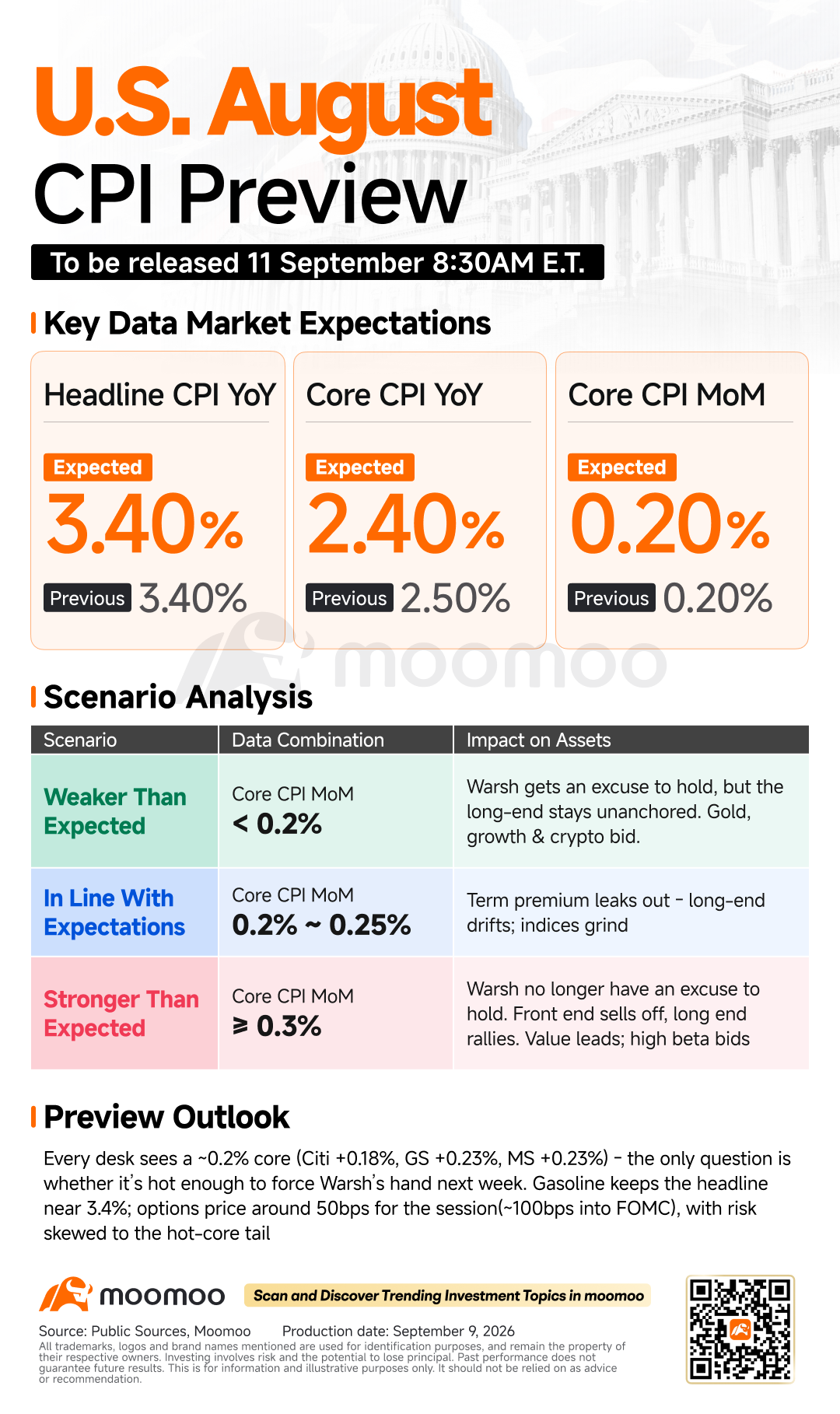
Headline and core are telling two different stories. Gasoline drives the top line: with oil elevated on faded Middle East de-escalation hopes, Goldman Sachs sees energy +2.3% and a +0.39% headline (+3.40% YoY), while Morgan Stanley is hotter at +0.41%. Airfares are the swing factor — GS pencils a +4.0% jump on jet-fuel passthrough.
Underneath, the core looks tame. Shelter is normalizing (GS: OER +0.22%, rent +0.23%) and electronics are fading after Apple's one-off price hike, so the Street clusters on a +0.2% core month. That is the number that matters: Citi notes anything rounding to 0.2% keeps the Fed "comfortably on hold," while 0.3% and above could trigger a hike. Nobody on the sell-side is forecasting 0.3% — which makes the hot tail the market's real fear, not its base case.
The Institutional Divergence: From Citi's 2.3% to the Hawks' Hike-Trigger
The monthly core is bunched, but the read splits hard. Citi is the dovish outlier at +0.184% (YoY falling to 2.3%, the lowest since early 2021), tracking core PCE 50bp under the Fed's June projection. Goldman and Morgan Stanley both sit at +0.23% — MS flagging that core services ex-housing re-accelerates to +0.33% on hotels. The hawk that matters is J.P. Morgan, which projects the Fed hikes 25bp in December to 3.75–4.00% explicitly to "defend the institution's inflation mandate," with 10-year yields climbing to 4.85% by year-end.
Why This Print Is a Credibility Test
Warsh has spent his tenure sounding hawkish — his Jackson Hole remarks helped drive the recent yield surge — while doing nothing. Rhetoric is now running into an ugly backdrop:
– The long end won't behave. 10s and 30s sit at multi-year highs on a renewed focus on term premium — the compensation demanded to hold duration against $2.0tn (FY26) and $1.96tn (FY27) deficits.
– The buyback bazooka misfired. Treasury lifted long-end buybacks from a $2bn cap to "at least $4bn" per operation — a move JPM ties to "discomfort with the level of rates" — yet yields kept rising. You cannot buy your way out of a credibility problem.
– Demand is turning price-sensitive. With ownership shifting toward price-sensitive buyers and ~$543bn of extra supply to absorb, a Fed that tolerates 3%+ headline inflation while cutting is not a reason to hold duration.
Hence the counterintuitive trade the bond market is edging toward: a hike could actually lower long-end yields, because restored credibility compresses the term premium and removes the fiscal-dominance tail. Restoring the Fed's word is worth more to the 30-year than another buyback.
The Real Event Is Six Days Later
The market has stopped debating cuts — money markets price 50bp+ of hikes over the coming year, and JPM's base case is a December hike. So Friday is no longer about whether the Fed eases; it is how hot the print is, and whether Warsh has any reason left not to hike on September 16. The counterintuitive feature: the hotter the number, the better it may be for the long end.
– Extremely hot (core ≥0.3%) — Warsh's out disappears. Citi's hike-trigger level; it pulls the move into the September meeting itself. Paradoxically the most bullish outcome for duration: term premium compresses hard and 10s/30s could rally sharply as the front end sells off — a violent bull-flattening.
– In line to slightly hot (~0.2–0.25%) — the hike stays on rails. No reason for Warsh to abandon the priced-in path; it confirms December and keeps September live as a hawkish hold. And because the market already expects the Fed to act, the credibility premium starts leaking out — 10s/30s can still drift lower as the "will they follow through?" tail fades.
– Cool (≤0.2%, YoY toward 2.3%) — the Fed gets boxed in. Hands Warsh an excuse to stall, but fixes nothing at the long end. A Committee that stands down because data cooled reads as less resolute, not more, and the long end stays unanchored — or backs up on a renewed bear-steepener.
This is why the cleanest expression is index options, not single stocks. The whisker chart below shows the market pricing only a ±0.57% one-day move on the $S&P 500 Index (.SPX.US)$ for CPI day — but the bigger event is the FOMC six days later. The S&P's broad implied daily move is already running near ±1.0% (30-day $CBOE Volatility S&P 500 Index (.VIX.US)$ ≈ 15), and the September 16 decision — a far bigger binary than any single CPI — will carry a wider event straddle still. The last five CPI prints nearly all landed inside their band, with June's −1.62% the lone breakout; a print that swings the September/December hike call, on top of a long end in revolt, is precisely where realized vol breaks the implied band.

For traders, that argues for owning index optionality — SPX/ $SPDR S&P 500 ETF (SPY.US)$(or $Invesco QQQ Trust (QQQ.US)$ ) straddles and defined-risk structures — over single names, because the payoff is a market-wide repricing of the rate path. Watch the curve, not the level: a hot core that bull-flattens (front end up, long end down) is the credibility-restoring signal and the friendliest backdrop for $iShares 20+ Year Treasury Bond ETF (TLT.US)$ ; a cool print that steepens the curve is the fiscal-dominance warning. In equities, $Financial Select Sector SPDR Fund (XLF.US)$ and value skew to the hot outcome, while the knee-jerk hike-scare downside lands on high-beta growth ( $Invesco QQQ Trust (QQQ.US)$, $VanEck Semiconductor ETF (SMH.US)$) and $Grayscale Bitcoin Mini Trust (BTC.US)$ .
Headline will flash hot on gasoline — but that is noise. Friday's number is no longer about whether the Fed eases; that debate is over. It is about whether Warsh walks into September 16 with any excuse left to keep his hands off the trigger. A cool core hands him one. A hot core takes it away — and, counterintuitively, could be the best thing that happens to the long end all year.
Disclaimer: Moomoo Technologies Inc. is providing this content for information and educational use only.Read more


Comments (4)
to post a comment
37
22