
Apple bucks the trend higher; despite call dominance, IV drops! Is post-hike demand the next focus?
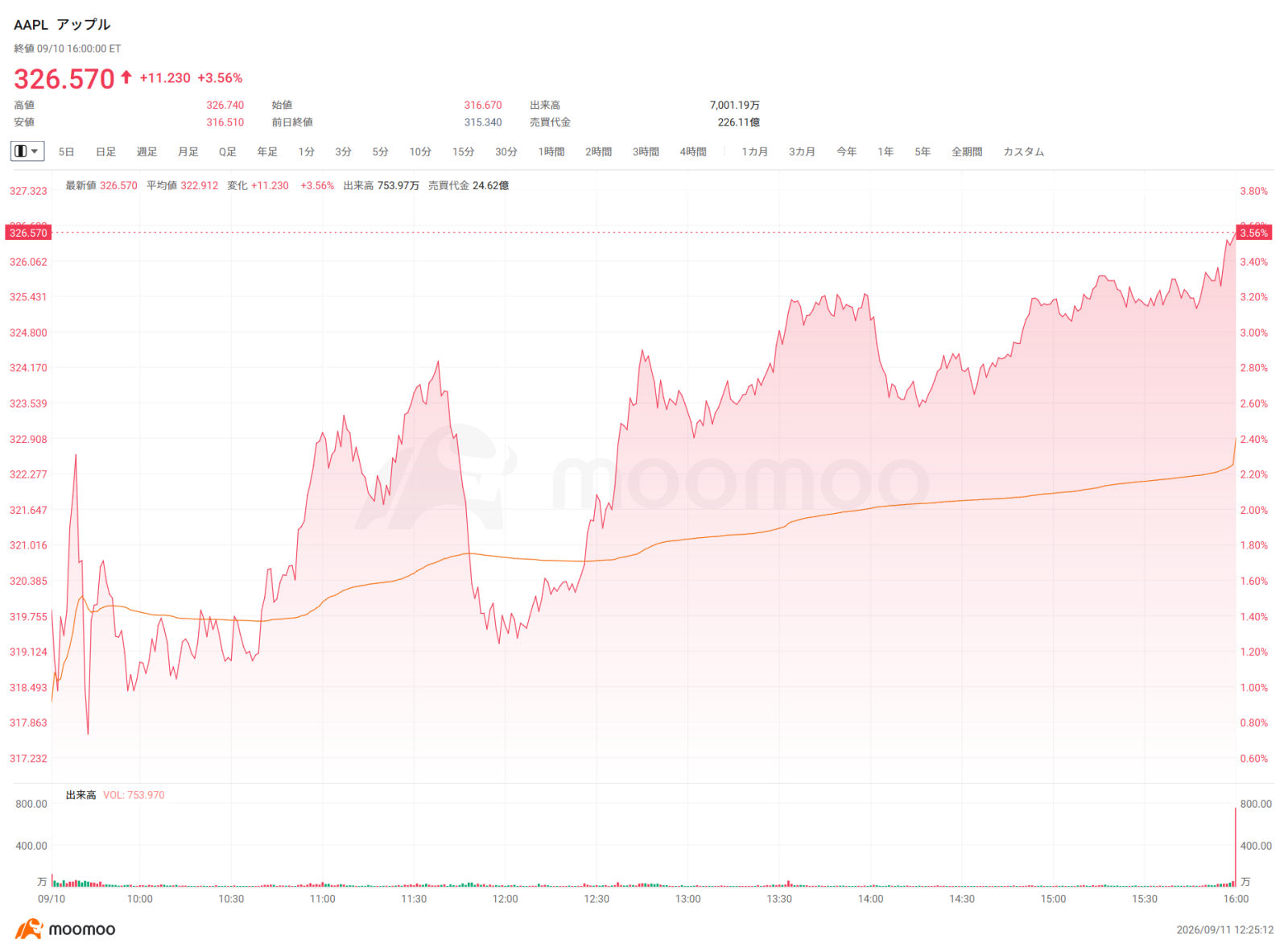
$Apple (AAPL.US)$ closed up 3.56% from the previous day on the 10th.

The stock rose against the trend as major equity indices remained soft, with the announcement of its first foldable device, the "iPhone Duo" ($1,999, pre-orders start Oct 16, launch Oct 23), and price hikes for flagship products serving as buying catalysts. The company implemented price increases of around 10% for some models and approximately 20% for high-end models, such as raising the price of the iPhone 18 Pro by $100 compared to the previous generation.
Market attention is focused not only on the foldable device itself but also on how much of the rising memory costs the company can pass on to sales prices. Whether the company can maintain its "pricing power," backed by brand strength and its ecosystem, has emerged as a new focal point.
Surging demand for AI data centers is tightening DRAM supply and demand, intensifying upward pressure on memory procurement costs. In this context, Tim Cook remarked during the earnings call that "there are many moves we can make," hinting at room for maneuver, including price strategies.
While Morgan Stanley holds a bullish view that price hikes will support profitability, other market participants are wary of margin pressure from rising costs, leading to divergent market assessments.
Against this backdrop, the key focus is whether the options market has begun to price in further upside or expanded price movements, or if it remains limited to a re-rating of stock price levels without a corresponding rise in volatility. The next earnings report is expected in late October, and neither the September 18 nor the October 16 expiration dates span across the earnings announcement.
Options Analysis
AAPL -- Call dominance, but skew favors puts; no accompanying rise in IV
$Apple (AAPL.US)$ In the options market, Constant Maturity Implied Volatility (CM IV) stands at 27.19%, approximately 4 percentage points above the 30-day Historical Volatility (HV) of 23.18%. While the volatility priced into options is slightly higher than realized volatility, the IV Rank is 50 and the IV Percentile is 48%, placing them roughly in the middle of the past year's range.Notably, despite a 3.56% rise in the stock price, CM IV decreased by about 0.3 percentage points from the previous day's 27.53%. The typical pattern of volatility being bought alongside rising stock prices has not materialized, suggesting that, at least for now, there is little evidence of heightened caution against sharp price swings.
[AAPL | Volatility Analysis]

Regarding the term structure, ATM IV is approximately 27.8% for the September 18 expiration, around 25.5% for October 16, and about 27.8% for November 20. The structure shows a dip in the near term followed by a rise in the longer term.
The October 16 expiration coincides with the start of pre-orders, but does not cover the October 23 product launch or the earnings report expected in late October. In contrast, the November 20 expiration covers both the launch and the earnings report. Therefore, the relatively high IV for the November contract may reflect uncertainty surrounding post-launch demand trends and the upcoming earnings.
Meanwhile, since the IV for the September expiration exceeds that of October, a certain premium is currently attached to short-term price movements following the recent sharp rally in the stock price.
[AAPL | Volatility Term Structure]

The volume-based put-call ratio across all expiration months is 0.35. Cumulative volume reached 2.8974 million contracts, with trading heavily skewed toward calls on the day. However, the put-call ratio is merely an indicator comparing the volumes of both sides and does not directly imply net buying of calls.
[AAPL | Execution Analysis: Volume]

The open interest-based put-call ratio is 0.73, with 3.0124 million call contracts outstanding against 2.2005 million put contracts.
Compared to the volume-based ratio of 0.35, the skew in open interest is smaller, indicating that calls are gaining prominence in recent trading activity rather than within the overall existing positions. However, since increased volume does not necessarily translate into new open positions, we cannot conclude that there has been a sharp surge in new bullish positions.
[AAPL | Execution Analysis: Total Open Interest]

Looking at the September 18 expiration by strike price, call open interest is highest at the $350 upside level with approximately 45,000 contracts, with significant accumulation also seen across the $320–$340 range. Volume expanded primarily around the current price levels of $320–$335, with notable trading activity also observed at $350.
On the other hand, put open interest is thick at $300, below the current price, with approximately 31,000 contracts, distributed in out-of-the-money (OTM) strikes.
However, concentration of open interest alone cannot be used to determine support or resistance levels. As indicators of position concentration, attention is focused on around $350 on the upside and around $300 on the downside.
[AAPL | Volume / Open Interest by Strike Price]

The 25-delta risk reversal (25Δ RR) stood at -0.44 points for the September 18 expiry, -1.64 points for the October 16 expiry, and -2.10 points for the November 20 expiry. Put IV exceeded call IV across all expiries, with the negative spread widening for longer-dated contracts.
This indicates a typical downside skew, where relatively higher premiums are attached to downside tail risks. While call volume is clearly dominant, the volatility skew still reflects caution on the downside, suggesting that the options market is not uniformly bullish.
[AAPL | Volatility Smile]

In block trades, executions suggestive of call buying in the $340–$360 strike range for the October 16 expiry were prominent, although these were mixed with call selling at similar strikes and put buying, such as the $300 strike for the October 23 expiry.
Although tags indicating trade direction are visible, they are limited to sampled data, and we have not performed net aggregation separating multi-leg from single-leg trades. Therefore, it is difficult to gauge the overall market sentiment based solely on block flow.
[AAPL | Block Trades]

* For Apple, the volume-based put/call ratio is 0.35, highlighting the strong presence of calls. While bullish call trades are evident in block transactions, the net direction of outright trades cannot be confirmed, and the 25Δ RR is actually skewed toward puts. Thus, it cannot be conclusively stated that the broader options market is strongly pricing in further upside.
Notably, CM IV declined slightly despite a 3.56% rise in the stock price. While interest is skewed toward calls regarding directionality, there is no strong indication that the volatility market is pricing in sharp price movements.
Going forward, the focus will be on whether trading activity remains concentrated in calls around the $350 level. Conversely, if put demand strengthens near current prices and the negative spread of the risk reversal widens further, it would signal heightened caution on the downside.
What is priced into the expected volatility range?
According to probability analysis (±1σ, 68.27%), AAPL's expected price range is approximately ±5% until the September 18 expiry, around ±10% for roughly 50 days out in late October, and expands to about ±12% for roughly 71 days out in mid-November.
Since the September 18 expiration does not span the next earnings release, the implied volatility range for the near-term is likely reflecting recent stock price movements rather than a premium specific to the earnings event. Meanwhile, for further-out expirations, which cover multiple catalysts such as post-launch demand trends and earnings, the expected price swings have widened over time.
[AAPL | Probability Analysis]

Summary
$Apple (AAPL.US)$ In the options market, the volume-based put/call ratio stands at 0.35, clearly indicating call dominance. While large-block trades show bullish call activity, the net direction of outright trades remains unclear, with the 25-delta risk reversal skewing toward puts. Although interest in calls is strong, the broader options market is not uniformly shifting bullish.
$Apple (AAPL.US)$ In the options market, the volume-based put/call ratio stands at 0.35, clearly indicating call dominance. While large-block trades show bullish call activity, the net direction of outright trades remains unclear, with the 25-delta risk reversal skewing toward puts. Although interest in calls is strong, the broader options market is not uniformly shifting bullish.
Another notable feature is that CM IV declined slightly despite a 3.56% rise in the stock price. The lack of accompanying volatility increase suggests there is little evidence of heightened caution against sharp price moves, at least in the immediate term.
Open interest shows concentration around the $350 strike on the upside and the $300 area on the downside. In terms of term structure, November IV exceeds October IV, as it spans both the product launch and earnings, indicating that uncertainty regarding upcoming events remains priced into further-out expirations.
The key focus going forward is whether the recent price hike will actually lead to higher average selling prices (ASP) and resilient profit margins. Demand and profitability post-price-hike will be sequentially validated through pre-orders starting October 16, the launch on the 23rd, and the anticipated late-October earnings release.
Beyond stock price movements, changes in forward-looking IV spanning these events, options flow, and particularly risk reversals, are likely to serve as clues for gauging the market's assessment of Apple's 'pricing power.'
This article uses machine translation in part
-moomoo News Kingsley
This document is prepared solely for informational purposes and does not constitute a recommendation to invest in or trade any specific financial instrument. Investors are solely responsible for their own final investment decisions and the resulting outcomes. Financial instruments carry risks including price volatility, credit risk, and liquidity risk. Principal is not guaranteed and losses may occur. The company assumes no liability whatsoever for any damages arising from the use of this document or from investment decisions made based on its content. Option trading involves the risk of losses exceeding the initial investment. Please be sure to review all key documentation—including the Contract Pre-Conclusion Document, Subscription Agreement, and other materials—covering important matters such as risks and fees, and trade only at your own discretion.
Disclaimer: Moomoo Technologies Inc. is providing this content for information and educational use only.Read more


Comments
to post a comment
2